

Scientists made a new enzyme to break down plastics very fast, which can boost plastic credits.
Plastic credits are eyed as the next big thing to deal with sustainability, next to carbon credits.
Plastic is one of the major pollutions damaging the environment, especially the oceans. About 80% of all debris polluting the seas is plastic waste.
Companies have been working to find solutions to deal with the plastic crisis.
Luckily, scientists recently created an enzyme that breaks down plastic waste very fast. This new enzyme reduces the time it takes to decompose plastics to hours, not decades.
The New Discovery That Can Boost Plastic Credits
A team of scientists from the University of Texas at Austin discovered the new enzyme. They called it the FAST-PETase – functional, active, stable, and tolerant PETase.
PET refers to polymer polyethylene terephthalate, one kind of plastic material.
FAST-PETase involved the study of 51 different plastic containers, 5 polyester fibers, and water bottles made from PET.
The team used a natural PETase that is capable of degrading PET plastic while modifying it using machine learning.
Their technology discovers mutations that degrade the plastic faster under different environmental conditions. It can break down PET within a week or as fast as 24 hours, which took decades to centuries to happen before.
More interesting is that the scientists also showed that decomposed plastic can become a new plastic product.
The team said that they can use the new enzyme to clean up areas polluted by plastics. Also, their technology can work in environments with ambient temperatures.
There are endless possibilities for various industries to leverage this novel plastic solution. According to one of the chemical engineers,
“Beyond the obvious waste management industry, this provides corporations from every sector the opportunity to take a lead in recycling their products.”
Currently, the most common way to dispose of plastics is to throw them in landfills where they rot at a very slow rate. Others are even burning them which further pollutes the air.
Thus, there’s a need for alternative strategies to resolve plastic pollution. And the discovery of FAST-PETase can be a solution that’s cheap, portable, and not too difficult to scale up.
Better yet, it’s a great aid to the emerging rise of plastic offset or credit schemes.
How Do Plastic Credits Work
The plastic credit industry works like how the carbon credit industry does.
In the carbon credit market, entities buy carbon credits. Each credit equals one metric ton of carbon, which is then “offset” through carbon projects. These often involve renewable energy and nature-based projects.
The carbon credit market has been growing rapidly over the last few years. Verification of carbon credit projects becomes stricter to ensure the quality of carbon credits.
Both countries and companies are thriving to reduce their carbon emissions as part of their climate goals in line with the Paris Accord. And so, the carbon credit industry is booming as the world races to net zero by 2050.
Essentially, the plastic credit industry works the same way. The only difference is that companies claim credits for projects that tackle plastics.
Each plastic credit is equal to one ton of plastic waste that would otherwise have not been collected or recycled.
Plastic credits also have to meet certain quality assurance criteria or principles. Confirmation of quality is done via the project’s validation and verification process.
And like carbon credits, companies also have to retire plastic credits to offset their plastic waste footprint.
Verra has seen initial estimates for plastic credit prices ranging from $200 – $800 per tonne.
How to Use Plastic Credits
Plastic credits can help enhance technologies and systems that collect and recycle plastics. It’s very much the same as how carbon credits can help reduce carbon emissions.
Companies can use plastic credits to address the plastic wastes that they can’t get rid of yet. And like establishing a robust carbon footprint, a company needs to assess its plastic footprint to engage well in plastic offsets.
Here are some activities companies can do to mitigate their plastic footprint:
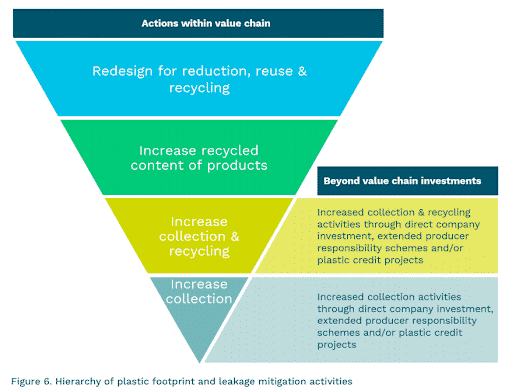
Plastic credits are issued to registry account holders listed on the Verra Registry. Under its Plastic Program, the issuance of plastic credits involves two parts.
One is the Waste Collection Credits (WCCs) for projects involving plastic collections. The other one is the Waste Recycling Credits (WRCs) for plastic recycling projects.
The discovery of the new plastic decomposing enzyme opens a new door for those who want to offset their plastic footprint.
Companies can leverage plastic credits with this enzyme along with carbon credits to address sustainability concerns.
Many firms even consider plastic waste reduction as part of their GHG emissions reduction strategy. It’s one viable way to deal with net zero commitments.