


SHEIN, the global online fashion and lifestyle retailer, has taken a new step in cutting the climate impact of its logistics. The company signed an agreement with DHL Group to use DHL’s GoGreen Plus service. This service allows corporate customers to support the use of sustainable aviation fuel (SAF) in air cargo operations.
SAF is blended into regular jet fuel to reduce carbon emissions from flights. This move is part of SHEIN’s broader work to explore low‑carbon solutions for its air transport footprint.
Mustan Lalani, SHEIN’s Head of Sustainability, remarked:
“Working with partners such as DHL allows us to better understand how sustainable aviation fuel solutions may be incorporated into air cargo logistics. Initiatives like this are part of SHEIN’s broader efforts to explore how emerging approaches across the aviation sector may contribute to addressing carbon emissions associated with air transport.”
What Sustainable Aviation Fuel Is: Cutting Emissions at the Source
DHL’s GoGreen Plus service gives customers lifecycle emissions reductions from SAF. It uses recognized accounting and certification methods. This means SHEIN can include a share of SAF‑related emissions reductions in its corporate reporting.
The collaboration follows earlier deals. In 2025, SHEIN signed a memorandum of understanding with Lufthansa Cargo to explore sustainable air freight technologies and fuel use.
Sustainable aviation fuel comes from renewable or low-carbon sources. These include used cooking oil, agricultural waste, and non-fossil carbon materials. Compared with conventional jet fuel, SAF can cut lifecycle greenhouse gas emissions by up to 80%. This is because SAF feedstocks carry less net carbon when burned, considering their origin and life cycle.
Air transport remains a significant source of emissions as global trade and e‑commerce grow. SAF is one of the few scalable solutions available today that can work with existing aircraft engines and fuel infrastructure. It reduces emissions at the source rather than offsetting them after the fact.
SAF is still a small part of global aviation fuel. However, demand and investment are rising due to the industry’s push for net-zero goals. The chart below shows how much SAF is necessary to meet the air transport net-zero target.

Growing Market for SAF: A $16 Billion Industry by 2030
The global sustainable aviation fuel market is expanding rapidly. A recent report by Grand View Research estimates the market was worth US$1.04 billion in 2024. It projects that the industry could reach US$15.85 billion by 2030, growing at a 57.5% compound annual growth rate (CAGR) from 2025 to 2030.
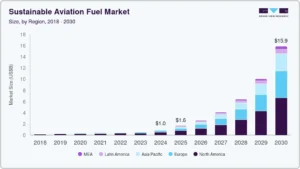
This growth is driven by several factors:
- Rising corporate and airline decarbonization targets,
- Stronger environmental regulations,
- Supportive government policy, and
- Increasing investment in SAF technologies.
Airlines and logistics providers are under pressure to cut emissions and invest in cleaner fuel alternatives.
Bio-based SAF comes from plants, waste oils, or renewables. It leads the market since it blends easily with jet fuel, needing few changes to aircraft.
Despite strong projected growth, SAF still accounts for less than 1% of global jet fuel use today. Industry groups, like the International Air Transport Association (IATA), estimate that SAF will supply about 0.7% of aviation fuel by 2025. This is due to slow production growth. By 2030, SAF production ranges from 17 to 20 Mt.

Governments in some regions are introducing mandates to increase SAF usage. For example, the UK requires airlines to blend at least 2% SAF starting in 2025, rising to 10% by 2030 and 22% by 2040. These rules aim to spur SAF production and adoption.
- SEE MORE: Heathrow Boosts 2026 Sustainable Aviation Fuel (SAF) Incentive 2% Above UK Government Mandate
SHEIN’s Sustainability Goals and Progress
SHEIN has publicly committed to reducing its environmental impact and aligning with climate science goals. The company’s science‑based, net‑zero target has been approved by the Science Based Targets initiative (SBTi). Under this plan, SHEIN aims to reach net‑zero greenhouse gas emissions across its value chain by 2050.
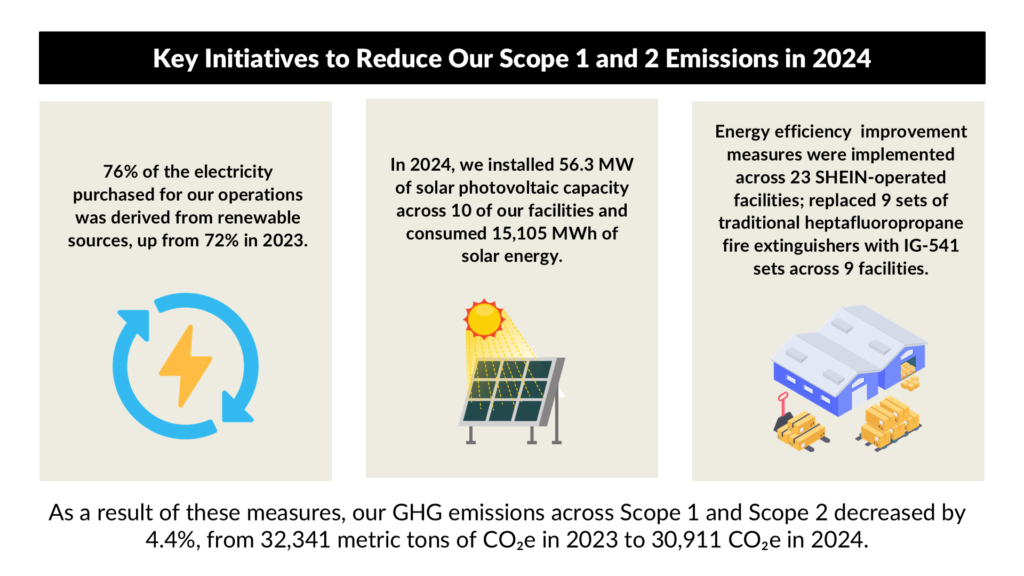
The approved targets include reducing Scope 1 and 2 emissions by 42% by 2030 and reducing Scope 3 emissions by 25% by 2030. SHEIN also plans to source 100% renewable electricity by 2030 as part of its energy transition.
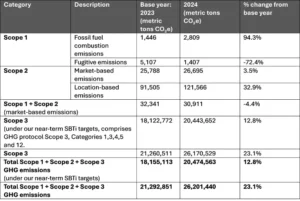
SHEIN developed a decarboniZation roadmap in 2024 with support from external sustainability consultants. This roadmap guides the company’s emissions reduction efforts and is designed to align with the Paris Agreement’s goal of limiting warming to 1.5 °C.
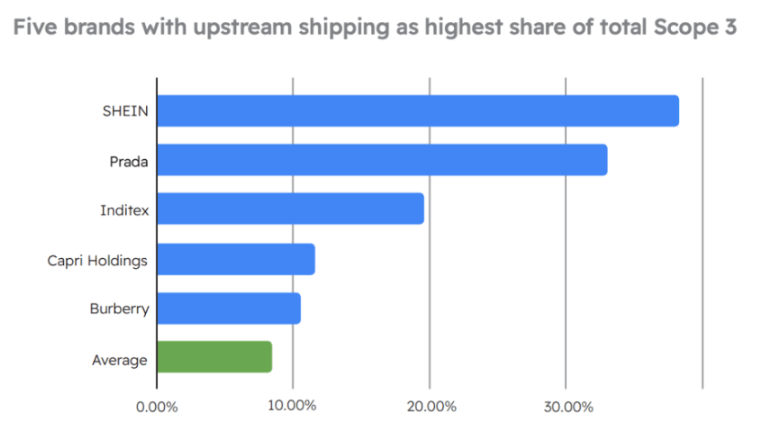
The logistics footprint — especially Scope 3 emissions from transportation and deliveries — is a major contributor to SHEIN’s overall emissions profile. Exploring low‑carbon fuels like SAF is a practical step in addressing these emissions categories.
Pilots, Traceability, and Carbon Accounting
DHL’s GoGreen Plus service lets customers increase the share of SAF blended into the fuel used in its air cargo network. Under the SHEIN agreement, partners like logistics providers, airlines, and certification frameworks team up. They work to allocate emissions reductions clearly for SHEIN’s reports.
SHEIN’s SAF initiatives include pilot programmes with cargo partners. In 2025, SHEIN procured 187.3 tonnes of SAF for use on 14 Atlas Air charter flights. This reduced an estimated 579.1 tonnes of CO₂ equivalent emissions compared with conventional aviation fuel.
The company is also participating in a SAF pilot in China alongside China National Aviation Fuel (CNAF) and the Second Research Institute of Civil Aviation of China. SHEIN plans to procure SAF through Air China Cargo, using traceability systems to document SAF usage and related emissions benefits.
Moreover, SHEIN joined the World Economic Forum’s Green Fuel Forward campaign. This campaign works to speed up SAF adoption in the Asia-Pacific region. It does this by building capacity, raising awareness, and encouraging collaboration.
Limited Supply, High Costs, Big Potential
Sustainable aviation fuel holds promise but also faces hurdles. Current SAF production capacity is limited, and costs remain significantly higher than conventional jet fuel. This makes widespread adoption difficult for many companies and airlines.
Because SAF is still a small part of the global aviation fuel supply, its current emissions impact is modest. SHEIN acknowledges that the emissions reductions from its initial SAF activities are limited relative to its total air transport footprint. But these pilots will help build experience and partnerships for broader future deployment.
Looking ahead, SAF market growth could ramp up as production capacity rises and regulatory and corporate demand increase. With strong annual growth rates, more companies might add SAF to their supply chains. This helps them meet climate goals and satisfy stakeholders.
For SHEIN, expanding SAF use through partnerships like DHL’s GoGreen Plus could help the company gain operational insights, shape emissions accounting frameworks, and position itself as a participant in emerging low‑carbon logistics solutions.