


Battery technology is changing fast. Companies and researchers are developing new designs that store more energy, last longer, and charge quickly. One of the most talked-about ideas is the solid-state battery. This battery type replaces the liquid inside a normal lithium-ion battery with a solid material. This makes batteries safer, more powerful, and more durable.
A new variation uses silver in the battery. Silver improves performance and may play a major role in the future of electric vehicles (EVs) and energy storage. This article explains what silver solid-state batteries are, how they work, and what they could mean for the economy, EVs, and energy systems.
What Are Solid-State Batteries?
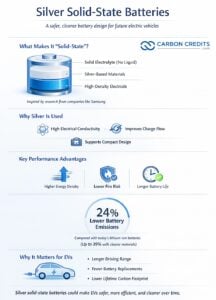
Solid-state batteries replace liquid electrolytes with solids for safety (non-flammable) and density targets of 400-500 Wh/kg. They use a solid electrolyte instead. Samsung’s Ag-C anode prototypes achieve 500 Wh/kg, 9-minute charges, and 1,500+ cycles by curbing dendrites.
Each 100 kWh SS pack may use ~1 kg silver, potentially adding 16,000 t/yr demand at 20% EV adoption vs. 824 Moz mine supply. Late-2020s commercialization eyed.
Solid electrolytes are not flammable. This reduces the risk of fires. Solid batteries also allow for higher energy density, meaning they can hold more energy in a smaller space. This makes them attractive for EVs and portable electronics like phones and laptops.
Moreover, solid-state batteries can help cut the carbon footprint of EV batteries compared with today’s lithium-ion batteries. Research shows that solid-state designs can reduce battery emissions by about 24 %, and up to 39 % if more sustainable materials and sourcing are used.
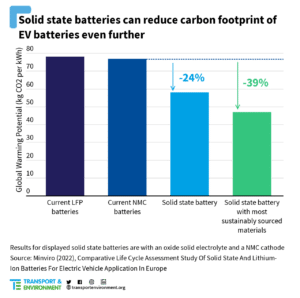
That means less greenhouse gas is released during battery production and use, which boosts the overall climate benefit of EVs over gasoline cars. These reductions come mainly because solid-state batteries need fewer raw materials and have higher energy density. Thus, they store more power with less manufacturing impact than conventional batteries.
Automakers and battery developers, including BYD and Samsung, are testing solid-state batteries. Some expect commercial EVs with these batteries to appear by the late 2020s. Early tests show they are safer and charge faster than current lithium-ion batteries.
Silver’s Role in Next-Gen Battery Performance
Silver is not just for jewelry or coins. It has very good electrical and thermal conductivity, which helps batteries work better.
In silver solid-state batteries, a silver-carbon (Ag-C) composite is used in the anode. The anode is the part that releases electrons when the battery powers a device. Silver helps ions move smoothly and prevents metal spikes called dendrites. Dendrites can damage batteries and reduce lifespan.
Silver also improves battery life and charging speed. Some prototypes can fully charge in under 10 minutes and last up to 20 years with minimal wear.
Key benefits of silver in solid-state batteries include:
- Higher energy density (~500 Wh/kg) versus 270 Wh/kg in standard EV batteries,
- Faster ion movement and reduced dendrite formation, and
- Longer lifespan and safer operation.
Automakers like BYD are using these designs in EV prototypes, while Samsung tests silver-based cells for future mass production. MG recently delivered its first mass-produced EV with a semi-solid-state battery, showing commercial viability.
How Silver Solid-State Batteries Transform EVs
Silver solid-state batteries could be especially important for electric vehicles. EV makers want batteries that last longer, charge faster, and provide more range for each charge.
Some estimates suggest that solid-state batteries with silver could deliver a range of up to 600 miles or more on a single charge. They may also reduce weight and size compared with current battery packs.
Faster charging and longer life could make EVs more practical for many buyers. Range anxiety — the fear of running out of power — is one barrier to EV adoption today. Longer range and quicker charges could help more drivers choose electric cars.
Prototype tests and early industrial work show promise. Samsung and others are sending samples to automakers for testing and validation. Initial feedback from early testers has been positive, according to industry reports.
However, mass production will take time. The materials and manufacturing systems needed for solid-state batteries are still under development. Many automakers are targeting the late 2020s for broader commercial use.
Silver Demand Could Surge with EV Battery Adoption
Silver solid-state batteries could affect the global silver market. The metal is already used in electronics, solar panels, and other industries. Industrial demand often exceeds supply.
Potential battery demand could be significant:
- Each 100 kWh EV battery could use ~1 kg of silver
- If 20% of global EVs adopt the tech, demand could rise by 16,000 metric tons per year
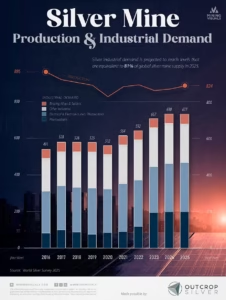
Global silver mine production is around 820–850 million ounces, while total demand exceeds 1.1 billion ounces. Adding battery demand could tighten supply and support higher prices over time.
Challenges and Outlook for Silver Solid-State Batteries
Silver solid-state batteries face challenges. Cost is high. Silver is more expensive than other materials, and mass production is complex. Factories need new processes to produce solid-state batteries at scale.
Supply could also be an issue. Silver is limited, and other industries already need it. Developers are exploring ways to use less silver or mix it with other materials to reduce costs.
Despite these challenges, research is advancing. Engineers continue improving solid electrolytes and silver-based anodes. If costs drop, silver solid-state batteries could become widespread in EVs and energy storage systems.
The Future of Silver Solid-State Batteries in EVs and Energy Systems
Silver prices depend on supply and demand. Today, demand already exceeds mine production. Adding silver to solid-state EV batteries would increase demand.
If each EV battery uses ~1 kg of silver and millions of EVs adopt it, demand could rise by thousands of metric tons per year. Supply may not keep up immediately, which could push prices higher.

Other factors like inflation, interest rates, and investor activity also affect prices. In the short term, prices may not change much because mass production is still years away. But as production scales in the late 2020s, silver demand could steadily rise, supporting moderate long-term price growth.
Silver solid-state batteries are a promising step in energy storage. They combine safety, high energy density, and the electrical benefits of silver. EVs with these batteries could have longer range, faster charging, and longer lifespans.
Adoption is likely to start with premium EVs and specialized applications. Companies like BYD, Samsung, and MG are leading development and early deployment. By the late 2020s, silver solid-state batteries could play a key role in electric vehicles and renewable energy systems.