

Amidst a challenging year for the climate, a recent Carbon Market Watch (CMW) report uncovered a concerning trend among the EU’s top 30 emitters, referred to as “Emissions Aristocracy”.
These companies span various sectors like power generation, steel, cement, oil refinement, and petrochemicals. And collectively, they contribute to 50% of the emissions accounted for by the EU Emissions Trading System (EU ETS).
Free Allowances Are Polluters’ “Freebies”
The EU ETS is a pivotal component of the European Union’s fight against climate change. Launched in 2005, it holds the distinction of being the world’s premier and most extensive transnational emissions trading initiative. Designed to curb greenhouse gas emissions, the system aligns with the EU’s overarching plan to fulfill climate objectives and global agreements like the Paris Agreement.
The CMW report, built upon existing research, sheds light on companies significantly polluting under the European carbon credit trading scheme. It identifies those not paying for their GHG emissions and sectors failing to meet their decarbonization commitments.
The European Commission (EC) had reported on the performance of the EU ETS for 2022 focusing on installations and sectors. But it didn’t reveal the entire story, according to CMW. Their new analysis promises a deeper understanding of emissions data, unveiling startling truths on free carbon allowances.
A policy expert at CMW and the report’s author, Lidia Tamellini, stressed the fact their analysis revealed:
“The EU ETS allows an Emissions Aristocracy to pollute without footing the bill. This report spotlights how these already hugely profitable companies are granted freebies. Rather than the polluter paying, it is the planet and society left carrying the tab.”
Under the EU ETS, the companies in the Emissions Aristocracy, despite generating substantial revenue, benefit from ‘free allowances’. That means they’re avoiding payment for the environmental harm caused by their planet-warming emissions.
The EU ETS is a market-driven climate policy, geared toward heavy industry and the power sector, that follows the ‘polluter pays principle’. It means emitters must pay for the environmental and social costs of their GHG emissions.
The Lion’s Share of EU Emissions is From Top 1%
CMW’s investigation found that while the power sector is responsible for most of the emissions, it pays for its pollution. However, companies in other sectors like steel, cement, and petrochemicals are among the top 30 polluters that receive huge amounts of free pollution permits.
The identified businesses are dominant players in their respective sectors.
The EU ETS is dominated by a small fraction of companies. In particular, the top 30 emitters alone account for over 50% of the scheme’s emissions in 2022, despite comprising less than 1% of total covered companies: 3,515. This highlights the huge responsibility of those companies in driving the climate crisis, underscoring greater accountability in their climate actions.
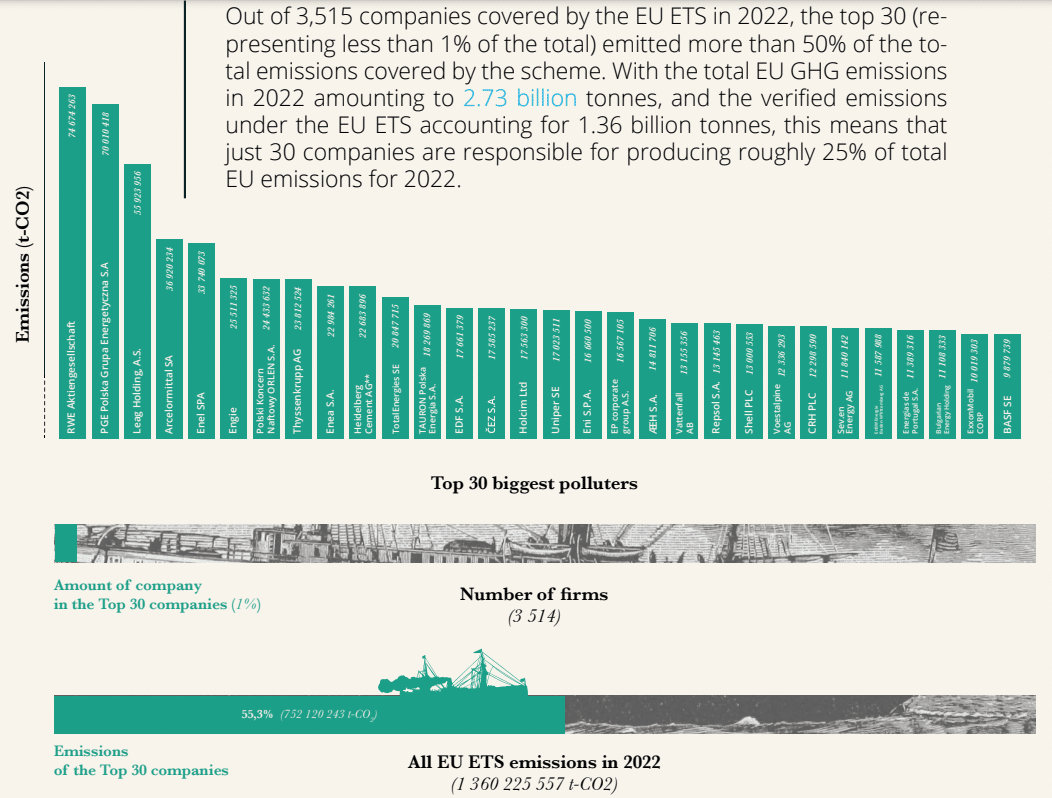
Given the total amount of EU emissions in 2022 and that covered by the ETS, only 30 businesses are accountable for generating about 25% of the total EU carbon footprint for last year.
However, within the EU carbon trading mechanism, major contributing sectors face minimal pressure for swift emission reductions, the report said. More remarkably, these sectors received about €47.6 billion in free allowances in 2022, essentially granting them a free-to-pollute pass.
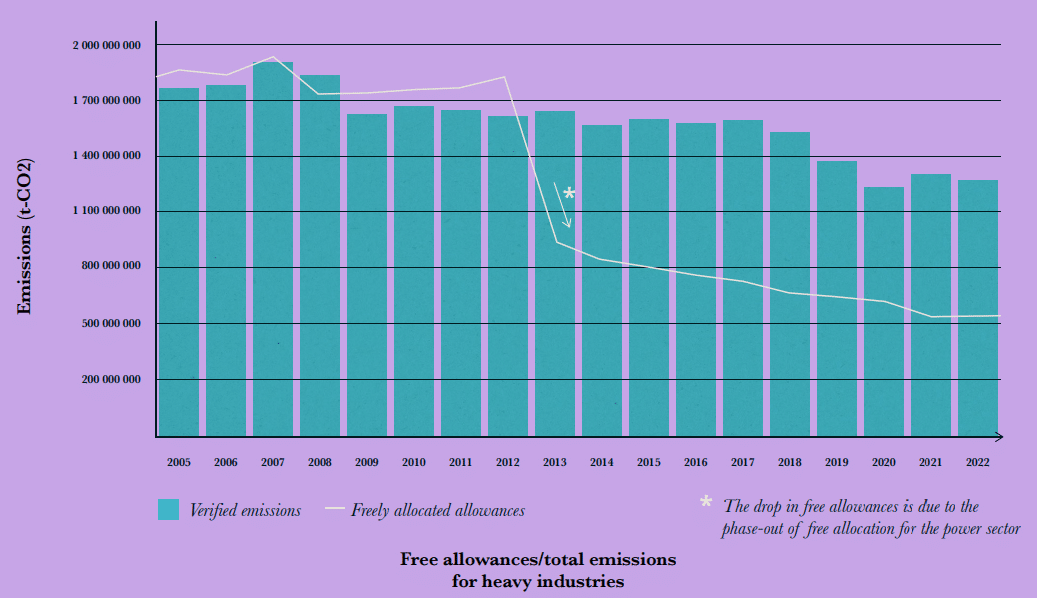
As can be seen in the chart, giving out free allowances especially favored the heavy industries. Prior to 2016, some sectors received more allowances than their carbon emissions. For the last 3 years (2020 – 2022), free allocation covered industrial emissions by 104%, 89%, and 95%, respectively.
The redirection of auctioning revenues toward climate-related purposes under the recent EU ETS revision signifies a loss in vital funding for innovative technologies, support to vulnerable households and small businesses, and climate mitigation efforts.
A handful of prominent companies are featured in the report’s list. RWE, a multinational energy corporation, holds the title as the largest emitter in the EU. Additionally, heavy industry entities like ArcelorMittal, ThyssenKrupp, and HeidelbergCement secure their presence within the top 10 of the listed emitters.
The report delves into the continued use of free allowances within specific sectors, hindering the European economy’s path to decarbonization. The analysis also highlights how the free allocation system has failed in fostering an efficient decarbonization path for heavy industry.
Make the Emissions Aristocrats Pay
The European Commission is in the process of formulating its post-2030 climate framework. Addressing how polluters evade paying the complete cost of their emissions should be a top priority of the EU ETS.
Carbon Market Watch advocates for a more robust EU ETS aligned with achieving climate neutrality by 2040. This entails phasing out free allowances for heavy industries and promptly implementing an auctioning system ahead of the current plan, which extends free allocation until 2034.
The EC must establish stricter regulations for major emitters to ensure genuine accountability and responsibility for polluting. For Tamellini, “Closing the loopholes in the EU ETS is essential…the Emissions Aristocracy has had it easy for too long.”
Carbon Market Watch report sheds light on the stark reality of the EU’s emissions landscape. Going beyond the surface, their analysis pinpoints key companies, sectors, and emission trends within the EU ETS, highlighting the urgent need for accountability and stronger decarbonization strategies.