


TotalEnergies has signed two long-term power purchase agreements (PPAs) with Google to deliver 1 gigawatt (GW) of solar capacity in Texas. Over 15 years, the projects are expected to generate around 28 terawatt-hours (TWh) of renewable electricity.
The deal reflects a deeper shift in how the tech sector secures power for artificial intelligence, cloud services, and digital infrastructure. As AI workloads surge, electricity has become a strategic resource, and companies like Google are moving early to lock in supply.
The projects will be developed at two TotalEnergies-owned sites—Wichita and Mustang Creek—with construction scheduled to begin in the second quarter of 2026. Once operational, they will directly support Google’s growing data center footprint in Texas.
Texas: A Crucial Hub for Big Tech Power Demand
Texas has emerged as one of the world’s most important regions for data center expansion. Its abundant land, strong solar resources, and deregulated power market make it attractive for hyperscale data centers. However, demand is rising rapidly, and the grid is under pressure from AI-driven electricity loads, industrial expansion, and extreme weather events.

The Wichita solar farm, with a capacity of 805 megawatts (MW), and the Mustang Creek project, with 195 MW, together form one of TotalEnergies’ largest U.S. renewable commitments to a single corporate buyer. These projects will add new generation capacity rather than simply reallocating existing renewable energy credits, which is critical for grid stability.
By building new supply, TotalEnergies and Google are addressing a major challenge facing the power sector: ensuring that clean electricity growth keeps pace with surging demand.
Corporate PPAs Are Now Shaping America’s Power Grid
Power purchase agreements were once seen as a financial tool for companies to claim renewable energy use. Today, they are becoming a core driver of grid expansion. Large corporate buyers are effectively acting as anchor investors for new energy infrastructure.
In this case, the 1 GW of solar PPAs complement another 1.2 GW of agreements recently secured by Clearway, a renewables developer half-owned by TotalEnergies. These deals span multiple U.S. grid regions, including ERCOT in Texas, PJM in the Northeast, and SPP in the Central U.S.
Together, these agreements illustrate how tech firms are diversifying their energy supply across regions to manage risk, hedge against price volatility, and ensure reliability.
Local Economic Impact and Community Benefits
Beyond climate goals, large-scale solar projects bring tangible economic benefits to local communities. The Wichita and Mustang Creek developments are expected to create several hundred construction jobs and generate significant tax revenues over their operating lifetimes.
For rural counties, utility-scale solar projects often become a long-term source of public funding for schools, infrastructure, and emergency services. As data centers expand into smaller communities, energy projects linked to them can transform local economies.
TotalEnergies’ Strategy: Tailored Power for High-Load Customers
TotalEnergies is positioning itself as a key energy partner for industries with massive and growing electricity needs. Its customer portfolio already includes major industrial and technology players such as Amazon, Microsoft, Airbus, Air Liquide, STMicroelectronics, Saint-Gobain, and Sasol.
The company’s approach goes beyond simple renewable supply. It combines solar, wind, battery storage, and flexible gas generation to deliver what it calls “clean firm power.” This hybrid model is increasingly important for data centers, which require 24/7 electricity with minimal interruptions.
Marc-Antoine Pignon, TotalEnergies’ Vice President for Renewables in the U.S., highlighted that the Google deal is the company’s largest renewable PPA volume ever signed in the country. He also pointed to the challenges of land availability and power supply for data centers, noting that large-scale colocation opportunities are becoming essential as AI infrastructure expands.
A Growing U.S. and Global Renewable Portfolio
TotalEnergies has been steadily expanding its renewable footprint. In the United States, it holds around 10 GW of onshore solar, wind, and storage capacity, with roughly 5 GW located in Texas. Globally, the company had more than 32 GW of installed renewable capacity by late 2025 and aims to produce over 100 TWh of net electricity by 2030.
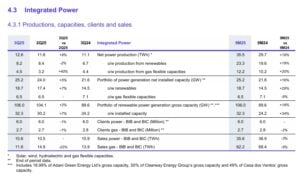
This growth reflects a broader strategy to transition from a traditional oil and gas company into a diversified energy producer. By investing heavily in renewables and flexible assets, TotalEnergies is positioning itself for a future where electricity plays a central role in the global energy mix.
EARLIER:
- Google Signs Solar Deals with TotalEnergies and Shizen Energy in Malaysia to Power Data Centers with Clean Energy
- Google and TotalEnergies Unlock Carbon-Free Future for Ohio Data Centers with 15-Year Solar Deal
Google’s Aggressive Clean Energy Procurement Drive
Google is one of the world’s largest corporate buyers of renewable energy, and its procurement strategy has accelerated dramatically in recent years. Since 2010, the company has signed more than 170 clean energy agreements totaling over 22 GW of capacity. These deals span North America, Europe, Asia Pacific, and Latin America.
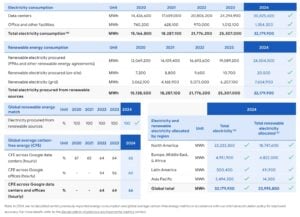
In 2024 alone, Google contracted more than 8 GW of additional clean energy—twice the volume of the previous year and the largest annual total in its history. These agreements are designed to stay ahead of the company’s rapid load growth, particularly from AI and cloud services.
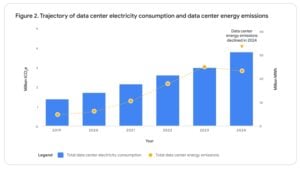
Despite a 27% year-on-year increase in data center electricity consumption in 2024, Google reported a 12% reduction in data center energy emissions.
- It estimates that its clean energy purchases avoided more than 8.2 million tonnes of CO₂ equivalent in 2024 and over 44 million tonnes cumulatively since 2011.
This shows that large-scale procurement can decouple emissions growth from electricity demand, at least in the near term.
Data Centers Are Reshaping Electricity Demand
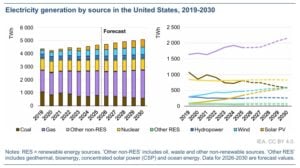
The International Energy Agency (IEA )’s latest electricity report has highlighted data centers as a major driver of electricity demand growth in the United States. Electricity consumption rose by 2.8% in 2024 and 2.1% in 2025, with data centers expected to account for nearly half of future growth.
Industrial sectors such as semiconductor manufacturing and battery production will also contribute significantly, but digital infrastructure is among the fastest-growing loads.
AI workloads are particularly energy-intensive. Training large models requires massive, continuously running computing clusters, while inference workloads scale with user demand. This creates a constant, high-load electricity profile that challenges traditional grid planning.
2026 US Renewable Outlook and Policy Headwinds
The IEA also forecasts that nearly 250 GW of renewable energy capacity will be deployed in the U.S. between 2026 and 2030, with utility-scale solar accounting for around 70% of additions. Wind and distributed solar will make up the remainder.
However, recent policy changes and the phase-out of certain tax incentives have led to a downward revision of deployment forecasts. This underscores the growing importance of corporate buyers in sustaining renewable development.
When government support weakens, long-term PPAs from companies like Google provide the financial certainty developers need to build projects. In this sense, tech firms are becoming critical enablers of the energy transition.
A New Power Paradigm for the Digital Age
The TotalEnergies and Google solar agreement states that electricity is no longer just an operating expense. It is a strategic asset that determines the scalability and sustainability of digital infrastructure.
For TotalEnergies, the deal reinforces its role as a key supplier of tailored renewable power to high-load customers. For Google, it ensures reliable, affordable, and low-carbon electricity for its expanding AI and cloud operations.
More broadly, the partnership reflects a new phase in the global energy transition, where private companies play a central role in financing and building clean power infrastructure. As AI, cloud computing, and digital services continue to expand, similar mega-scale PPAs are likely to become standard practice.
Lastly, but not least, Texas is becoming a global test case for high-growth, low-carbon grids. Its rapid demand growth, combined with large renewable deployment, will offer lessons for other regions facing similar challenges.