

Asia is entering a new energy era. Electricity demand is rising fast, and global energy giants are moving quickly to secure their position. A major $2.2 billion joint venture between TotalEnergies and Masdar reflects this shift. The deal is not just about building renewable assets. It is about capturing one of the biggest growth stories in global energy.
The simple reality is: Asia will drive most of the world’s electricity demand in the coming decade.
TotalEnergies and Masdar: A Power Partnership Built for Scale
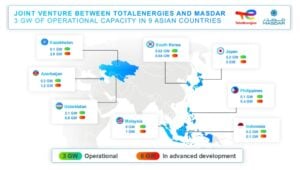
The new joint venture brings together the strengths of both companies under a single platform. It creates a 50:50 partnership that will manage onshore renewable energy assets across nine countries. These include Indonesia, Japan, South Korea, and several fast-growing markets in Southeast Asia and Central Asia.
The platform already holds 3 gigawatts (GW) of operational capacity. On top of that, it has a pipeline of 6 GW expected to come online by 2030. This combination gives the venture a strong starting point and a clear growth path.
More importantly, the focus goes beyond just building solar or wind farms. The joint venture plans to integrate solar, wind, and battery storage systems. This approach supports grid stability and ensures a reliable energy supply. As renewable energy expands, such integration becomes essential.
This is not a small regional project. It is a large, coordinated effort designed to meet rising demand while supporting cleaner energy systems.
His Excellency Dr Sultan Al Jaber, UAE Minister of Industry and Advanced Technology and Chairman of Masdar, noted:
“The UAE has established itself as a global energy leader by delivering at scale, investing with conviction, and building partnerships that endure. Masdar epitomizes that approach. We are proud to have pioneered renewable energy deployment in Central Asia and the Caucasus, and we have an expanding portfolio in some of the most attractive growth markets in Asia-Pacific. Asia will be the main driver of global electricity demand growth this decade, and this collaboration with TotalEnergies will accelerate our progress across the continent, unlocking new opportunities to deliver the competitive, reliable energy solutions that our partners and customers need.”
- READ MORE:
- TotalEnergies and Google’s 1 GW Solar Deal Signals a New Phase in the Data Center Energy Race
- TotalEnergies and AllianzGI Team Up on $580M Battery Storage Push in Germany
Asia’s Electricity Boom Is Reshaping Markets: Wood Mackenzie’s Analysis
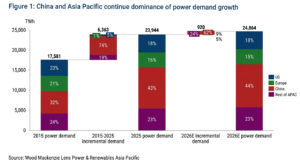
Asia has become the engine of global electricity demand. Over the past decade, the region accounted for nearly all new power demand compared to the United States and Europe.
In 2025, the scale reached a historic milestone. As per Wood Mac’s Asia Pacific Power & Renewables: What to look for in 2026 report, China alone generated over 10,000 terawatt-hours (TWh) of electricity. That was more than the combined output of the U.S. and Europe. At the same time, the rest of Asia continued to produce more electricity than either region year after year.
This growth is not random. It is driven by three powerful forces: rapid industrial expansion, urban population growth, and rising digital infrastructure.
Data centers are now a major driver. As artificial intelligence and cloud computing expand, electricity demand is rising sharply. Countries like Japan, China, and those in Southeast Asia are seeing new demand from this sector alone.
- For example, Japan could add up to 66 TWh of demand from data centers by 2034. China may need an extra 668 TWh by 2030. Southeast Asia will also see steady increases as digital services grow.
Even short-term slowdowns have not changed the bigger picture. In early 2025, trade tensions and tariffs slowed demand growth. China’s power demand growth dropped to 2.5% in the first quarter. India and Southeast Asia also saw weaker numbers.
However, the slowdown did not last long. By the third quarter, demand rebounded strongly. China recorded over 6% growth again. India and Southeast Asia also recovered, supported by industrial output and extreme heat driving cooling needs.
This resilience shows that Asia’s demand growth is not fragile. It is deeply rooted in economic and technological change.
Clean Energy Expansion Keeps Pace
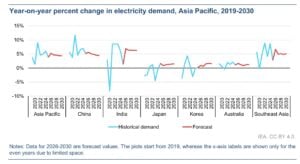
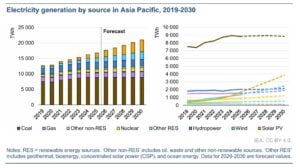
As demand rises, clean energy is expanding quickly across Asia. IEA predicts that by 2030, 56% of the world’s electricity use will be in the Asia Pacific, up from 53% in 2025.
In 2025 alone, the region added nearly 500 GW of wind and solar capacity. This shows strong momentum toward decarbonization.
Governments are also playing a key role. Many countries are introducing policies that allow renewable energy to reach consumers directly. These steps make clean power more accessible and encourage further investment.
However, challenges remain. Supply chain bottlenecks and trade barriers continue to create uncertainty. Equipment shortages, especially for gas turbines, could slow down parts of the energy transition. At the same time, global political shifts are affecting trade flows and investment decisions.
Despite these issues, the overall direction is clear. Clean energy is growing, and it is becoming central to Asia’s power systems.
Strategic Moves in a Competitive Market
The partnership between TotalEnergies and Masdar reflects a deeper strategy. Both companies are positioning themselves for long-term growth in high-demand markets.
For TotalEnergies, the deal supports its Integrated Power strategy. This approach combines renewable generation with flexible energy solutions and market access. It helps the company manage supply and demand more effectively.
For Masdar, the partnership strengthens its presence across Asia. It also brings the advantage of working with a global energy major. This combination improves its ability to scale projects and enter new markets.
Leadership also highlights the importance of this collaboration. Dr. Sultan Al Jaber, Chairman of Masdar, emphasized that Asia will drive global electricity demand growth. He also pointed out that partnerships like this will help deliver reliable and competitive energy solutions.
The choice of Abu Dhabi as the control hub adds another layer of significance. It shows how the UAE is expanding its role in global energy markets, especially in clean energy investments.
The Road Ahead: Demand, Data, and Decarbonization
Looking forward, Asia will remain the dominant force in global electricity demand. By 2026, the region is expected to account for about 85% of new power demand worldwide. This is a massive share, especially as the U.S. and Europe also increase their demand due to AI and data centers.
China will continue to lead in absolute terms. However, India and Southeast Asia will play equally important roles as growth engines. Together, they will shape the region’s energy future.
At the same time, the energy transition will face key questions:
- Can renewable energy keep up with rising demand?
- Will supply chain issues slow progress?
- How will countries balance growth with sustainability?
The answers will define the next phase of Asia’s energy story.
Thus, the $2.2 billion joint venture is a signal of where the energy world is heading. Companies are not just building power plants. They are building platforms that combine scale, technology, and market access.
Asia offers the biggest opportunity, but it also demands smart execution. Projects must be large, reliable, and integrated. They must support both growth and sustainability.
And this is why partnerships like the one between TotalEnergies and Masdar matter. They bring together capital, expertise, and long-term vision.