


Trafigura has signed a long-term offtake agreement to purchase lithium carbonate from the South West Arkansas (SWA) Project. Smackover Lithium is a joint venture between Standard Lithium Ltd. and Equinor ASA.
Trafigura Secures Long-Term Lithium Supply
Trafigura will purchase 8,000 metric tonnes of battery-grade lithium carbonate each year from the SWA Project. The agreement runs for ten years, bringing the total contracted supply to about 80,000 tonnes.
The contract follows a take-or-pay structure. This means Trafigura must purchase the agreed volume every year or pay for it regardless. Agreements like this are common in mining and energy because they provide financial certainty for new projects.
Deliveries will begin once the project enters commercial production. The partners expect production to start in 2028, while the final investment decision is planned for 2026. Notably, for developers, long-term supply contracts often play a key role. They signal market confidence and make it easier to secure project financing.
Gonzalo De Olazaval, Head of Metals and Minerals at Trafigura, commented:
“We are pleased to have signed this offtake agreement with Smackover Lithium, further strengthening our North American critical minerals footprint. The SWA Project is expected to provide a reliable source of battery-grade lithium carbonate produced in the United States, enhancing domestic supply chains. We look forward to collaborating with Smackover Lithium on this strategic project and to delivering this material to customers across North America and globally.”
Unlocking The South West Arkansas Lithium Project
The SWA Project sits in southern Arkansas near the borders of Texas and Louisiana. It lies within the Smackover Formation, a geological region known for lithium-rich brine deposits.
- Smackover Lithium operates the project as a joint venture. Standard Lithium owns 55%, while Equinor holds 45%, and Standard Lithium serves as the operator.
The project covers roughly 30,000 acres of brine leases. The first phase of development focuses on the Reynolds Brine Unit, which spans more than 20,800 acres. Regulators approved the unit without objections from local stakeholders. And this approval marked an important milestone for the project’s development.
The first stage of the project aims to produce about 22,500 tonnes of battery-grade lithium carbonate each year. Nearby leases offer additional space for future expansion if production increases.
Direct Lithium Extraction at the Core
The project will rely on direct lithium extraction (DLE) technology to recover lithium from underground brine.
Traditional lithium operations often use evaporation ponds that take months or even years to produce lithium chemicals. In contrast, DLE removes lithium directly from brine using specialized materials and chemical processes.
After extraction, the remaining brine is usually pumped back underground. This process helps maintain reservoir pressure and reduces surface water use.
Because of these advantages, DLE has attracted strong attention across the lithium industry. It can shorten production times and reduce the land footprint of operations. The company has spent several years testing and refining this technology. The SWA Project aims to apply it on a commercial scale.
Smackover Formation: A Rising Center for U.S. Lithium Production
The Smackover Formation stretches from central Texas to the Florida Panhandle. It is widely considered one of the most promising lithium brine regions in North America. Lithium concentrations in the formation are comparable to those found in major production areas in Argentina and Chile.
Arkansas sits at the center of this resource. The region already has a long industrial history. Oil and gas production began there in the early twentieth century. Later, the region became a key hub for bromine extraction from brine.
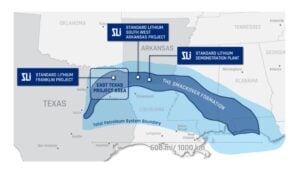
This industrial background created several advantages for lithium development. Infrastructure such as wells, pipelines, and processing facilities already exists. In addition, the local workforce has decades of experience handling brine extraction.
Because of this foundation, lithium production can build on existing systems rather than starting from scratch. Furthermore, the region also faces fewer water stress challenges than some lithium-rich areas in South America or the western United States. This improves the long-term feasibility of brine-based lithium projects.
Strong Resources Support the Project
The company revealed that resource estimates suggest the SWA Project holds significant lithium potential. Current studies project about 447,000 tonnes of proven lithium carbonate equivalent reserves.
This represents roughly 38 percent of the project’s measured and indicated resource base, which totals about 1.17 million tonnes of lithium carbonate equivalent.
The operation will begin production with lithium concentrations of around 549 milligrams per liter in the brine. Over its estimated 20-year operating life, the project is expected to process about 0.20 cubic kilometers of brine. The average lithium concentration during that period is expected to remain around 481 milligrams per liter.
Higher lithium grades play a major role in project economics. Strong concentrations allow producers to recover more lithium from each unit of brine. As a result, processing costs fall, and efficiency improves.
Because of this, projects with both strong grades and large resources tend to attract greater interest from investors and long-term buyers.
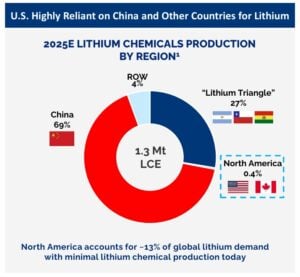
U.S. Lithium Potential in a Global Context
Lithium resources in the United States come from several geological sources.
- According to the latest data from the U.S. Geological Survey, measured and indicated lithium resources in the country are estimated at around 30 million tons.
These resources occur in different types of deposits, including continental brines, oilfield brines, geothermal brines, claystone deposits, hectorite, and hard-rock pegmatites.
Global exploration continues to expand the lithium resource base. And worldwide, measured and indicated lithium resources are estimated at 150 million tons. As exploration advances and new extraction technologies emerge, more regions are becoming viable sources of lithium supply.
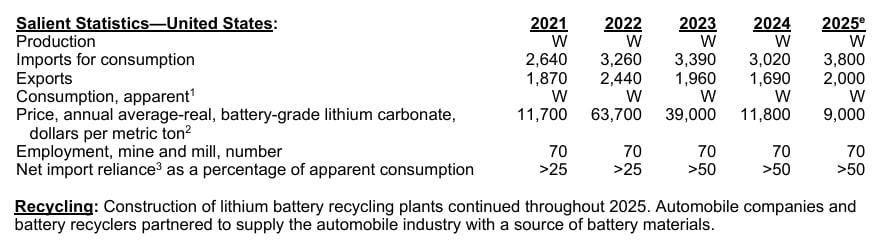
Rising Demand from EVs, Energy Storage, and AI
Lithium demand continues to increase across several sectors. The largest driver remains the electric vehicle market.
In the United States, lithium demand for EV batteries is expected to grow by about 25% per year over the next decade. This growth rate exceeds the projected global EV demand growth of about 13 percent annually.
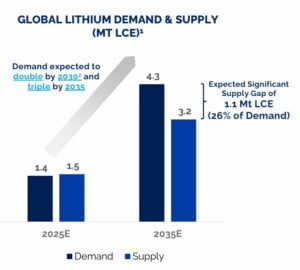
Energy storage is another rapidly expanding market. Large battery systems help store electricity from renewable sources such as solar and wind power and release it when demand rises.
At the same time, digital infrastructure is creating new pressure on electricity systems. Data centers that support artificial intelligence require massive amounts of energy. This trend is pushing utilities to expand battery storage capacity.
Because of these factors, the U.S. energy storage market could grow by roughly 29 percent per year, further increasing the need for lithium-based batteries.
A Practical Shift in the U.S. Lithium Story
For many years, the United States relied heavily on imported lithium materials. However, that approach is slowly changing.
Projects like the SWA development show how companies are trying to rebuild parts of the battery supply chain domestically. Instead of shipping raw materials across several continents, producers are exploring ways to supply lithium closer to battery and vehicle manufacturing centers.
The Smackover region fits naturally into this transition. Its geology, infrastructure, and long history of brine extraction already support industrial operations.
The agreement with Trafigura adds another layer of confidence. Commodity traders usually commit to long-term supply deals only when they believe a project has strong potential.
If development moves forward as planned, the SWA Project could turn southern Arkansas into a new center for lithium production. Over time, the region may shift from its long history of oil, gas, and bromine toward a growing role in supplying the battery metals needed for modern energy systems.