

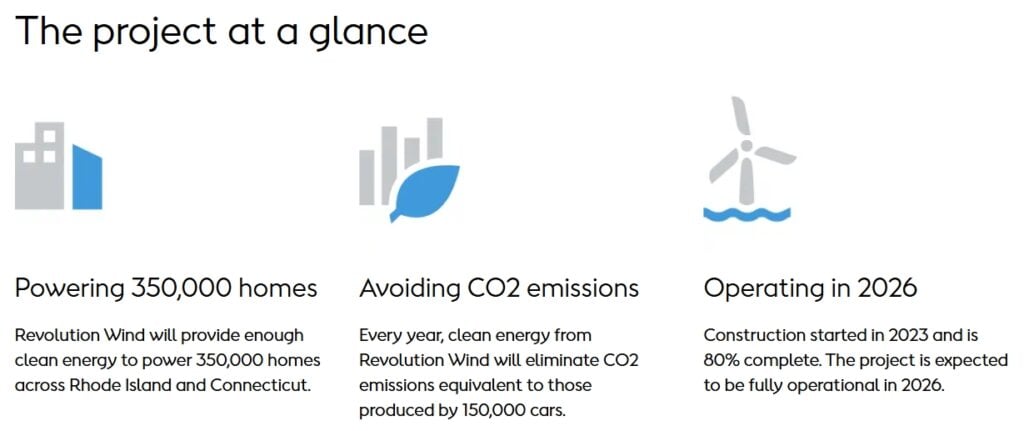
A major win for U.S. offshore wind came on January 13, 2026, when a U.S. District Court overturned a Trump-era block on Ørsted’s Revolution Wind project. The ruling allows the Danish energy giant to resume full operations immediately. Ørsted shares rose 5–5.5%, reflecting strong investor confidence in the U.S. clean energy sector. The 704 MW project off Rhode Island will provide renewable electricity to around 350,000 homes.
Ørsted’s Shares Soar with Legal Win
The press release explained that the court acted swiftly after Ørsted challenged the Bureau of Ocean Energy Management’s (BOEM) stop-work order, originally issued in August 2025, over national security concerns. A preliminary injunction in September 2025 had temporarily paused the halt. Today’s ruling clears all barriers, calling the stop-work order likely unlawful and highlighting the serious harm to the project if work remained suspended.
Construction now resumes with a target of full operation by Q2 2026, despite earlier delays caused by soil cleanup at Quonset Point. The decision demonstrates how courts can check executive actions that threaten renewable energy development. BOEM’s 2023 approvals, including the Construction and Operations Plan (COP), had already authorized 65 Siemens Gamesa 11 MW turbines on monopile foundations in federal lease OCS-A 0486.
- The ruling now ensures Rhode Island stays on track for 100% renewable electricity by 2033 and supports Connecticut’s offshore wind goal of 2,000 MW by 2030.
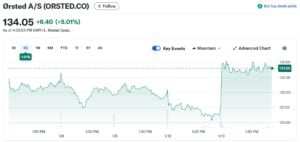
Following the announcement, Ørsted’s shares jumped 5.37%, reaching 134.45 DKK in early European trading, up from 127.65 DKK, signaling strong market approval of the project restart.
READ MORE: Offshore Wind Shock: Trump Administration Hits Pause Citing National Security Risks
Revolution Wind: Key Facts
Revolution Wind sits about 15 nautical miles southeast of Point Judith, Rhode Island, covering 83,798 acres in the Rhode Island/Massachusetts Wind Energy Area. Submarine cables connect the farm to the Davisville substation at Quonset Business Park, supplying 400 MW to Rhode Island through National Grid and 304 MW to Connecticut via Eversource and United Illuminating.
Power purchase agreements (PPAs) lock in electricity rates of 9.8–10 cents per kWh for 20 years, helping stabilize costs and cut emissions. Ørsted leads the project alongside Skyborn Renewables, a Global Infrastructure Partners firm, after Eversource exited in 2024.
The total investment exceeds $5 billion, including $100 million each for manufacturing hubs in Connecticut and Rhode Island and $35 million for Quonset logistics. The project supports 1,200 direct jobs and thousands of indirect roles.
Revolution Wind Project
Economic Impact and Job Creation
The court’s ruling boosts local economies. ProvPort ramps up turbine production, creating 125 union jobs, while Quonset Point’s $35 million hub adds crew vessels and the U.S.’s first offshore wind helicopter base. Connecticut’s $310 million State Pier redevelopment supports heavy turbine lifts.
Financially, the project benefits from IRA incentives and RECs, with National Grid expecting $4.6 million over 20 years, while Ørsted’s stock rises on renewed market confidence.
Environmental Benefits and Mitigation Measures
Revolution Wind reduces fossil fuel use and helps Rhode Island meet its climate goals under the Act on Climate. The “Aligned Grid” turbine layout reduces wake losses and coordinates with nearby projects like South Fork Wind. Monopile foundations disturb less seabed than jacket structures, while cables are buried 4–6 feet deep.
Agencies like NMFS, USACE, and EPA require safeguards, including seasonal pile-driving pauses for North Atlantic right whales, vessel speed limits, and noise-reduction measures. The project sets aside $12.9 million to compensate fisheries, $5.3 million for studies and contingency funds, and consults tribes through BOEM’s ERIF program. Continuous monitoring ensures adaptive protection of marine life.
Implications for U.S. Offshore Wind
The court’s decision reverses setbacks from 2025, including a Trump executive order halting new offshore leases. Revolution Wind’s development reflects 15 years of planning—from 2011 site calls to 2023 approvals—with the first turbine installed in September 2024. It is the first U.S. offshore wind farm spanning multiple states.
The project boosts the blue economy by establishing ProvPort and State Pier as East Coast offshore wind hubs. Carbon reduction is significant: 704 MW of renewable energy offsets millions of tons of CO₂ each year. Ørsted’s expertise positions it for further U.S. expansion.
Looking ahead, the ruling could accelerate permitting, attract private investment, and stabilize policy for the sector. Jobs in clean energy will grow, local supply chains will expand, and emissions will drop—key factors for ESG investors and carbon markets.
However, challenges remain. Visual impacts, FAA aviation markings, and EPA air permits require ongoing attention. Fisheries and tribal groups raise legitimate concerns, underlining the need for balanced, responsible development. With full operation expected in Q2 2026, Revolution Wind demonstrates how courts, regulators, and developers can align for sustainable growth in U.S. offshore wind.