

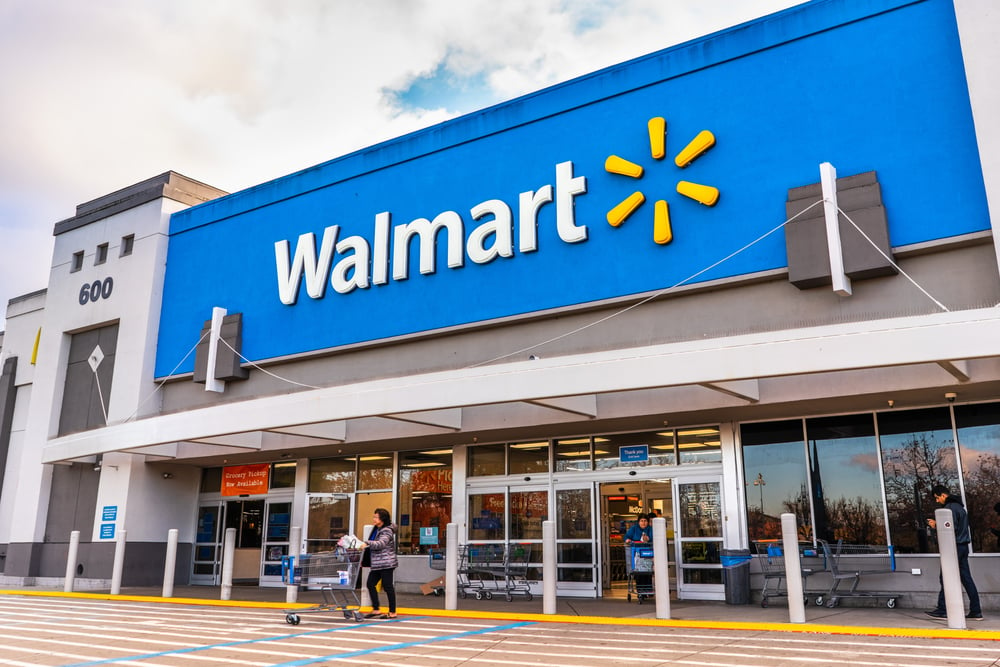
Walmart has crossed a historic financial mark. It became the first traditional retailer to reach a $1 trillion market value, a level previously limited to technology and energy giants.
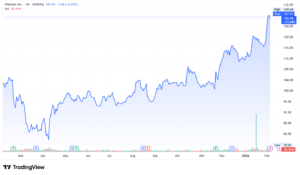
The milestone followed a strong move in the company’s share price. During recent trading in New York, Walmart’s stock rose by about 1.6% and hit an intraday high of around $126 per share.
That gain pushed the Bentonville, Arkansas-based retailer past the trillion-dollar threshold. Since the start of the year, Walmart’s stock has been up about 12%, far ahead of the S&P 500, which has gained less than 2% over the same period.
Investors have responded to Walmart’s steady revenue growth, digital expansion, and cost control. At the same time, the company has continued to expand its environmental and climate commitments. Given Walmart’s size, those efforts carry weight across global supply chains.
Big Targets for an Even Bigger Footprint
Walmart has set long-term climate targets that cover its own operations and its value chain. The company aims to reach zero greenhouse gas emissions across global operations by 2040, without using carbon offsets. It also plans to source 100% renewable electricity by 2035.
These targets apply to Scope 1 and Scope 2 emissions. Scope 1 includes direct emissions from company operations. Scope 2 covers emissions from purchased electricity. Walmart’s strategy includes improving energy efficiency, switching to low-impact refrigerants, and electrifying parts of its vehicle fleet.

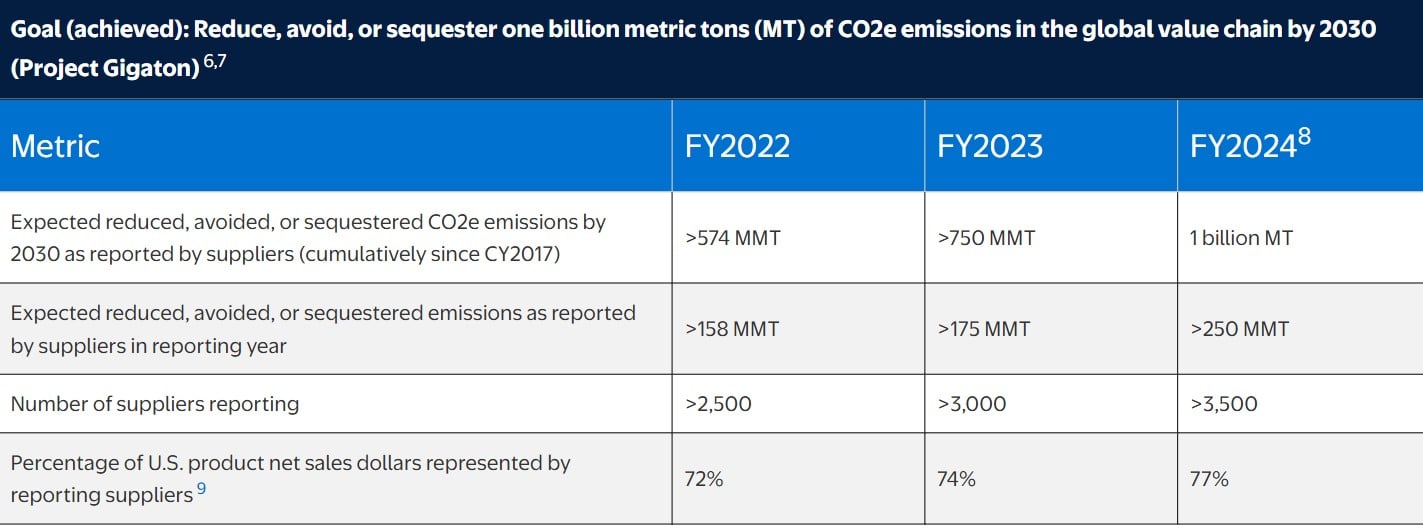
Most of Walmart’s emissions sit outside its direct control. Like many large retailers, the bulk of its footprint comes from suppliers, logistics, and product use. To address this, Walmart launched Project Gigaton in 2017. The program set a goal to avoid, reduce, or remove one billion metric tons of greenhouse gas emissions from the global value chain by 2030.
Progress Made, Deadlines Slipping
Walmart’s reporting shows clear progress in several areas.
On clean power, the company said that nearly half of its global electricity use now comes from renewable sources. This includes on-site generation and long-term power purchase agreements tied to wind and solar projects. These steps move Walmart closer to its 2035 renewable energy target.
On emissions, Walmart has reduced Scope 1 and Scope 2 emissions by about 18% compared with its 2015 baseline. During this time, the company cut carbon intensity by 45%. This means it emits less for each unit of business activity.
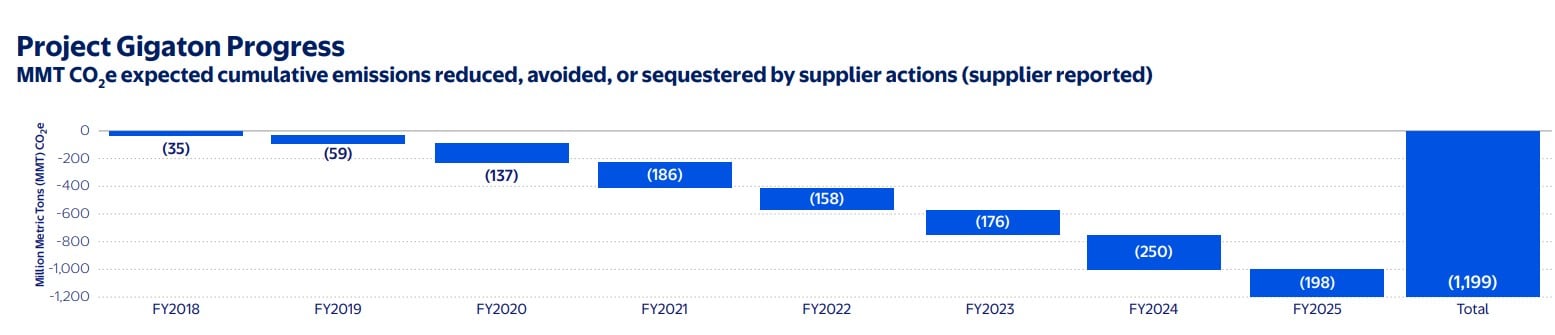
Project Gigaton has also delivered results. Walmart announced it hit its one-billion-ton emissions reduction goal six years early, 1.19 billion metric tons of CO₂e. Over 5,900 suppliers joined in. They helped cut down on energy use, packaging, transportation, and waste.
Still, the path to net zero is not smooth. Walmart has admitted that it probably won’t meet its interim goals. These include reducing Scope 1 and 2 emissions by 35% by 2025 and 65% by 2030, based on 2015 levels. The company has pushed those timelines further out as it faces technical and operational limits.
Where Most Emissions, and Leverage, Live
Supply chains remain Walmart’s biggest climate challenge. In retail, Scope 3 emissions often account for the vast majority of total emissions. Industry research shows that for large retailers, supply chain emissions can make up as much as 90% to 98% of total carbon output.
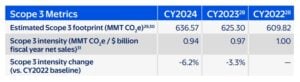
Project Gigaton targets this gap. It asks suppliers to set goals in six areas, including energy, waste, packaging, agriculture, and logistics. Many suppliers focus on energy efficiency and renewable power, while others work on sustainable sourcing and transport optimization.
With that initiative, emissions intensity in Scope 3 has dropped by about 6.2% since 2022. This shows progress in lowering the carbon intensity of the wider supply chain.
Beyond emissions, Walmart has expanded work on waste reduction and responsible sourcing. The company promotes circular economy practices, aims to cut food waste, and supports sustainable agriculture across key commodities. These efforts link climate goals with land use, water, and biodiversity outcomes.
Transport innovation:
Walmart is investing in new technologies to reduce emissions in transport and logistics. They are focusing on heavy-duty electric vehicles and hydrogen fuel cell forklifts. This comes as transportation emissions have recently increased because Walmart decided to bring more fleet operations in-house.
Refrigerant upgrades:
The retailer is replacing high-impact refrigerants with lower global warming potential systems. This effort contributed to a 2.4% decrease in refrigerant emissions in 2024, aided by preventive maintenance and specialized technician training.
Packaging challenges and circularity:
Walmart is working to increase recycled content in private-brand packaging. In 2024, recycled content in plastic packaging reached 8%, up from prior years, although it remains below the company’s 2025 goal of 20%. Efforts also include recycling and reuse programs for cardboard and other materials.
When Growth Multiplies the Climate Test
Walmart’s financial scale helps explain both its influence and its difficulty. In its latest fiscal year, the company generated more than $680 billion in revenue, making it the largest retailer in the world.
That scale means even small efficiency gains can lead to large absolute emissions cuts. But it also means that business growth can offset progress if demand rises faster than efficiency improves. Areas such as refrigeration, trucking, and cold-chain logistics remain hard to decarbonize quickly.
Technology limits also play a role. Some low-carbon solutions are still costly or not available at scale. These constraints have slowed progress toward interim targets, even as long-term goals remain in place.
Still, the retail giant continues to work on its sustainability actions spanning energy, supply chains, packaging, climate intensity, and innovation.
A Trillion-Dollar Reminder of Climate Responsibility
Walmart’s rise to a $1 trillion market value highlights how financial performance and sustainability planning now move side by side. The company has invested heavily in clean energy, supplier engagement, and efficiency. It has also been open about where progress has fallen short.
For the wider retail sector, Walmart’s experience offers a clear lesson. Large climate commitments can drive change, but execution takes time, capital, and coordination across thousands of partners. Success depends not only on targets, but on steady delivery and transparent reporting.
As Walmart continues to grow, its climate strategy will remain under scrutiny. The company’s size ensures that progress, delays, and course corrections all carry global impact. In that sense, Walmart’s trillion-dollar milestone is not just a financial marker; it is also a reminder of how closely corporate scale and environmental responsibility are now linked.