


A plastic-eating enzyme by Australian recycling startup Samsara Eco found its way into the fashion industry through clothing giant Lululemon.
Lululemon teamed up with the startup and held a minority stake in it, though the amount wasn’t revealed. This multi-year collaboration marks the Canadian athletic wear company’s first investment in a recycling company.
More notably, it represents the fashion industry’s commitment to promoting new approaches that emit less carbon and recycle old textiles.
Why Recycle Plastic in Textiles?
The fashion industry’s emissions account for about 10% of annual global carbon emissions, and that will increase by 50% by 2030. The industry is also using tons of plastic-derived textiles from petroleum.
Around 70% of the materials used in making apparel such as pants, skirts, jackets, and other clothes contain plastic, be it polyester, nylon, spandex, or acrylic.
Unfortunately, very little of these plastic-derived materials go to recycling facilities. The US Environmental Protection Agency estimates that only 15% of them are recycled.
As much as 87% of discarded textiles, which are 90% reusable and recyclable, end up in landfills or incinerators. And demand for apparel continues to grow, meaning more plastics will be needed to make new clothes.
That also means the fashion or apparel industry needs more plastic recycling efforts to avoid using virgin plastic materials.
Currently, there are two major ways for fashion companies like Lululemon to recycle textiles: mechanical and chemical using solvents. Both options are problematic because the former approach doesn’t allow the recovered plastics to be recycled several times while the latter often uses too much energy.
This is what Samsara Eco, which raised a $37 million Series A round, addresses with its innovative enzymatic approach.
Samsara Eco’s Infinite Recycling Tech
Samsara Eco uses enzymes that can attack complex plastics (polymers) and revert them back to their original chemical composition (monomers). This is what makes the startup’s recycling technology infinite.
It can make new, virgin-grade plastics without the need to use fossil fuels again. Plus, it also uses less heat to break down the textiles more efficiently, as per Paul Riley, Samsara Eco’s CEO. He further explained their company’s plastic recycling process using the enzyme:
“Our process can handle hard-to-recycle plastics, contaminated plastics, mixed plastics and plastics containing additives (like colors) again and again, and now textiles in a low-heat environment that is carbon neutral.”
Samsara Eco Plastic Recycling Process
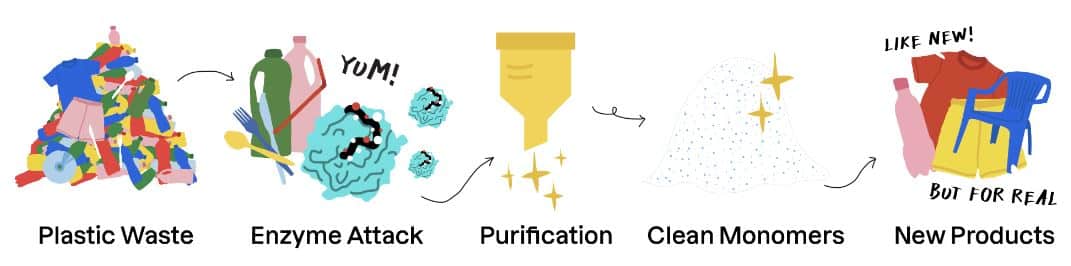
Riley added that their enzymatic recycling technology can produce virgin-like plastics without trading off the environment. It has a low carbon emission and doesn’t need high temperatures to break down plastic waste.
Putting that in context, the enviro-tech startup can stop releasing 1 billion tons of carbon dioxide into the atmosphere annually.
This matters a lot because manufacturing virgin plastics made from fossil fuels significantly contributes to global warming. And projections show that by 2050, the plastics sector will consume 15% of the carbon budget.
Samsara Eco aims to recycle 1.5 million metric tons of plastic each year by 2030. Right now, the world produces about 391 million metric tons of plastic a year and has a total of 8.3 billion tons of plastic waste.
Samsara Eco’s partnership with Lululemon will make the startup the first to infinitely recycle nylon and polyester. Together, these plastic materials comprise about 60% of apparel manufactured.
Using the startup’s plastic recycling enzyme technology, Lululemon seeks to repurpose nylon and polyester blends from old apparel to make new collections. Voicing the fashion brand’s concern with plastic, especially nylon, Yogendra Dandapure of Lululemon said:
“Nylon remains our biggest opportunity to achieve our 2030 sustainable product goals. Through Samsara Eco’s patented enzymatic process, we’re advancing transforming apparel waste into high-quality nylon and polyester, which will help us live into our end-to-end vision of circularity.”
Other Textile Recycling Technologies
Scientists have been working on finding the most cost-effective ways to break down plastics for decades, particularly polyethylene terephthalate (PET).
Collaborative efforts and the use of artificial intelligence (AI) help ramp up practical applications of plastic-eating enzymes.
A different team discovered a natural enzyme PETase that’s capable of degrading PET plastic while modifying it using machine learning. They called it FAST-PETase – functional, active, stable, and tolerant PETase.
Another startup, Circ, has also developed a unique hydrothermal processing technology for recycling blended textiles, like polyester-cotton blends. The Circ system uses hot water, pressure, and chemical solvents to recycle both materials, recovering 90% of the waste textile.
A Connecticut-based company, Protein Evolution, is also developing a similar enzymatic approach for recycling plastics. They turn leftover nylon and polyester from used textiles into materials for new collections.
These companies may also be eligible for earning plastic credits or carbon credits. Each plastic credit is equal to one ton of plastic waste that would otherwise have not been collected or recycled.
Companies can leverage plastic credits along with carbon credits to address their sustainability concerns. Many firms also consider plastic waste reduction as part of their net zero commitments.
Same with other circular economy approaches, Samsara Eco needs more years to scale up and commercialize its technology. But the kind of support from clothing giants and popular fashion brands like Lululemon is a great milestone.