


The press release from Japan Climate Transition Bonds Framework under the Ministry of Finance (MoF) states that on July 2, 2024, Japan will launch its inaugural JPY1.6 trillion (USD 11 billion) Climate Transition Bond, dedicated to funding the nation’s extensive Green Transformation (GX) program.
The GX Plan aims to mobilize JPY150 trillion (USD 1 trillion) in public and private investments over the next decade, targeting cutting-edge, sustainable technologies to mitigate domestic emissions. This initiative aligns with Japan’s commitment to achieving its 46% greenhouse gas (GHG) reduction targets by 2030 and becoming carbon neutral by 2050.
Key Initiatives in Japan’s GX Promotion Strategy
As per the Climate Transition Bond Framework, In FY 2021, Japan’s energy self-sufficiency rate was 13.3%. It has been heavily reliant on imported oil, coal, and liquefied natural gas since the Great East Japan Earthquake occurred in 2011.
Achieving Green Transformation (GX) necessitates addressing high-emission sectors.
Emission reduction efforts are crucial for energy transformation in the following sectors:
- Heavy industries like steel and chemicals, significantly contribute to emissions after distribution.
- Everyday life sectors include households, transportation, commercial, and educational facilities.
Priority will be given to technologies that efficiently and effectively reduce emissions in each sector. The prime focus will be on those that forge industrial competitiveness and drive economic growth.
Japan’s GX promotion strategy establishes two key initiatives to meet international commitments, ensure a stable energy supply, and realize economic growth.
1. Stable Energy Supply and Decarbonization:
- Promote energy conservation measures.
- Transition power sources to improve energy self-sufficiency, focusing on renewable energy and nuclear power.
2. Growth-Oriented Carbon Pricing Concept:
- Implement and execute bold upfront investment support using instruments such as GX Economy Transition Bonds.
- Provide incentives for GX investment through carbon pricing.
- Utilize new financial mechanisms to support the transition.
These initiatives ensure a stable energy supply while advancing toward decarbonization and economic growth.
Image: GX promotion strategy
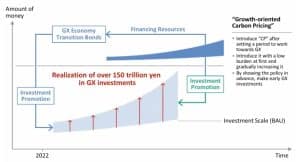 source: Japan Climate Transition Bond Framework
Japan’s Climate Transition Bonds Set New Standards in Sustainable Finance
The press release discreetly mentions that Japan’s Climate Transition Bonds are certified under the Climate Bonds Standard. It assures investors’ adherence to global best practices in environmental objectives.
Sean Kidney, CEO, of Climate Bonds Initiative, said:
“Transition is the theme for the year: corporates, cities and countries need to do transition plans in line with global emission reduction targets; under the Paris Climate Agreement countries are working on ambitious new Nationally Determined Contributions (NDCs) – transition plans – to be tabled at next year’s COP. “This bond shows clearly how governments, and others, can raise funds to invest in that transition. It marks a significant milestone in transition finance.”
The First 55.5% Share
A substantial 55.5% of the bond’s proceeds will fund R&D initiatives. It would focus on renewable energy and hydrogen utilization in steelmaking, to help limit global temperature increases to 1.5°C.
The Second 44.5% Share
The remaining 44.5% will support subsidies for activities like manufacturing electricity storage batteries and implementing energy-efficiency measures in buildings. Notably, the bond explicitly excludes funding for gas-fired power generation or ammonia co-firing in coal-fired plants.
The independent verification report, prepared by the Japan Credit Rating Agency (JCRA), a Climate Bonds Approved Verifier, reinforces the bond’s credibility.
Atsuko Kajiwara, Managing Executive Officer and head of the Sustainable Finance Evaluation Group at JCRA, said:
“Since 2020, JCR has been contributing to the government’s efforts to develop Japan’s transition pathway toward net zero by 2050 and alignment with the Paris Agreement. JCRA hopes the government’s strong initiative will help various Japanese corporates that struggle to find a way to attain both carbon neutrality and business expansion in the coming decades.”
We shall elaborate on the history and additional details of this bond in the next paragraphs.
The development of Climate Transition Bonds (JCTBs) in Japan, IEA Reports
In February 2024, Japan made history by issuing the world’s first sovereign transition bonds—Japan Climate Transition Bonds (JCTBs). The issuance included two tranches of JPY 800 billion (USD 5 billion) each, with tenors of 5 and 10 years. Certified by the Climate Bonds Initiative, these bonds are grounded in Japan’s national transition strategy.
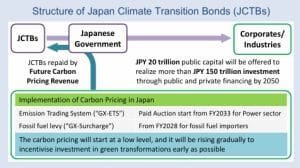
source: IEA Report 2024
Unlocking the Key Features of JCTBs
Investment Plan
Japan’s Basic Policy for the Realization of Green Transformation, published in February 2023, outlines a detailed investment plan for 22 industrial sectors to achieve carbon neutrality by 2050.
- Envisions JPY 20 trillion (USD 130 billion) of public capital
- Aims to generate over JPY 150 trillion (USD 1 trillion) in investment through public and private financing by 2050
- Includes sector-specific transition roadmaps developed by expert committees
Focus on Nascent Technologies
Over half of the proceeds from JCTBs will be allocated to emerging technologies crucial for the transition.
Innovative Carbon Pricing Approach:
- Utilizes future carbon pricing revenue for immediate bond repayment
- Allows for immediate deployment of capital based on assumed future revenue from carbon taxes
Potential for Emerging Markets and Developing Economies (EMDE):
- Credit Intermediary Role: The government acts as a credit intermediary, enhancing the creditworthiness of corporates and simplifying financing for small-scale projects.
- Credit Enhancements: For countries with sub-investment-grade credit ratings, additional credit enhancements such as guarantees from Development Finance Institutions (DFIs) may facilitate access to international capital markets.
Japan’s climate transition bonds set a new standard for sovereign transition bonds. This model can guide other nations, especially in emerging markets. Consequently leveraging future carbon pricing revenues and attract significant investment for green transformations.