

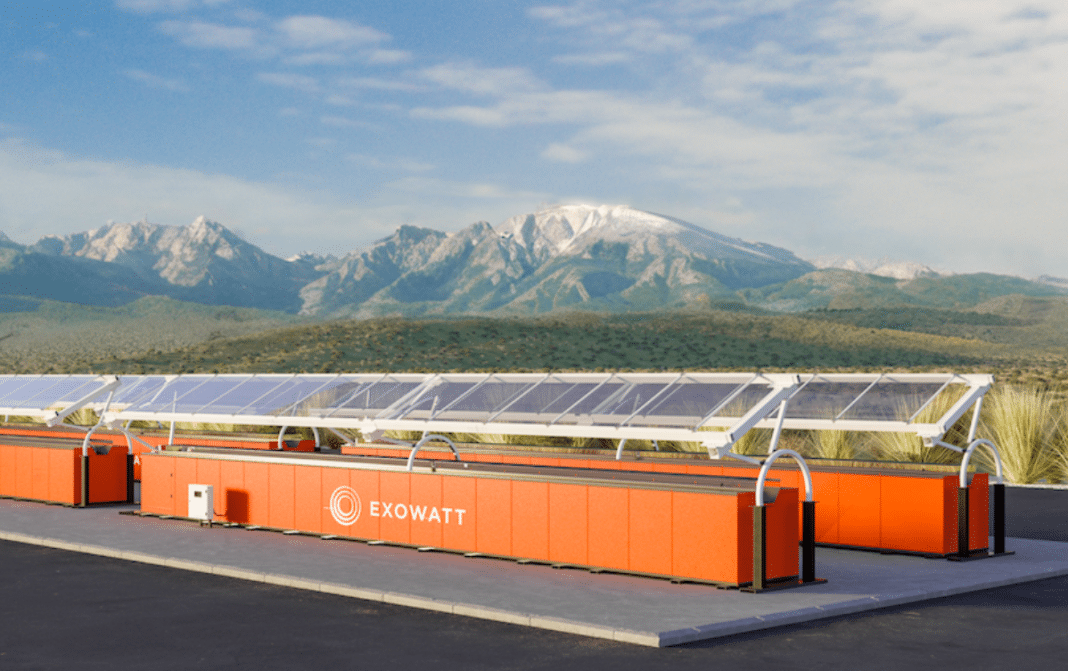
As AI data centers surge in number, their energy consumption poses a significant challenge. These facilities are increasingly straining power grids and threatening the climate commitments of major tech companies like Microsoft, Google, and Amazon. This is what the Miami-based Exowatt, a startup backed by Sam Altman of OpenAI, tries to solve.
The next generation renewable energy company aims to provide a clean, affordable alternative with its modular system that can generate, store, and dispatch solar energy to power these data centers. With a 1.2-gigawatt demand backlog, Exowatt is stepping into a market hungry for sustainable energy solutions.
Following a $20 million seed round led by a16z, Atomic, and Sam Altman, Exowatt could make a significant impact in renewable energy.
Revolutionizing Energy Storage
Exowatt’s system is revolutionary; it’s called Exowatt P3. It pairs a solar energy collector with a thermal battery that can either provide heat or electricity on demand. According to Jack Abraham, Exowatt’s co-founder, data center operators are desperate for affordable, renewable energy. Highlighting the demand for cleaner power, he said that:
“Even if our energy costs were three or four times higher, we’d still have nearly the same number of customers.”
The system has been designed to help data centers self-sustain, thereby reducing their dependency on traditional grids or, worse, fossil fuels.
Exowatt’s Unique Energy Collection Process
Exowatt P3’s optical collection system features cutting-edge technology. It is akin to using a magnifying glass to focus the sun’s rays. The energy is then stored in a heat battery composed of a clay and ceramic composite—a readily available and cost-effective material.
The solar energy can be stored for months, but most customers are interested in storing energy for periods of 8 to 24 hours, to be used when other power sources become more expensive. Compact enough to fit within a 40-foot shipping container, this low-maintenance “install and forget” system meets the needs of industries aiming to cut energy costs and reduce their environmental footprint.
According to the company, their unsubsidized energy cost is $0.04 per kilowatt hour, competitive with conventional energy sources. Producing electricity at this rate, the Exowatt P3 is both scalable and efficient, storing energy for 24-hour use.
- In real-world application, the system can save up to $35 million in energy costs and reduce CO2 emissions by 438,000 tons for an average data center project.
Meeting Data Center Power Demand
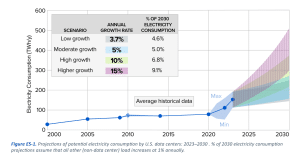
As data centers continue to grow, Exowatt’s solution becomes even more critical.
EPRI U.S. Data Center Load Projections
Exowatt’s first data center project will go live in West Texas later this year, targeting a large crypto-mining customer.
By next year, this project could reach 50 megawatts. While Exowatt has declined to name its current customers, the demand points to its system’s ability to alleviate energy pressures on the grid and meet the clean energy needs of these power-hungry facilities.
Thermal Batteries and the Climate Tech Boom
Exowatt is part of a broader wave of investment in thermal battery technology. Competitors like Antora Energy and Rondo Energy have raised substantial funds to scale systems that store energy as heat. While these companies primarily target heavy industries such as cement and steel production, Exowatt has chosen a simpler and more scalable market in data centers.
Despite the fast-growing interest, scaling thermal battery systems can be challenging. Industries often require customized retrofits that are costly and complicated. Convincing customers to transition from fossil fuels can be a hard sell, especially where there’s institutional resistance. But by starting with data centers, Exowatt avoids much of this complexity, offering a more straightforward path to market.
Scaling Up: Challenges and Opportunities
The demand for the energy startup’s product is strong. However, scaling Exowatt’s production will be a significant challenge. As co-founder Hannan Parvizian pointed out, building a few prototypes is easy, but producing thousands or millions of units is an entirely different case.
Supply chain issues and manufacturing capacity will play a critical role in determining whether Exowatt can meet the huge market potential.
Moreover, Exowatt’s solution also has geographical constraints. According to Abraham, about 60% of U.S. data centers are located in areas with enough sun to make the system viable. This means Exowatt’s technology may not be a universal fit, leaving a significant portion of the market unserved.
Despite its challenges, Exowatt’s approach to clean energy for data centers is a promising step toward reducing the carbon footprint of the tech industry. By providing an affordable, renewable alternative to fossil fuels, the startup is helping data centers meet their climate goals while also easing the strain on power grids.
As AI continues to grow, the need for sustainable, reliable energy solutions like Exowatt’s will only become more pressing. The company’s success will depend on its ability to scale manufacturing, build a robust supply chain, and continue innovating in the thermal battery space. With the backing of Sam Altman and a growing list of eager customers, Exowatt could play a significant role in the future of clean energy for AI and data centers.