


Disseminated on behalf of SolarBank Corporation.
SolarBank Corporation (NASDAQ: SUUN; Cboe CA: SUNN, FSE: GY2) has announced a major step forward in the development of its 7.2 MW DC ground-mount solar power project, known as the North Main Project, in Wyoming County, New York. The project has finished the Coordinated Electric System Interconnection Review (CESIR). This important step allows the company to move forward with the permitting process.
SolarBank Corporation is an independent renewable and clean energy project developer and owner. It specializes in distributed and community solar projects across Canada and the United States.
The company develops solar, Battery Energy Storage System (BESS), and EV Charging projects. These facilities supply electricity to utilities, commercial, industrial, municipal, and residential off-takers.
SolarBank has a development pipeline exceeding one gigawatt. It has successfully developed renewable energy projects with a combined capacity of over 100 megawatts.
After securing the needed permits and funding for North Main, SolarBank plans to start building the community solar project. This project will provide clean energy to around 850 homes. The project should also qualify for incentives from the NYSERDA NY-Sun Program. This will help its financial and operational success.
Bringing Affordable Clean Energy to Communities
Community solar projects like North Main play a crucial role in the transition to renewable energy. Community solar is different from traditional rooftop solar. It lets both renters and homeowners enjoy solar power benefits. They don’t need to install panels on their properties.
Moreover, participants can subscribe to the project. They will receive credits on their electricity bills. This lowers their energy costs and supports renewable energy growth.
Current Market Landscape and Growth Projections
As of June 2024, the United States has about 7.87 gigawatts (GW) of community solar capacity. This capacity is spread across 44 states and the District of Columbia.
In the third quarter of 2024, the community solar segment installed 291 megawatts direct current (MWdc). This is a 12% increase compared to the same period in the previous year. This growth underscores the sector’s resilience and expanding appeal.

Looking ahead, the U.S. Department of Energy has set an ambitious target to achieve 25 GW of community solar capacity by 2025. This was a target of the prior Federal administration but most community solar projects are developed with the support of state and local governments. The Coalition for Community Solar Access expects the U.S. to exceed 30 GW of community solar by 2030. This shows strong growth potential for the sector.
Wood Mackenzie forecasts that the national community solar market will grow at an average rate of 5% annually through 2026. However, a subsequent average annual contraction of 11% is anticipated through 2029. This shows that near-term growth is strong. Yet, long-term sustainability may need strategic actions and policy support.
SolarBank is focusing on community solar, aiming to provide clean, affordable energy to thousands of homes. This initiative supports the company’s mission to speed up renewable energy use in North America.
A Strong Partnership with Solar Simplified
SolarBank has teamed up with Solar Simplified. They are a leading provider of services for community solar programs. They focus on customer acquisition, enrollment, and management.
Solar Simplified works with SolarBank to make sure community solar projects are fully signed up. This way, they can boost revenue right from the start.
Solar Simplified takes care of all customer operations. This lets SolarBank focus on growing its renewable energy portfolio and launching more projects each year.
Overcoming Challenges in Solar Development
The North Main Project is a big step forward, but challenges still exist for large-scale solar projects. The project depends on three key steps:
- getting a community solar contract,
- obtaining permits, and
- securing third-party financing.
Also, changing government incentives and policies about solar power can affect how financially sound future projects will be.
Navigating the US-China Solar Trade Landscape
The solar industry has been heavily affected by U.S.-China trade tensions, with President Donald Trump issuing an executive order on February 1, 2025 imposing a 10% tariff on imports from China, which has since doubled to 20%. This move builds on former President Joe Biden’s tariff hikes from 25% to 50%, effective January 1, 2025, bringing total duties on Chinese solar polysilicon, wafers, and cells to 70%.
China dominates the global solar panel supply chain, producing over 80% of the world’s photovoltaic (PV) modules. Dependence on Chinese imports has led to increased costs and supply chain challenges for many U.S. solar developers.

However, SolarBank has positioned itself to mitigate the effects of these trade disputes. By prioritizing domestic manufacturing, SolarBank not only avoids tariff-related cost fluctuations but also contributes to strengthening the U.S. solar supply chain.
In an exclusive interview, SolarBank’s CEO Dr. Richard Lu emphasized the company’s edge on this matter, stating:
“We want to do our part to “Make America Great Again”. Solar energy is the power that we can deliver at a low cost in a timely manner, and we want to use “Made in the USA” solar panels to achieve our strategic goal. The Made in the USA panels demonstrate our commitment to supporting domestic production for the clean and renewable energy industry. For the sector, it will enable the industry to meet its demand with domestic supplies.”
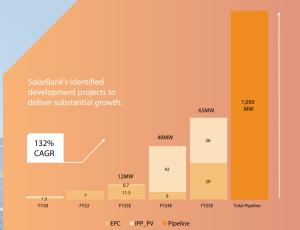
SolarBank is dedicated to growing renewable energy in North America with the following project pipeline. It uses its skills in solar, battery storage, and EV charging projects to meet this goal.
Innovative Projects and Market Expansion
SolarBank is committed to innovation. It has teamed up with Viridi to turn a landfill in Buffalo, New York, into a solar farm. This project will have a capacity of 3.06 MW and include a 1.2 MWh battery energy storage system.
This project shows the company’s commitment to turning unused sites into renewable energy sources. It provides clean energy to the community and helps tackle environmental issues.
SolarBank is also planning a move into the growing data center market. This market is expected to hit $395 billion by 2030. Using its renewable energy expertise, the company plans to create and partner on data centers. This will help meet the industry’s huge energy needs with scalable and eco-friendly solutions.
SolarBank’s commitment to renewable energy continues to drive meaningful progress in the community solar sector. The North Main Project and other new developments are helping the company expand clean energy access and support sustainable infrastructure across North America. SolarBank leads the way to a cleaner energy future through partnerships, expanding markets, and tackling industry challenges.
This report contains forward-looking information. Please refer to the SolarBank press releases entitled “SolarBank Provides Update on 7.2 MW North Main Project in Wyoming County, New York.”; “SolarBank Partners with Viridi on Combined 3.06 MW Solar and 1.2 MWH Battery Energy Storage Project Located in Buffalo, New York.”; and “SolarBank Announces 2024 Highlights”.
Disclosure: Owners, members, directors, and employees of carboncredits.com have/may have stock or option positions in any of the companies mentioned: None.
Additional disclosure: This communication serves the sole purpose of adding value to the research process and is for information only. Please do your own due diligence. Every investment in securities mentioned in publications of carboncredits.com involves risks that could lead to a total loss of the invested capital.