

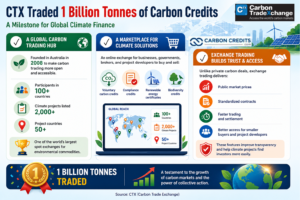
The carbon market has reached another major milestone. Carbon Trade Exchange (CTX) has now traded more than 1 billion tonnes of carbon dioxide equivalent (CO₂e) since launching in 2008. The company has spent nearly two decades building one of the world’s largest electronic marketplaces for carbon credits and other environmental products.
That number is significant. One carbon credit equals one tonne of CO₂e that has been avoided, reduced, or removed from the atmosphere. Together, those trades have helped direct funding to climate projects such as renewable energy, forest protection, methane capture, and clean cooking programs.
The milestone also comes as global demand for carbon credits continues to change. Buyers are looking for higher-quality credits. Governments are expanding carbon pricing. More companies are using carbon markets as part of their net-zero strategies.
How CTX Became a Global Carbon Trading Hub
CTX was founded in Australia in 2008 to make carbon trading more open and accessible.
Today, the company operates an online exchange where businesses, governments, brokers, and project developers can buy and sell environmental products. These include voluntary carbon credits, compliance credits, renewable energy certificates, and biodiversity credits.
According to CTX, its marketplace now serves participants in more than 100 countries, has 2,000+ climate projects listed, and has 50+ project countries. Over the years, it has become one of the world’s largest spot exchanges for environmental commodities.
Unlike private carbon deals, exchange trading offers several advantages:
- Public market prices,
- Standardized contracts,
- Faster trading and settlement, and
- Better access for smaller buyers and project developers.
These features help improve transparency while making it easier for climate projects to find investors.
CTX says that trading one billion tonnes shows how carbon markets have grown. They have moved from a niche industry to a vital source of climate finance. Wayne Sharpe, CEO & Founder of CTX, remarked:
“There is no Planet B – we need to save this one. This milestone represents businesses choosing to put capital behind climate action. The work now is to make access to quality carbon credits more transparent, practical and scalable worldwide.”
Carbon Markets Continue to Expand Worldwide
CTX’s milestone reflects a much bigger trend.
The World Bank’s State and Trends of Carbon Pricing 2026 report states that 87 carbon pricing instruments are now in use or planned worldwide. These include emissions trading systems (ETSs) and carbon taxes.
Together, they cover about 29% of global greenhouse gas emissions.
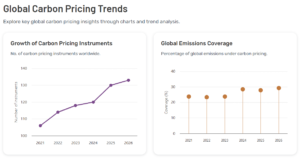
Carbon pricing also generated a record $107 billion in government revenue during 2024. More than half of that money was used to support climate and nature projects, according to the World Bank.
Voluntary carbon markets (VCMs) are much smaller than compliance markets, but they continue to play an important role. Many projects supported by voluntary carbon finance are located in developing countries.
Carbon credit sales help fund activities such as protecting forests, restoring mangroves, building renewable energy projects, capturing methane from landfills, and distributing cleaner cookstoves. These projects reduce emissions while creating jobs and supporting local communities.
The OECD says global climate finance hit $136.7 billion in 2024. It is more than the developed countries’ goal of $100 billion a year for developing nations.
Even so, the United Nations says developing countries will need trillions of dollars annually this decade to meet climate and development goals. Private investment, including carbon markets, will play an important role in closing that gap.
Why Transparent Carbon Exchanges Matter More Today
As carbon markets grow, exchanges are becoming more important. Many carbon credits are still bought through private negotiations, but:
- Organized exchanges offer greater transparency by publishing market prices and using standard trading rules. That helps buyers compare credits more easily.
- It also gives project developers access to more potential investors.
- More trading also improves market liquidity. Buyers can find credits more easily, while project developers gain greater confidence that they can sell future credits.
This matters because demand is shifting toward higher-quality carbon credits. Companies increasingly want credits that meet stronger environmental standards and provide clear climate benefits.
CTX’s one-billion-tonne milestone shows how much carbon markets have grown over the past 18 years. More importantly, it shows that exchanges are becoming key financial infrastructure for the global carbon market, helping move private capital toward projects that reduce emissions and support the transition to a lower-carbon economy.
Digital Exchanges Can Help Scale Climate Finance
The need for climate finance continues to grow.
According to the United Nations Framework Convention on Climate Change (UNFCCC), developing countries will require $5.1 trillion to $6.8 trillion by 2030 to deliver their national climate plans. Public funding alone will not be enough to meet that need.
Private capital will play a much bigger role.
Carbon markets are one way to direct that investment toward projects that reduce emissions or remove carbon from the atmosphere. These include reforestation, mangrove restoration, biochar, methane capture, and carbon removal technologies.
Digital exchanges help this process by making carbon trading faster, more transparent, and easier to access. Instead of relying on private negotiations, buyers can compare prices, review available credits, and complete transactions through a centralized marketplace.
CTX is not alone. Other exchanges are also growing rapidly as demand for environmental commodities increases.
Xpansiv’s CBL, the world’s largest spot marketplace for environmental commodities, has facilitated trading of more than 330 million carbon credits since 2020. The platform also serves more than 1,500 active participants across carbon, renewable energy, clean fuels, and water markets. It has over $2 billion in cumulative notional trading value.
Meanwhile, the Intercontinental Exchange (ICE) reported another record year in 2025. More than 20.9 million environmental futures and options contracts traded on ICE. This is a 4% increase from the previous record.
ICE has now recorded the equivalent of more than $1 trillion in annual notional environmental trading for five consecutive years. This suggests a growing role of carbon markets in global finance.
As more countries build carbon markets under Article 6 of the Paris Agreement, exchanges can connect buyers and sellers internationally. This connection helps improve transparency and price discovery.
One Billion Tonnes, and the Beginning of a Bigger Market
CTX’s one-billion-tonne milestone is about more than trading volume. It shows how much carbon markets have evolved over the past 18 years. What started as a niche market has become an important tool for mobilizing private climate finance.
For CTX, reaching one billion tonnes traded confirms its role as one of the industry’s longest-running carbon exchanges. For the wider market, it signals that carbon trading is becoming more organized, more transparent, and increasingly focused on quality.
As countries and companies work toward net-zero emissions, carbon exchanges like CTX are likely to play an even larger role. By connecting global buyers with climate projects, they help move private capital where it is needed most—supporting emissions reductions while expanding access to climate finance around the world.