

In January, President Donald Trump signed an executive order titled “Removing Barriers to American Leadership in Artificial Intelligence.” The goal was to maintain and expand America’s edge in AI technology to enhance national security, economic power, and human development.
Following up on that directive, the White House released “Winning the AI Race: America’s AI Action Plan” on July 23. The strategy aims to place the U.S. at the forefront of global AI development by fast-tracking infrastructure, encouraging innovation, and promoting international cooperation. Officials called it a transformative roadmap to power a new era of American technological dominance.
Key Highlights of America’s AI Action Plan
The plan outlines over 90 policy actions centered around three core areas:
- Accelerating innovation
- Building strong AI infrastructure
- Leading global AI diplomacy and security
White House Science and Technology Policy Director Michael Kratsios said,
“America’s AI Action Plan charts a decisive course to cement U.S. dominance in artificial intelligence. President Trump has prioritized AI as a cornerstone of American innovation, powering a new age of American leadership in science, technology, and global influence. This plan galvanizes Federal efforts to turbocharge our innovation capacity, build cutting-edge infrastructure, and lead globally, ensuring that American workers and families thrive in the AI era. We are moving with urgency to make this vision a reality.”
Several major actions were outlined in the strategy:
- Exporting AI Technology: The U.S. Commerce and State Departments will work with industry leaders to export complete AI solutions—including hardware, software, and standards—to trusted allies.
- Faster Buildout of Data Centers: The government plans to speed up the permit process for building data centers and chip factories. It will also support workforce development in trades like electrical and HVAC services.
- Regulatory Reform: The administration will eliminate or ease federal rules that slow AI progress. Businesses will be asked to share feedback on outdated regulations that should be scrapped.
- Safeguarding Free Speech: New guidelines for government AI contracts will require that language models are free from political bias and allow open discourse.
Relaxed Environmental Rules Raise Red Flags
The plan includes fast-tracking environmental permits under the National Environmental Policy Act to ease the construction of large data centers. This also involves rolling back rules from the Clean Air Act and Clean Water Act. In return, data centers must promise to invest at least $500 million per site.
Federal agencies have also been asked to offer up government-owned land for building both data centers and their supporting energy infrastructure. These moves aim to speed up construction but have raised concerns about environmental oversight.
The Department of Energy announced four government sites where private companies will partner to build new AI data centers and power facilities. Energy Secretary Chris Wright called it “a bold step” and compared it to launching a new Manhattan Project.
Global Data Center Energy Use Set to Soar
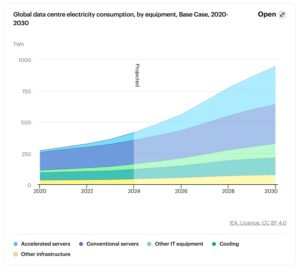
AI needs a lot of electricity to power advanced servers, cooling systems, and data management. The International Energy Agency (IEA) warned that global electricity use from data centers could double by 2030, reaching more than Japan’s current energy demand.
By 2030, it could reach about 945 TWh, which is nearly 3% of total global demand.
- From 2024 to 2030, data center electricity use is projected to grow 15% each year—four times faster than other sectors.
Notably, all data center types, enterprise, colocation, and hyperscale, contribute to this rise.
The U.S. AI Infrastructure Demands Massive Power
Talking about the U.S., a report revealed that data centers and AI platforms used 4% of the nation’s electricity in 2023. The electricity use has remained steady for 20 years, but the rise of AI will likely push total demand up by 9% by 2028 and 20% by 2033.
Much of this power may come from fossil fuels like coal and natural gas, which release greenhouse gases such as carbon dioxide and methane. This could worsen global warming and increase extreme weather events.
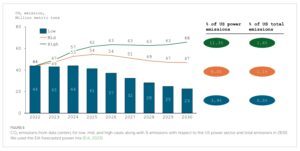
- This surge in electricity use could lead to greenhouse gas emissions equal to 40% of the U.S.’s current annual emissions. This amount is the same as emissions coming from 540 million gasoline-powered cars.
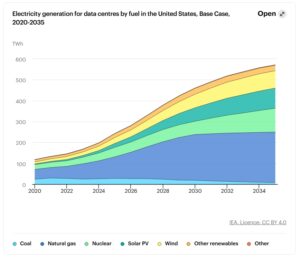
Chart: CO2 emissions from data centers for low, mid, and high cases, along with % emissions concerning the US power sector and total emissions in 2030.
Additionally, AI data centers require large amounts of water for cooling, putting stress on water supplies in already dry regions.
Why is AI so energy-hungry?
GPUs used in AI are much more power-intensive than standard chips. Even a single ChatGPT query uses nearly 10 times the power of a Google search. Creating AI-generated images takes thousands of times more electricity than generating text.
- In 2024, ChatGPT alone used over 500,000 kilowatt-hours of electricity daily, which is equal to the power used by 180,000 U.S. homes.
- A single Meta data center consumes as much power as 7 million laptops running eight hours a day.
- In Santa Clara, California, 50 data centers use 60% of the city’s electricity, often paying lower rates than residents.
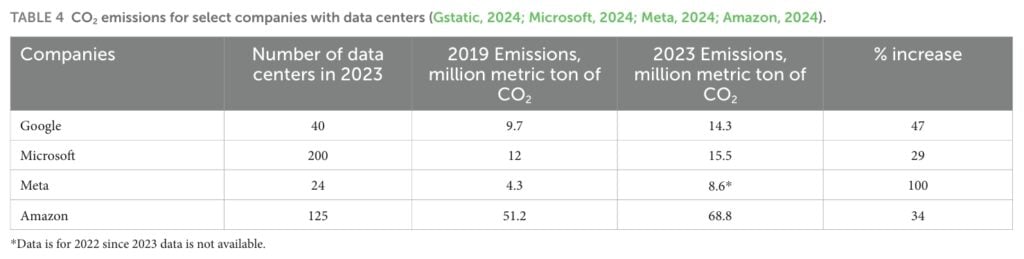
How Big Techs Are Responding to Trump’s AI Policy?
To keep up with rising energy demands, many tech companies are relying on existing power plants. In the U.S., most of these still use fossil fuels, especially natural gas. While some areas are adding renewables and battery storage, nuclear energy is gaining attention as a cleaner, steadier power source.
To begin with, Nvidia CEO Jensen Huang said,
“America’s unique advantage that no country could possibly have is President Trump.”
Meanwhile, OpenAI and Oracle announced progress on their massive “Stargate” project. The $500 billion effort aims to create a national AI infrastructure network. The companies revealed they are developing 4.5 gigawatts of new data center capacity, more than twice the power used in San Francisco. While specific energy sources weren’t mentioned, one site in Abilene, Texas, is already up and running. The rest of the project will be rolled out in phases over the next four years.
With demand from AI and cloud services growing fast, nuclear energy is becoming a key part of the tech industry’s strategy to ensure reliable, low-carbon power.
AI Is the New Arsenal—And America Must Win
Even though critics stress the need for updated energy policies and better efficiency standards, Trump stays undeterred. He is clean on his stance. America has to dominate the artificial intelligence space.
And Secretary of State and Acting National Security Advisor, Marco Rubio, also vouches for this vision. He noted,
“Winning the AI Race is non-negotiable. America must continue to be the dominant force in artificial intelligence to promote prosperity and protect our economic and national security. President Trump recognized this at the beginning of his administration and took decisive action by commissioning this AI Action Plan. These clear-cut policy goals set expectations for the Federal Government to ensure America sets the technological gold standard worldwide, and that the world continues to run on American technology.”