

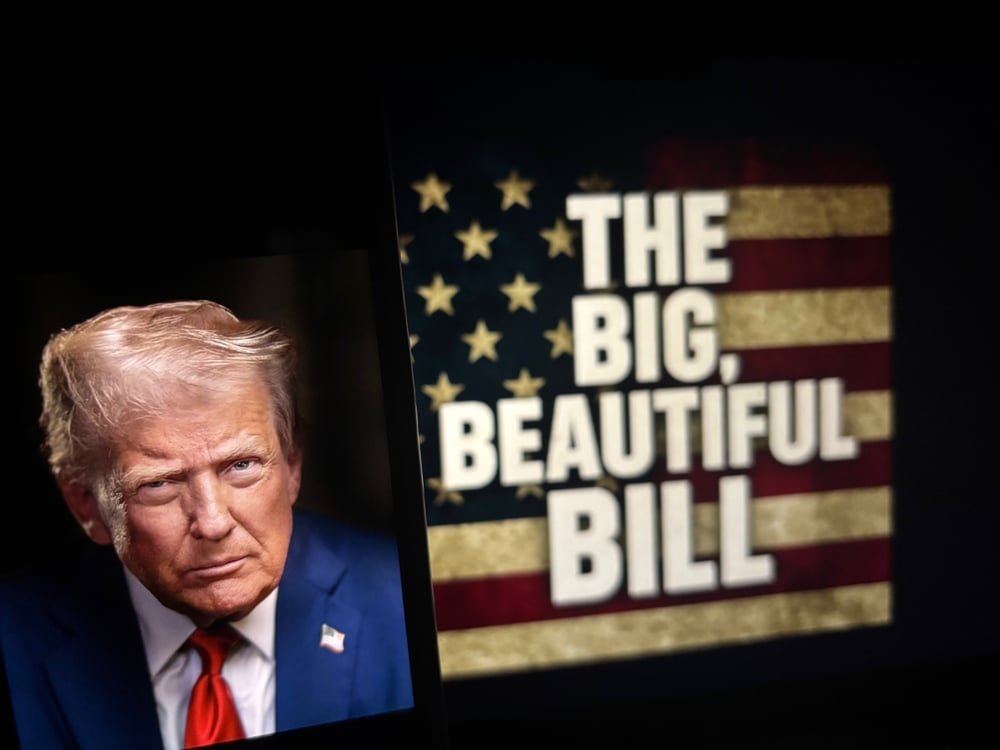
The recently passed President Donald Trump’s “One Big Beautiful Bill Act” (OBBB) by Congressional Republicans is raising alarms among energy and climate experts.
According to a report from Princeton University’s REPEAT Project, the sweeping repeal of Biden-era climate legislation could derail the United States’ path to net zero. The analysis finds that the bill, combined with Trump’s planned executive actions, could lead to more than 7 billion tons of additional greenhouse gas emissions by 2050.
This marks a sharp reversal from current policy momentum under the Inflation Reduction Act (IRA) and the Infrastructure Investment and Jobs Act (IIJA), which helped push the U.S. toward cleaner energy, lower emissions, and affordable electricity.
What the “One Big Beautiful Bill” Does
The OBBB repeals nearly all clean energy tax credits passed under the IRA. These credits supported wind, solar, battery storage, clean fuels, and electric vehicles. The bill also rescinds billions in unspent funding for clean energy projects from both the IRA and IIJA.
Key actions under OBBB include:
- Canceling tax incentives for clean electricity, electric vehicles, and green manufacturing.
- Freezing the use of unspent federal funds for climate programs.
- Repealing EPA emissions standards and DOE efficiency rules.
- Rolling back vehicle fuel economy requirements.
In short, OBBB represents a full-scale retreat from the policies that formed the foundation of U.S. climate action over the last few years, per the report findings.
U.S. Emissions Rise Under the Bill
One of the most serious consequences of the OBBB is its impact on U.S. greenhouse gas emissions. According to the REPEAT Project analysis, the rollback of climate policies under the bill will significantly slow down the country’s progress in reducing emissions.
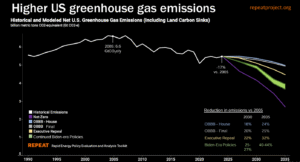
Under current policies—especially the IRA—the U.S. was on track to reduce its emissions to about 38% below 2005 levels by 2030. This was already falling short of the country’s official Paris Agreement target of a 50–52% reduction by 2030. But under the OBBB, this gap widens even further.
The report estimates that emissions in 2030 will be about 190 million metric tons higher than they would be if current climate policies remained in place. To put that into perspective, that’s roughly equal to the annual emissions of the entire state of New York or the combined emissions of over 40 million gasoline-powered cars.
And the gap continues to grow, as the chart above from the report shows. By 2035, annual emissions could be 470 million metric tons higher under the OBBB pathway. This means more pollution from fossil fuels, more climate-related risks like extreme weather, and a greater burden on future efforts to catch up.
Even more alarming, the cumulative emissions added between now and 2050 could reach over 7 billion metric tons of CO₂. That’s more than the total emissions the entire U.S. economy produces in a single year today. These extra emissions would be very difficult—if not impossible—to offset in time to meet net-zero goals by mid-century.
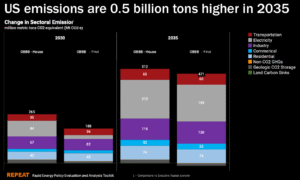
The increase in GHG emissions comes from several sources as a consequence of the new law:
- Less clean electricity
- Slower EV adoption
- Weaker building and appliance standards
- Increased industrial emissions
All these factors combined mean that the U.S. will emit more carbon dioxide and other greenhouse gases than it would have under current climate laws. That means the U.S. would miss its climate pledges under the Paris Agreement, including the nationally determined contribution (NDC) to cut emissions by at least 50–52% by 2030.
Not only that. There are also significant impacts on other areas and sectors involved as follows.
Costs to Households and the Economy
According to the REPEAT analysis, the bill will increase energy costs for American households and businesses. By 2030, total U.S. energy spending will rise by $28 billion annually, and by 2035, that number could exceed $50 billion per year.
For households, that means higher monthly bills:
- An increase of $165 per year in 2030, growing to $280 per year in 2035.
- That’s roughly a 7.5% rise in 2030 and over 13% in 2035 compared to the current policy.
Higher fossil fuel use and slower renewable deployment will lead to more expensive energy systems in the long run.
Clean Energy Development Slows Sharply
The report finds that OBBB will cut cumulative clean energy investment by $500 billion between 2025 and 2035. Solar and wind additions will drop significantly:
- Nearly 29 gigawatts less solar and 43 gigawatts less wind by 2030.
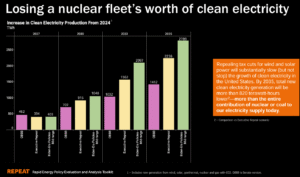
- By 2035, clean energy generation will be 820 terawatt-hours lower—equal to the combined output of today’s entire nuclear or coal fleet.
The result: more fossil fuel reliance, slower energy system modernization, and fewer climate benefits.
- SEE MORE: Clean Energy Beats Fossil Fuel in Historic $3.3T Global Energy Investment in 2025, IEA Report
Battery storage and geothermal will see some growth, but not enough to compensate for the loss of wind and solar momentum. Fossil gas and gas with carbon capture may step in to fill part of the gap, but their emissions profile is still far from net zero.
Electricity Demand Is Rising — But Clean Supply Shrinks
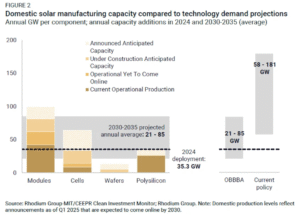
Another concern raised by the REPEAT Project is that electricity demand is expected to grow 25% from 2024 to 2035, driven largely by AI, data centers, and electric vehicles. This makes clean energy capacity even more urgent.
But under OBBB, clean electricity growth slows, while demand keeps rising. That means more coal and gas could be used to meet growing needs, pushing emissions even higher.
Notably, the report reveals that clean electricity generation will be much lower, like “losing a nuclear fleet’s worth of clean power”.
Will Carbon Credits Close the Gap?
The rollback also affects carbon markets. By removing incentives for clean energy and low-carbon technologies, the U.S. may rely more on carbon credits and offsets—if at all. However, experts warn this won’t be enough.
Without federal backing, carbon credit markets may shrink in scale and credibility. The U.S. would lack domestic reductions to balance out emissions, and there’s no guarantee that offsets from abroad would meet the needed quality or volume.
And worse, companies may abandon climate targets if federal policies signal that emissions cuts are no longer a priority.
What Happens Next? A Turning Point in U.S. Climate Policy
While the bill passed both chambers of Congress, legal challenges and regulatory battles are expected. Some state governments may double down on their own clean energy programs to fill the gap. However, state efforts alone likely won’t make up for the national rollback.
REPEAT’s modeling shows that even with favorable market trends, federal policy remains critical to accelerating the clean energy transition. The One Big Beautiful Bill represents a sharp reversal in the U.S. clean energy journey.
For now, the new law’s full impact depends on future elections, legal challenges, and how aggressively states and companies react. But the REPEAT findings leave no doubt: the policy shift under OBBB could be a major setback for U.S. climate leadership.