


Stellantis, the 6th largest automotive firm worldwide, revealed its plan to become carbon net zero by 2038.
The automaker owns 14 different car brands. These include famous ones like Fiat, Chrysler, Dodge, Ram, Jeep, Alfa Romeo, Citroen, Peugeot, and Maserati.
The company seeks to be the industry champion in fighting climate change. It uses its 2021 emissions as a baseline to reduce Scope 1 and 2 by 50% in 2025 and 75% in 2030.
And unlike most auto companies that plan to hit net zero goals by 2050, the automaker aims to achieve it by 2038.
Stellantis 2021 Baseline for Carbon Net-Zero Plan
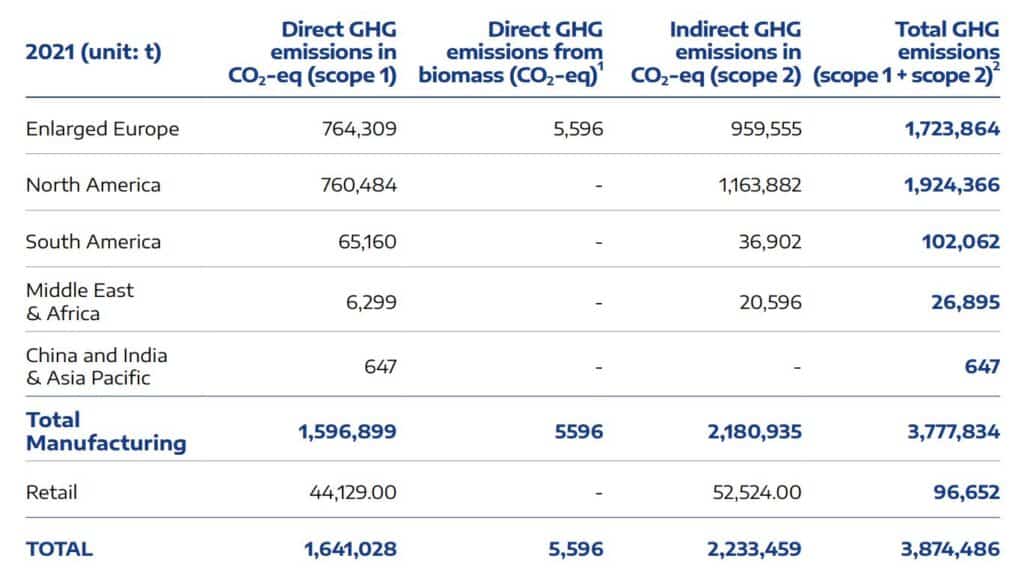
In 2021, Stellantis Scope 1 emissions equal to over 1.6 million tonnes of CO2eq, while Scope 2 emissions amounted to 2.2 million tonnes of CO2eq. This translates to 0.663 tons of CO2eq per vehicle manufactured.
Here is the company’s breakdown of GHG emissions per region for 2021 for more details.
When it comes to tracking and managing its carbon footprint and targets, Stellantis follows the SBTi (Science-Based Target Initiative) method.
For 2021 alone, the automaker’s emissions of CO2 eq for cars sold in Europe only is equal to 136 million tonnes.
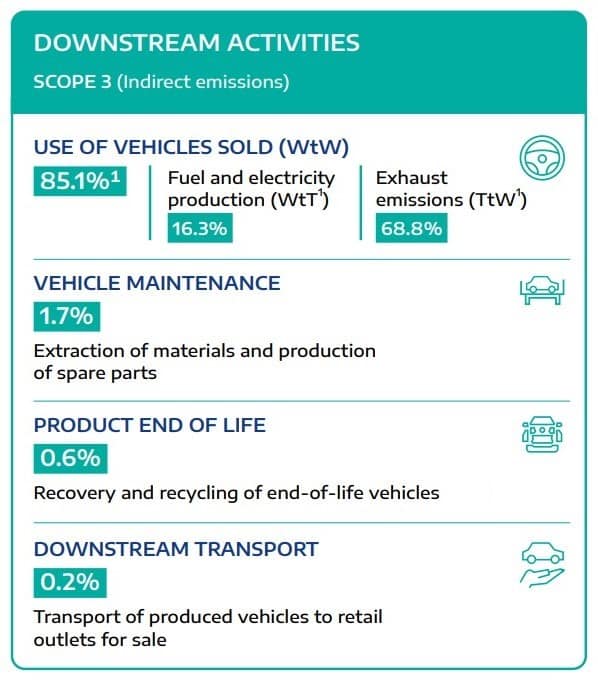
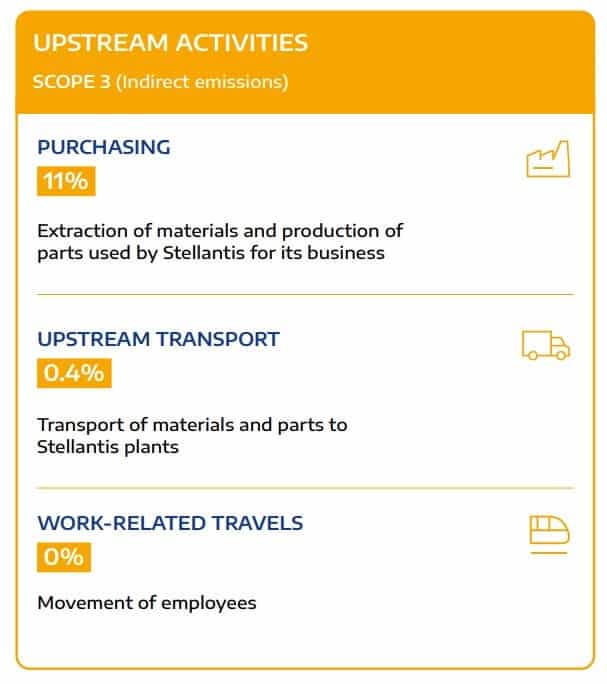
The images below show the firm’s main emission items by activities per emissions scope.

Stellantis’ initiatives in the previous year allowed it to reduce direct emissions (Scope 1 + 2) by 49,924 tonnes of CO2eq. This is equivalent to 8.8 kg of CO2eq per vehicle produced.
For instance, the electrification ramp-up and technical improvements to its cars reduced significant emissions. This particularly involves its battery electric vehicles (BEVs) and low emission vehicles (LEVs).
The LEV models sold in 2021 accounted for 12.8% of passenger cars in Europe and 3.4% (cars and trucks) in the US.
In line with Stellantis’ carbon net-zero target, it plans to make LEV sales become 100% in Europe and 50% in the US in 2030. Likewise, the automaker also aims to have more than 75 BEVs and earn BEV sales of 5 million vehicles by the end of this decade.
For the same year, Stellantis also managed to invest over €6.3 million in energy savings, corresponding to about €1.1 per vehicle produced. It was also able to gain a share of decarbonized electricity of 45%.
Stellantis Carbon Emissions Roadmap
To become carbon net-zero in 2038, the automaker focuses on the following main levers.
Short term 2025:
-
Energy management in all plants
-
Energy-efficient projects
Medium-term 2030:
-
Site compression and improvement of industrial footprint
-
Use and production of renewable energies
Long term 2038:
-
Technical innovations (e.g. Hydrogen, Power to gas)
-
CO2 capture and storage
-
Compensation of residual emissions
In addition, the firm continues to invest in CO2 reduction projects. This entails taking part in major emissions allowance schemes. These include the EU ETS and the Canadian Federal Output-Based Pricing System (OBPS).
Stellantis implemented two distinct internal carbon prices to aid its investments.
The first one refers to the shadow price of carbon. Its purpose is to show industrial climate-related risks and opportunities to guide the firm on which projects to invest in.
The other one is called the internal carbon price. This is to measure the cost efficiency of Stellantis’ technical levers that reduce vehicle emissions.
Finally, to make its reduction efforts run smooth, the firm links its 3 major CSR issues to its net zero ambition. These are:
-
Vehicle CO2 emissions (100% nameplates with BEV offering in EU and US)
-
Industrial and sites carbon footprint (Scope 1 and 2 emissions are net-zero)
-
Carbon footprint of the supply chain: purchasing and logistics
(carbon net-zero per Paris Agreement)
On top of its carbon net-zero plan, Stellantis also aims to double its net revenues to $335 billion by 2030. This and sustain its big profit margins while growing efforts to electrify its cars.