

The U.S. energy landscape is shifting again. Invenergy, one of America’s largest private energy developers, has agreed to end four offshore wind lease projects worth about $765 million and redirect those investments toward natural gas and geothermal energy.
The move comes under a settlement agreement announced by the U.S. Department of the Interior. It aligns with President Donald Trump’s Energy Dominance Agenda, which focuses on expanding reliable domestic energy supplies while reducing dependence on government-supported renewable projects.
Instead of continuing offshore wind development, Invenergy will invest in new natural gas-fired power plants across several states and accelerate geothermal energy projects in the western United States.
Why Invenergy Is Walking Away from Offshore Wind
Under the agreement, Invenergy will voluntarily terminate four offshore wind leases located in the New York Bight, the Central Coast of California, and the Gulf of Maine.
The company will receive a partial reimbursement for the lease payments already made to the federal government. It will then reinvest those funds into energy projects that can begin producing electricity much sooner.
According to the Department of the Interior, the settlement is designed to lower costs, strengthen America’s energy security, and support projects that require less taxpayer assistance. Officials believe shifting investments toward proven technologies can deliver faster returns while improving grid reliability.
Rising Electricity Demand Is Driving Investment
The timing of Invenergy’s strategy reflects a major change in U.S. electricity consumption. Industry forecasts show U.S. electricity demand could increase by 20% to 40% over the next decade, marking the fastest growth in more than twenty years.
Several factors are fueling that increase, including artificial intelligence, cloud computing, advanced manufacturing, electric vehicles, and new industrial facilities.
These industries require large amounts of around-the-clock electricity. As a result, utilities are looking for power plants that can operate continuously and respond quickly when demand spikes.
Invenergy says its investment strategy is focused on projects that can be built on commercially reasonable timelines while delivering reliable and affordable electricity to customers.
- The company has already developed more than 225 energy projects representing approximately 38 gigawatts (GW) of power infrastructure.
- Today, it operates more than 25 GW across North America.
As electricity demand continues to rise, the government is increasingly prioritizing projects that can quickly supply dependable power.
Invenergy Builds on Its Natural Gas Experience
Natural gas already plays a major role in Invenergy’s business.
- The company currently operates 14 natural gas facilities with a combined generating capacity of about 7 GW.
- In 2024, those facilities produced roughly 21,000 gigawatt-hours (GWh) of electricity.
Its portfolio also includes liquefied natural gas (LNG)-powered facilities. One example is the Energía del Pacífico project in El Salvador, which supplies nearly 30% of the country’s total electricity demand.
Invenergy says it continues to develop advanced natural gas technologies, including combined-cycle plants, fast-start peaking units, and LNG-to-power systems that can improve grid flexibility and reliability.
Natural Gas Projects
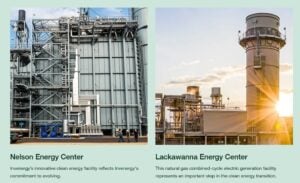
Projects in Pipeline
A large share of Invenergy’s new investment will go toward natural gas power generation. The company plans to develop or expand gas-fired power projects in:
- Indiana
- Wisconsin
- Iowa
- Kansas
- Missouri
These facilities are expected to add significant generating capacity while creating hundreds of construction and long-term operating jobs.
One of the biggest projects is the Sycamore Riverside Energy Center in Sullivan County, Indiana. The planned facility will generate 918 megawatts (MW) using natural gas combustion turbines. It will become Invenergy’s third energy project in the county.
The company announced in April that Indiana Michigan Power (I&M) had already asked the Indiana Utility Regulatory Commission for approval to acquire the project through a Certificate of Public Convenience and Necessity.
Daniel Runyan, Senior Vice President of Development at Invenergy, said reliable and affordable electricity is becoming increasingly important as power demand grows across the country. He added that projects like Sycamore Riverside can help provide consistent electricity for customers while supporting economic growth.
Geothermal Becomes a Second Growth Opportunity
While natural gas will receive much of the new investment, geothermal energy is also becoming an important part of Invenergy’s long-term strategy.
Unlike solar and wind, geothermal plants generate electricity around the clock because they use heat from beneath the Earth’s surface.
Although geothermal currently produces less than 1% of U.S. electricity, the industry is gaining momentum.
New drilling techniques and Enhanced Geothermal Systems (EGS) are enabling developers to access underground heat in areas previously unsuitable for geothermal power generation.
- Invenergy has already secured 44 geothermal leases from the Bureau of Land Management covering approximately 139,000 acres across Nevada, Idaho, California, and Utah.
These projects could significantly expand geothermal generation throughout the western United States over the coming years.
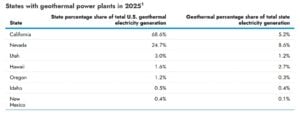
EIA data reveals that currently, geothermal power plants operate in seven U.S. states and generate roughly 16 billion kilowatt-hours (kWh) of electricity, or about 0.4% of total U.S. utility-scale electricity production.
Natural Gas Still Dominates the U.S. Power System
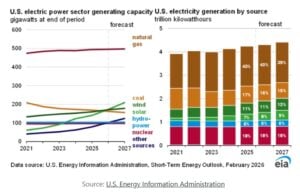
EIA’s Short Term Energy Outlook shows that, despite rapid renewable energy growth, natural gas remains the backbone of the U.S. electricity grid. Today, it accounts for about 42% of America’s installed electricity generation capacity.
- Developers plan to add approximately 6.3 GW of new natural gas-fired generating capacity during 2026.
- About 3.3 GW will come from combined-cycle plants, while another 2.8 GW will use combustion turbines.
- More than 80% of these new projects are scheduled for Texas, Oklahoma, Ohio, Tennessee, and Florida.
- Two of the largest projects are the 1,158-MW Orange County Advanced Power Station in Texas and the 900-MW Trumbull Energy Center in Ohio.
At the same time, natural gas production continues to reach record levels. The United States has become the world’s largest exporter of liquefied natural gas, helping strengthen global energy markets.
Growing LNG exports, increasing gas production from the Permian Basin, expanding manufacturing, and soaring electricity demand from AI data centers are all expected to support long-term natural gas consumption.
However, infrastructure challenges remain. During periods of extreme weather, pipeline constraints can limit supplies available to manufacturers because residential customers receive priority access to natural gas.
A Strategic Shift Toward Reliable Energy
Invenergy’s decision reflects a broader shift in U.S. energy investment priorities.
Rather than pursuing offshore wind projects with uncertain timelines, the company is focusing on energy sources that can deliver electricity sooner while strengthening grid reliability.
By combining expanded natural gas generation with growing geothermal investments, Invenergy aims to meet rising electricity demand while supporting domestic energy security.
As AI, data centers, manufacturing, and electrification continue driving power consumption higher, investments in dependable, large-scale generation are likely to play an increasingly important role in America’s evolving energy mix.