

Tesla (TSLA) is strengthening its clean energy strategy with two major power purchase agreements (PPAs) that will secure renewable electricity for years to come. The electric vehicle giant has signed separate deals with renewable energy developers Zelestra and ContourGlobal, adding large-scale solar and battery storage projects to its growing energy portfolio.
Together, the agreements highlight Tesla’s increasing focus on long-term renewable power as electricity demand rises across its manufacturing operations and energy business. The projects also reflect a broader trend as companies lock in clean electricity supplies to support growing demand from AI, battery manufacturing, and data centers.
Tesla Expands Partnership With Zelestra
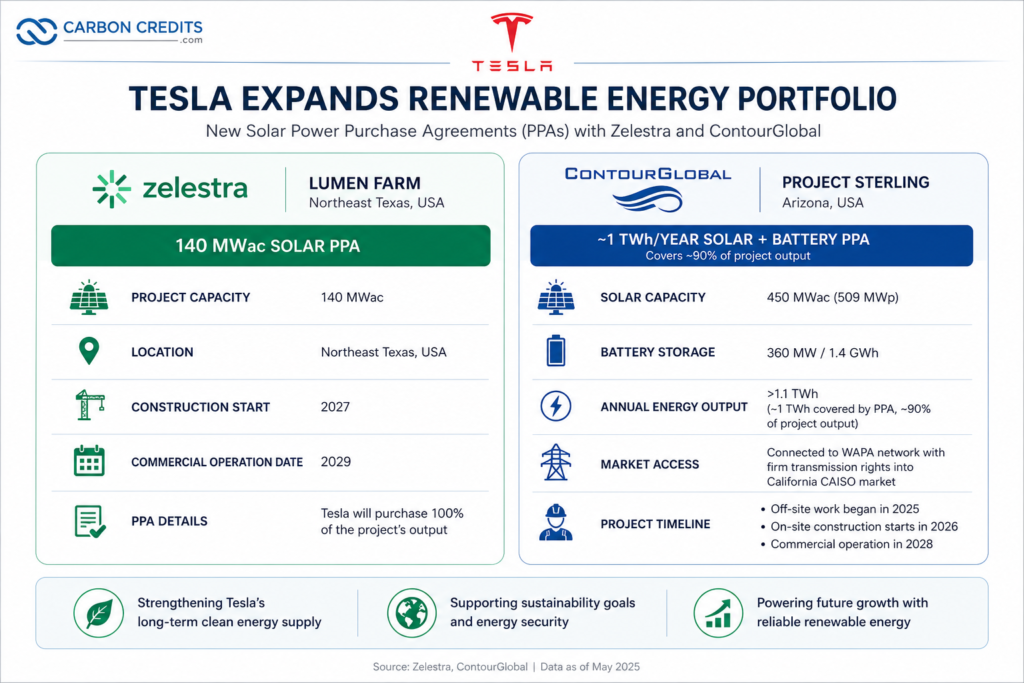
Global renewable energy developer Zelestra has expanded its relationship with Tesla by signing a new power purchase agreement for the entire output of its 140-megawatt alternating current (MWac) Lumen Farm solar project in Texas.
Located in northeast Texas, the project is expected to begin construction in 2027 and reach commercial operation in 2029.
The latest agreement builds on an existing partnership between the two companies. In 2025, Tesla signed a 57 MWac PPA with Zelestra covering electricity from the Brazatortas I, II, and IV solar plants in Spain’s Castilla-La Mancha region.
Phil North, CEO of Zelestra US, said the company is pleased to bring its partnership with Tesla to the United States.
He noted that Zelestra can provide customized renewable energy solutions across multiple countries and aims to bring the Texas project online as quickly as possible to support Tesla’s growing electricity needs.
The agreement also strengthens Zelestra’s expanding presence in the United States, where the company is developing more than 16 gigawatts (GW) of renewable energy projects.
Tesla Signs One of America’s Largest Solar-Plus-Storage PPAs
Tesla has also secured another significant renewable energy contract with ContourGlobal.
The companies signed a long-term PPA for Project Sterling, a massive hybrid solar and battery storage facility located in Arizona. The agreement covers approximately 1 terawatt-hour (TWh) of renewable electricity each year, representing about 90% of the project’s annual power output.
According to ContourGlobal, Project Sterling is one of the largest corporate solar-plus-storage PPAs ever signed in the United States from a single project.
- The project combines 450 MWac (509 MWp) of solar capacity with a 360 MW/1.4 GWh battery energy storage system.
- Once operational, it is expected to generate more than 1.1 TWh of renewable electricity annually.
- The battery will store excess daytime solar power and supply electricity during peak demand, improving grid reliability.
Project Sterling is connected to the Western Area Power Administration (WAPA) transmission network and has firm transmission rights into California’s CAISO market, ensuring reliable renewable power for Tesla.
ContourGlobal acquired the project in late 2024 and redesigned it to meet Tesla’s energy needs. Off-site construction and equipment procurement began in 2025, with on-site construction planned for 2026 and commercial operations expected in 2028.
Battery Storage Is Becoming a Bigger Growth Driver
The PPAs also align with Tesla’s rapidly expanding energy business.
While Tesla remains best known for electric vehicles, its energy storage division has become one of its fastest-growing businesses.
- During its latest quarter, Tesla deployed a record 13.5 GWh of battery storage systems, driven largely by demand for its Megapack products.
Megapacks allow utilities and businesses to store electricity generated by solar and wind projects. The systems improve grid stability, reduce dependence on fossil fuel generation, and help renewable energy operate around the clock.
As more companies seek reliable clean electricity, battery storage is becoming an essential part of new renewable energy projects.
Why Long-Term Renewable Contracts Matter
Power purchase agreements have become a preferred strategy for large corporations looking to secure stable electricity prices while reducing carbon emissions.
Unlike buying electricity on the open market, long-term PPAs provide predictable energy costs over many years. They also encourage developers to finance and build new renewable energy projects.
For Tesla, these agreements support multiple business priorities.
They provide renewable electricity for manufacturing facilities and energy operations, reduce exposure to fluctuating electricity prices, and strengthen the company’s long-term sustainability strategy.
Can Clean Energy Investments Lift TSLA Stock?
Market analysts also view the deals as a positive development for Tesla’s investment outlook.
Although the agreements are unlikely to have a significant short-term impact on earnings, they reinforce Tesla’s expanding energy business and reduce long-term operational risks. The PPAs also support the company’s environmental commitments while providing reliable electricity for future growth.
Nonetheless, Tesla’s stock has declined nearly 30% year-to-date amid concerns that its significant investments in new technologies could weigh on near-term profitability.

Rising Data Center Demand Is Reshaping the Power Market
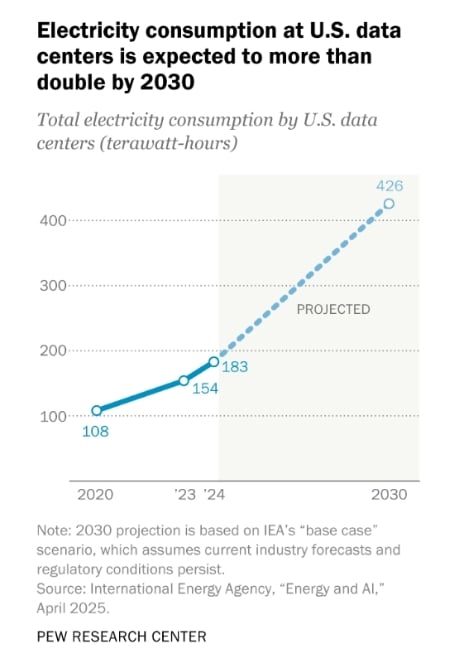
Tesla’s latest renewable energy deals come at a time when electricity demand is rising rapidly, especially from AI infrastructure and data centers.
Industry forecasts estimate that global data center electricity demand could require as much as 219 GW of additional generating capacity over the next five years—enough to power roughly 180 million U.S. homes.
The U.S. Department of Energy projects that data centers could account for 12% of total U.S. electricity consumption by 2030.
In scenarios with strong clean energy policies, renewable sources such as solar and wind could supply 60% to 90% of data center electricity by 2035.
This growing demand has pushed major technology companies, including Meta, Google, and Microsoft, to sign long-term renewable energy agreements that secure clean electricity while protecting against future energy price increases.
Solar Leads America’s Clean Energy Expansion
The broader U.S. renewable energy market continues to grow at record speed.
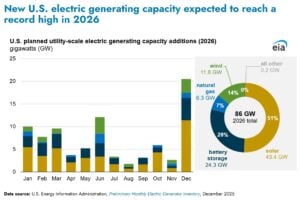
According to the U.S. Energy Information Administration (EIA), developers plan to add 86 GW of new utility-scale generating capacity in 2026—the largest annual increase ever recorded if completed as planned.
- Solar will account for 43.4 GW, or 51%, of all planned capacity additions. Battery storage will contribute 28%, while wind projects will make up another 14%.
Texas remains the country’s largest solar market and is expected to account for about 40% of all new utility-scale solar capacity scheduled for completion in 2026. Arizona and California also continue to attract significant renewable energy investment.
One of the largest planned projects is the 837 MW Tehuacana Creek 1 Solar and Battery Energy Storage System in Texas, which will also include 418 MW of battery storage.
Clean Energy Partnerships Continue to Grow
Tesla’s agreements with Zelestra and ContourGlobal demonstrate how corporate renewable energy procurement is evolving beyond standalone solar projects.
Developers are increasingly pairing large-scale solar with battery storage to deliver more reliable electricity throughout the day. At the same time, long-term PPAs are helping companies secure affordable clean power while supporting new renewable energy investment.
As electricity demand accelerates from AI, manufacturing, and electrification, agreements like these are likely to become an even more important part of corporate energy strategies. For Tesla, they strengthen both its expanding energy business and its long-term commitment to operating on renewable power.