


The UK and US are expanding their partnership on fusion energy, with a focus on artificial intelligence (AI), advanced computing and simpler rules for developing fusion plants. The agreements were announced at the Global Fusion Policy Summit in London on September 14, 2026.
The partnership links the UK Atomic Energy Authority (UKAEA) with the US Department of Energy’s Princeton Plasma Physics Laboratory (PPPL). The two countries will also work together on fusion safety and regulation.
The move comes as both countries step up spending on fusion and try to turn decades of research into working power plants.
The UK has committed more than £2.5 billion to fusion over five years. The US has set out a plan aimed at supporting pilot plants and commercial fusion power in the mid-2030s.
AI Could Speed Up Fusion Research
One part of the partnership will link two advanced computers: the UKAEA’s SUNRISE supercomputer and PPPL’s STELLAR-AI system.
The planned SUNRISE–STELLAR-AI Federation will allow researchers in both countries to train AI models using data from fusion experiments. The goal is to improve reactor designs, better understand plasma, and speed up research.
The UK has committed £45 million to SUNRISE. The system is expected to use about 1.4 megawatts of power and become one of the world’s most powerful computers focused on fusion research.

Researchers could also use these systems to create digital twins of fusion plants. These virtual models allow engineers to test designs and changes before trying them on real equipment. This could save time and reduce the cost of testing.
The partnership also creates an interesting link between AI and fusion. AI needs large amounts of electricity, while fusion could eventually provide steady, low-carbon power for data centers and other energy-intensive industries.
Both Countries Want Clearer Fusion Rules
The UK and US also want closer cooperation on fusion regulation and safety standards. The two countries said they will work toward rules that reflect the different risks of fusion compared with traditional nuclear fission.
Clear rules matter because fusion plants will require billions of dollars in investment. Developers need to know how projects will be licensed and operated before they can commit large amounts of money.
The UK has already created a dedicated regulatory framework for fusion. It is also developing a Fusion National Policy Statement and a new market framework for future fusion plants.
Minister for Energy, Michael Shanks, stated:
“By strengthening our partnership with the US, we’re accelerating the race to commercial fusion, turning cutting-edge research into economic growth and cementing Britain’s position as a world leader in fusion energy.”
The US is also working to speed up its approval process as private fusion companies move closer to commercial projects. FCDO Minister for the Americas, Chris Elmore, said:
“By bringing together world-leading expertise in fusion, artificial intelligence and advanced computing, we’re helping British businesses and researchers access the investment, knowledge and international partnerships needed to succeed in the industries of the future.”
Britain Bets £1.3 Billion on Its 2040 Fusion Plant
The UK’s main project is STEP Fusion, a prototype power plant planned for West Burton in Nottinghamshire. The plant is expected to begin operating in 2040. It is designed to show that a fusion plant can produce net electricity for the grid and make its own tritium fuel.
The UK has allocated £1.3 billion for the next stage of STEP. The wider five-year fusion programme also includes £180 million for the LIBRTI programme, which is working on tritium fuel, and £110 million for industry support and commercialization.

The UK government estimates the global fusion market could be worth between £3 trillion and £12 trillion by the end of the century.
US Targets Commercial Fusion in the 2030s
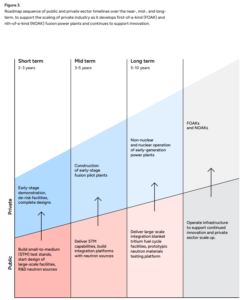
The US has set a faster target. The Department of Energy’s Fusion Science and Technology Roadmap, finalized in June 2026, aims to support pilot plants and commercial fusion power in the mid-2030s. It covers research, technology, infrastructure, skills, and commercial development.
The US plan is also designed to support the growing private fusion industry.
Private companies are developing several different fusion technologies, including magnetic and inertial fusion. The UK-US partnership could help these companies access more research, computing power, and technical expertise.
Tritium Could Be Fusion’s Biggest Fuel Challenge
Fusion works by joining light atoms at extremely high temperatures. This releases energy without burning coal, oil, or gas.
That means fusion does not create CO2 from fuel combustion during operation. It also has a potential advantage over wind and solar: fusion plants could produce power continuously instead of depending on weather.
That makes fusion a possible source of firm, low-carbon electricity for future power grids. But commercial fusion power does not yet exist at scale.
Scientists and engineers still need to solve major challenges. These include keeping the plasma stable, protecting reactor parts from intense radiation, producing enough fuel, and operating reactors reliably for long periods.
- One of the key problems is tritium, a radioactive form of hydrogen.
Many planned fusion systems will use a mixture of deuterium and tritium as fuel. Future plants therefore need a reliable way to produce and recover tritium during operation.
The UK’s LIBRTI programme is working on this challenge. Its goal is to develop systems that can produce enough tritium to support future fusion reactors. Solving this problem will be important before fusion can become a large commercial energy source.
A New Fusion Industry Is Taking Shape in Britain
The partnership comes as electricity demand is rising from data centers, manufacturing, electric vehicles and other technologies. Renewable energy could provide much of the new clean electricity, but power systems also need reliable generation, storage and stronger grids.
Fusion could eventually work alongside wind and solar by providing steady low-carbon power. It is not a replacement for renewable energy today.
The technology still needs to prove that it can produce electricity reliably and at a competitive cost. For now, the focus is on research, testing, and demonstration projects.
The UK is also working with companies and research groups on materials and other parts needed for future reactors. A separate £2.63 million project involving the University of Birmingham, the Electric Power Research Institute and industry partners will study fusion reactor shielding materials.
Japan’s Kyoto Fusioneering has also committed up to £3 million to Project ALBION, which supports materials development for STEP. These projects can help build a supply chain before commercial fusion plants are ready.
The Race Now Moves From the Lab to the Grid
Fusion has spent decades in the research stage. That is now starting to change. Fusion is moving from basic research toward commercial development.
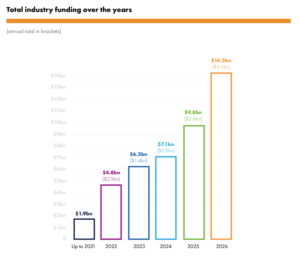
Private fusion companies have raised a cumulative total of $14.24 billion globally as of July 2026, according to the Fusion Industry Association. Private funding has grown sevenfold since 2021, showing how quickly investor interest is increasing.
Governments are also putting more money into pilot plants, while private companies are raising capital to develop commercial systems.
The UK-US partnership tackles several of the main barriers at once. AI and supercomputers could speed up research. Shared rules could make future projects easier to approve. Cooperation could also help companies develop common technologies and standards.
For the energy transition, the potential is large: a reliable, low-carbon power source that could eventually help meet rising electricity demand from AI, industry, and electrification.
The next milestone will be turning these partnerships and research programmes into working pilot plants—and proving that fusion can move from the laboratory to the power grid.