


Alphabet’s latest quarterly results tell a powerful story. Google is accelerating its artificial intelligence push at historic speed, but that momentum is colliding with the hard physics of energy, emissions, and infrastructure limits. The company is scaling AI faster than any previous technology cycle—yet keeping emissions in check is becoming more complex and uncertain.
This tension between explosive AI growth and ambitious climate goals defines Google’s next decade.
Alphabet’s Blockbuster Quarter Signals a New AI Era
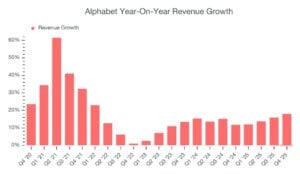
Alphabet closed 2025 with one of its strongest quarters ever. Revenue surged nearly 18% year over year to $113.8 billion, beating analyst expectations. Earnings per share also exceeded forecasts, and net income jumped almost 30%.
Advertising remained the company’s largest revenue driver, while Google Cloud continued its breakout growth. However, YouTube advertising slightly missed expectations, partly due to weaker comparisons against election-driven ad spending in 2024.
The biggest headline, though, came from Alphabet’s spending plans. The company expects $175–$185 billion in capital expenditures in 2026, more than double its recent annual spend. Most of that money will go toward AI infrastructure, cloud capacity, and strategic investments.
This marks one of the largest corporate infrastructure spending waves in tech history.

Gemini and AI Are Reshaping Google’s Core Business
Google’s AI ecosystem is expanding rapidly across products, platforms, and enterprise services.
Gemini now has over 750 million monthly active users, reflecting massive adoption across search, productivity tools, and developer platforms. Google claims it reduced Gemini’s serving costs by 78% in 2025 through optimization and better infrastructure utilization—highlighting how scale economics are starting to kick in.
Search, YouTube, and Cloud are Increasingly AI-driven:
Google’s main businesses performed strongly.
- Search revenue reached around $63 billion, beating analyst expectations.
- YouTube ads earned $11.38 billion, up from $10.47 billion a year earlier.
- Google Cloud stood out with $17.66 billion, growing nearly 48%.
- Subscriptions, platforms, and devices added another $13.58 billion.
AI is driving much of this growth. Search usage hit record levels as new conversational AI features let people ask longer, more interactive questions. Enterprise adoption of AI is also rising fast. Millions of Gemini Enterprise seats were sold in just a few months, showing strong demand for AI tools across industries.
Waymo Expands Autonomous Ride Services
The earnings report also mentioned that Waymo raised its largest investment to date and continues strong growth, providing over 400,000 rides weekly with safety as a priority.
In December, it surpassed 20 million fully autonomous trips and recently launched service in Miami, with plans to expand across the US, UK, and Japan, including airports and freeways.
- ALSO READ: Alphabet (Google) Surpasses Apple in Value: But How About Their Climate Ambitions and Progress?
Full-Year Context
Annual revenue topped $400 billion for the first time, driven by AI momentum like Gemini processing over 10 billion tokens per minute. Operating income was $35.93 billion for the quarter, with net income at $34.46 billion
The broader strategy is clear: AI is becoming the growth engine across Google’s entire stack, from consumer products to enterprise platforms.
GOOGL Stock Reacts to AI Spending Plans
Alphabet Inc. (GOOGL) shares fell slightly to $331.25, down 0.54% on high trading volume of 87 million shares. The stock moved after Alphabet’s earnings were out. It’s up 18% year over year.
Investors are watching the company’s $175–185 billion AI spending plan for 2026, which is driving short-term volatility. Analysts remain positive, with a price target of $344 and a “Strong Buy” rating.
The Hidden Cost: Exploding Energy Demand
Behind this AI expansion lies a massive infrastructure footprint. Training and running large AI models require enormous computing power, and that translates directly into electricity consumption.
Google openly acknowledges that AI is driving non-linear growth in energy demand. Unlike traditional digital services, AI workloads scale unpredictably, especially with the rise of multimodal models, agentic systems, and real-time inference.
This uncertainty makes forecasting emissions trajectories far more difficult. Even with efficiency gains, absolute electricity demand is rising sharply.
Let’s take a closer look at Google’s sustainability progress and see the full picture behind its climate efforts.
Google’s Sustainability Moonshot Under Pressure
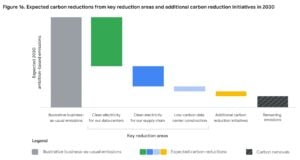
Google’s climate ambition is among the most aggressive in corporate history. The company aims to cut combined Scope 1, 2, and 3 emissions by 50% by 2030 compared with 2019 levels. Its long-term goal remains net zero across operations and value chains.
There has been real progress:
- Scope 1 emissions declined 8% in 2024.
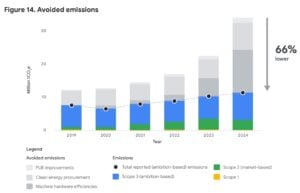
- Scope 2 emissions dropped 11% through clean energy procurement.
- Data center energy emissions fell 12% due to new carbon-free power projects.
These gains are notable because Google’s electricity consumption grew 27% in a single year. Decoupling growth from emissions is one of the hardest challenges in corporate decarbonization, and Google has partially achieved it.
But the bigger problem sits outside operational emissions.
Scope 3 Emissions: The Biggest Hurdle
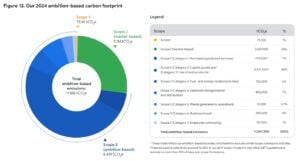
Google’s total ambition-based emissions reached 11.5 million tCO₂e in 2024, up 11% year over year and 51% above its 2019 baseline. The main driver is supply chain emissions—Scope 3—which rose 22% year over year.
These emissions come from hardware manufacturing, construction materials, logistics, and third-party services. As Google builds more data centers and buys more AI hardware, supply chain emissions rise almost automatically.
This creates a paradox: AI expansion increases Scope 3 emissions faster than operational decarbonization can offset them.
Data Center Construction: A Growing Carbon Challenge
One of the fastest-growing emission sources is data center construction. Embodied carbon from steel, concrete, and heavy machinery is becoming a significant part of Google’s footprint.
In 2024, data center construction emissions reached 1.6 million tCO₂e, accounting for 19% of Google’s ambition-based Scope 3 emissions. That figure is expected to rise as AI-driven data center expansion accelerates.
Google is responding with several strategies:
- Standardized data center designs to reduce material use
- Low-carbon concrete and steel to cut embodied emissions by up to 40%
- Electrified construction equipment powered by clean electricity
- Improved space efficiency to maximize infrastructure utilization
These measures can reduce carbon intensity, but they cannot fully offset the scale of new construction.

Policy and Regional Constraints Add Complexity
The company also highlights that policy uncertainty is a major risk. Changes in climate and energy regulations can affect project timelines, costs, and investment decisions.
Regional constraints are equally critical. Many Asia-Pacific markets—key growth regions for Google—lack sufficient carbon-free electricity. Land scarcity, weak renewable resources, and high construction costs make clean energy deployment difficult.
This means AI-driven growth in Asia could significantly increase emissions unless grid decarbonization accelerates.
Google’s Dilemma: AI vs Net-Zero Equation
Alphabet is not an outlier. Every major AI company is facing the same trade-off. AI is becoming core infrastructure for the global economy, but its energy footprint is massive and rising.
Thus, the real question is whether corporate decarbonization can keep pace with AI-driven growth. Three structural tensions stand out:
- Infrastructure Scale vs Emissions Targets: AI requires massive data center buildouts, which drive Scope 3 emissions.
- Energy Demand vs Clean Power Supply: Electricity consumption is growing faster than carbon-free power deployment.
- Corporate Action vs Systemic Constraints: Many challenges, like grid capacity, policy frameworks, and supply chains, are beyond Google’s direct control.
Google’s disclosures offer a rare, transparent look into the carbon cost of the AI revolution. They highlight a broader reality: decarbonizing digital infrastructure is far harder than decarbonizing traditional IT services.
Can it Still Hit Its 2030 Climate Target?
As said before, the tech giant remains committed to cutting emissions by 50% by 2030, and the Science Based Targets initiative has validated its targets. But the path is increasingly narrow.
Operational emissions are trending downward, which is encouraging. The challenge is Scope 3 emissions tied to hardware, construction, and suppliers. Without systemic supply chain decarbonization, absolute emissions could continue rising—even if Google becomes more efficient per unit of compute.
However, its net-zero ambition is still alive, but it now depends as much on global energy systems, policy frameworks, and supply chains as on its own technology and investments.
Aggressive Investment in Carbon-Free Energy
It is investing heavily in clean energy, low-carbon materials, and carbon removal while simultaneously scaling AI faster than any previous technology wave.
Some steps include signing pioneering corporate deals for advanced geothermal and small modular nuclear reactors. The company is also using AI to speed up grid interconnections and optimize power purchasing.
In 2024, Google achieved in nine of its 20 data center grid regions. That’s a significant milestone, but it still falls short of its 24/7 carbon-free energy ambition.
Boosting Carbon Removals
Google is also expanding its carbon removal portfolio. In 2024, it signed 16 new offtake agreements worth over $100 million, bringing its total removal portfolio to around 782,400 tCO₂e.
That is a 14-fold increase from 2023, but it is still tiny compared to millions of tonnes of annual emissions. Carbon removal is a long-term tool, not a near-term solution.
All in all, Alphabet’s Q4 results show a company entering a new phase of AI-driven growth. The planned $185 billion annual infrastructure spend underscores how central AI is to Google’s future.
But the sustainability story is becoming more complex. The next decade will test whether AI can scale sustainably—or whether the world’s most advanced tech companies will struggle to keep their climate promises in the age of artificial intelligence.