


TeraWulf Inc. (Nasdaq: WULF) saw its stock surge after Google deepened its investment in the data center operator and bitcoin miner. The company said that the move not only raised Google’s financial backing but also strengthened TeraWulf’s position as a growing force in the booming artificial intelligence (AI) and high-performance computing (HPC) market.
Google Doubles Down on TeraWulf, Sending WULF Stock Soaring
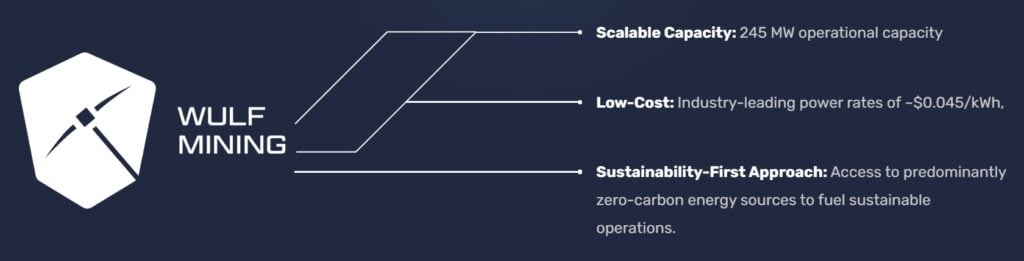
Shares of TeraWulf gained more than 4% after the company announced that Google increased its stake to 14% from 8%, alongside a fresh $1.4 billion backstop commitment. This brings Google’s total support for the company to $3.2 billion.
The deal gives Google warrants to buy an additional 32.5 million shares, further solidifying the partnership between the tech giant and the fast-rising digital infrastructure operator. Earlier in the session, TeraWulf shares had spiked by over 10% before settling higher.

Analysts See a Strong Signal
In Q2 2025, TeraWulf’s revenue jumped 34% year-over-year to $47.6 million, boosted by a stronger bitcoin price and expanded mining capacity.
At the same time, expenses also climbed, with revenue costs (excluding depreciation) rising 59% to $22.1 million, mainly from higher infrastructure use and increased power costs in Upstate New York.
Even with these added expenses, TeraWulf’s growth path and shift toward AI infrastructure have fueled investor optimism. The WULF stock has surged nearly 90% in the past week.
Analysts view Google’s larger stake as a strong show of confidence. By providing financial backing and equity exposure, C reduces risks tied to financing or project delays—giving TeraWulf a clear edge as it scales.
What’s Inside TeraWulf’s $6.7 Billion Locked-In Revenue?
With the expansion, TeraWulf’s contracted revenue now stands at $6.7 billion, with the potential to reach $16 billion if lease extensions are exercised. This represents one of the largest financial commitments in the sector, signaling growing investor confidence in the company’s long-term strategy.
The boost comes at a critical time as demand for AI-ready data center space accelerates. TeraWulf is emerging as one of the few companies capable of delivering large-scale, low-carbon infrastructure tailored for AI workloads.
Strategic Expansion at Lake Mariner
The latest investment will fund CB-5, a new data center building at TeraWulf’s Lake Mariner campus in Western New York. The facility will add 160 MW of critical IT load, with operations expected to begin in the second half of 2026.
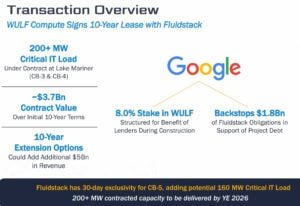
The expansion builds on TeraWulf’s previously announced agreements with AI cloud provider Fluidstack, under which it is delivering more than 200 MW of AI-optimized capacity at the same campus. With CB-5 included, Fluidstack’s total contracted IT load at Lake Mariner jumps to 360 MW, making it one of the largest HPC campuses in the U.S.
TeraWulf and Fluidstack are also in talks about even more expansions, signaling that Lake Mariner could continue to scale beyond current projections.
TeraWulf CEO Paul Prager said in the press release,
“This expansion underscores the unmatched scale and capabilities of the Lake Mariner campus. By adding CB-5, we are not only increasing our contracted capacity with Fluidstack, but also further deepening our strategic alignment with Google as a critical financial partner in delivering the next generation of AI infrastructure.”
He further added,
“This expansion not only scales our contracted platform but reinforces TeraWulf’s leadership in the AI and HPC infrastructure ecosystem, delivering globally competitive, sustainable, and scalable compute solutions.”
Also, Nazar Khan, Chief Technology Officer of TeraWulf, said,
“Fluidstack’s decision to expand so soon after our initial agreement speaks volumes about the quality, readiness, and scalability of our infrastructure. Like the prior buildings, CB-5 will be purpose-built for high-density, liquid-cooled workloads, leveraging Lake Mariner’s dual 345 kV transmission lines, sustainable water cooling, and ultra-low-latency connectivity. And with the scale, resources, and infrastructure we have in place, there is significant potential for even further expansion with Fluidstack as their compute requirements continue to grow.”
Fluidstack Partnership Fuels Growth
Earlier this month, TeraWulf signed two 10-year deals with Fluidstack, a premier AI cloud platform, to supply more than 200 MW of compute capacity. These contracts are expected to generate $3.7 billion in revenue over the initial term, with potential extensions pushing the total to $8.7 billion.
The first phase of this project will deliver 40 MW by the first half of 2026, with full deployment completed the following year. By aligning with Fluidstack, TeraWulf is repositioning itself as a major player in AI infrastructure while maintaining its strong bitcoin mining roots.
TeraWulf’s Shift: From Bitcoin Mining to AI Infrastructure
The CB-5 project is TeraWulf’s next major step in the fast-growing AI and HPC market. With support from Fluidstack and Google, the expansion helps the company scale quickly while staying true to its zero-carbon energy plan. It also boosts TeraWulf’s role in the AI computing space.
TeraWulf designed CB-5 to deliver both efficiency and reliability. The project moves the company closer to its goal of providing scalable, sustainable, and globally competitive computing power. Each milestone proves its strong execution and leadership in the sector.
As AI demand grows and energy supplies tighten, this model stands out. At the top, the recent stock rally shows rising market confidence in its strategy.
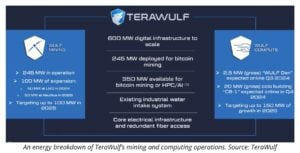
Thus, once known mainly for large-scale bitcoin mining, TeraWulf is now shifting toward AI-focused infrastructure. This showcases a larger industry trend, where miners diversify into AI and HPC data centers to secure steady revenue streams.
Energy Costs Highlight the Challenge
AI data centers cost far more to build than mining sites. Bitcoin mining averages about $500 per kilowatt hour, while AI and HPC centers range from $5,000 to $8,000 per kilowatt hour.
Unlike bitcoin mining, which can adjust power use, AI and HPC facilities require a steady 400–500 MW of uninterrupted energy. This demands heavy investment not only in computing hardware but also in backup systems to ensure reliability.
Speaking with Cointelegraph, CTO Nazar Khan emphasized that electrical load flexibility is critical for long-term success. Bitcoin miners can shift power usage every 10 minutes to help balance the grid. In contrast, AI centers run nonstop and depend on backup generators to avoid downtime.
Khan also noted that many utility providers struggle to meet such massive energy needs. He added that operators who strategically integrate these large loads will succeed, while those who scale without proper planning may fail to grow as expected.
On the other hand, with soaring demand for AI infrastructure, tech giants are racing to secure carbon-free power. Google, for example, struck a deal with Kairos to build a small modular reactor by 2030.
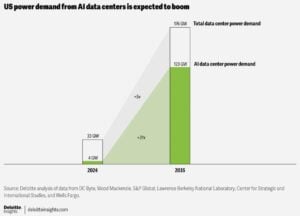
All in all, this shift underscores the energy challenges of AI data centers and how TeraWulf is well-positioned to leverage low-carbon power. With backing from Google, billion-dollar Fluidstack contracts, and Lake Mariner expansion, TeraWulf is emerging as a frontrunner in the HPC race.