

The recent merger talks between two mining giants—Glencore and Rio Tinto—signal a major shift in the global market. The merger, though now discontinued, was a strategic move aimed at creating a powerhouse focused on electric metals crucial to the global low-carbon economy.
These metals, including copper, nickel, and cobalt, are key components in the development of electric vehicles (EVs), renewable energy infrastructure, and other clean technologies that are central to the global energy transition.
The Strategic Merger Discontinued: But Climate Commitments Persist
Glencore and Rio Tinto recently engaged in months-long merger talks, signaling a shift in Rio’s previously cautious approach to mega-deals. A decade after Rio rejected Glencore’s proposal, the mining giants revisited discussions amidst an industry-wide push for consolidation in energy transition metals.
Changes in leadership, strategy, and market dynamics—alongside pressure from BHP’s bold moves—catalyzed these talks. Although the discussions are currently inactive, Rio’s openness to Glencore highlights evolving priorities as both companies adapt to global decarbonization demands.
The news fuels speculation of an impending wave of mergers and acquisitions across the mining sector.
The potential merger between Glencore and Rio Tinto is more than just asset consolidation. It is also about positioning both companies at the forefront of the green energy revolution.
The focus was on strengthening their leadership in the production of essential transition metals like copper and nickel. These metals are vital for EV batteries, renewable energy storage, and electrified transportation networks. As the world moves towards electrification, ensuring a sustainable, reliable supply of these metals is important.
Both companies share a commitment to the goals of the Paris Agreement. Together, they pledged to reduce their carbon emissions and ensure that their efforts to supply clean energy solutions won’t contribute to the environmental challenges they seek to address.
Glencore’s Commitment to Electric Metals and Decarbonization
Glencore has long been a leader in mining and is heavily invested in producing metals crucial for the transition to a low-carbon future. The company focuses on metals like copper, nickel, and cobalt, which are integral to the electrification of the world’s infrastructure.
With the global rise in electric vehicle production and the expansion of renewable energy sources, Glencore’s strategic approach centers on securing a stable and sustainable supply of these key transition commodities.
A standout focus is on nickel, which is used extensively in EV batteries. As the demand for EVs continues to surge, Glencore has committed to increasing its nickel production.
In its 2024-2026 Climate Action Transition Plan (CATP), Glencore outlined ambitious plans to achieve net-zero Scope 1 and 2 emissions by 2050. The plan incorporates a range of strategies aimed at reducing emissions across its operations while ensuring the continued availability of critical metals, with the following target based on 2019 baselines:
- 2026: 15% reduction in Scope 1, 2, and 3 CO₂e emissions by end-2026.
- 2030: 25% reduction by end-2030 (new interim target added based on stakeholder feedback).
- 2035: 50% reduction by end-2035.
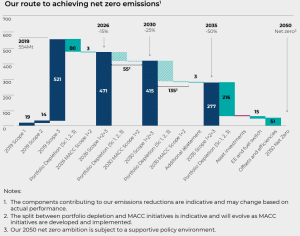
Glencore’s net-zero emissions strategy prioritizes reducing emissions while using carbon credits for residual emissions, aligned with the Paris Agreement. As seen below, the mining giant’s footprint in 2023 has increased from 2022 but is 22% less than 2019 levels.
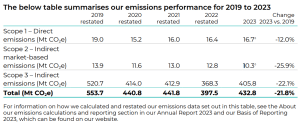
Glencore’s approach to decarbonization extends beyond just emissions reduction. It is also focused on transitioning its entire industrial portfolio to support the global energy transition. The company has committed to a holistic decarbonization strategy that includes reducing its combined Scope 1, 2, and 3 emissions.
Rio Tinto’s $6 Billion Decarbonization Pledge
Similarly, Rio Tinto has long recognized the importance of electric metals in the global transition to clean energy. The company has significantly ramped up its production of copper and lithium—two metals that are pivotal for EV batteries and renewable energy storage.
The world’s second-largest metals and mining corporation also aims to reach net zero emissions by 2050, with this roadmap:
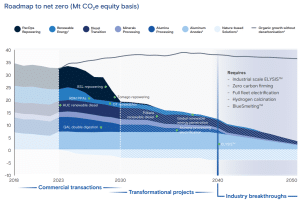
In January 2025, Rio Tinto announced the establishment of a standalone lithium division, following its $6.7 billion acquisition of Arcadium Lithium. This move solidified Rio Tinto’s position as the 3rd-largest global producer of lithium vital for the development of high-capacity batteries.
The company’s strategy is aimed at meeting the accelerating demand for electric metals as more countries commit to electrification.
Like Glencore, Rio Tinto has committed to ambitious decarbonization goals. The company aims to reduce its Scope 1 and 2 emissions by 15% by 2025 and by 50% by 2030.
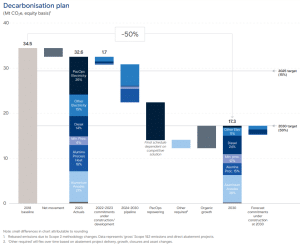
To achieve these targets, Rio Tinto has pledged $5–6 billion in decarbonization initiatives, focusing on energy transition efforts, renewable energy adoption, and advancements in clean technologies for mining processes.
In 2023, the company spent $425 million on decarbonization projects, including transitioning mining equipment to renewable energy sources and repowering its aluminum operations. For the same year, the miner’s Scope 1 and 2 emissions totaled 32.6 Mt CO2e, a 6% reduction from the 2018 baseline of 34.5 Mt CO2e and slightly below the adjusted 2022 figure of 32.7 Mt CO2e.
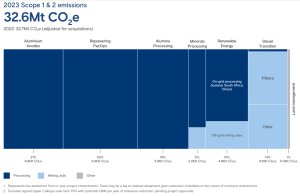
The company’s emissions abatement projects outpaced growth from higher production, leading to a minor decrease on a like-for-like basis. However, emissions were slightly higher than the actual 2022 total of 32.3 Mt CO2e due to recent acquisitions of additional equity.
Future Prospects: Meeting the Rising Demand for Clean Energy Materials
Although merger talks between Glencore and Rio Tinto were ultimately discontinued in January 2025, both companies remain key players in the global mining and energy transition sectors. Their strategies continue to strengthen their positions in the electric metals market.
The merging of their expertise and resources would have allowed them to combine their mining operations and expertise. This could have given them an edge in the low-carbon energy transition.
Looking forward, both Glencore and Rio Tinto will continue to focus on expanding their portfolios of electric metals and achieving their decarbonization and net-zero targets. As more countries and industries pivot to sustainable energy, these companies will be critical in ensuring a steady supply of the metals required for a low-carbon world.