

A Canadian carbon management company, DevvStream Corp., and a United Arab Emirates (UAE) investment platform have joined forces to launch a new climate investment vehicle. The goal of the partnership is to build a US$100 million fund by the end of 2027 to invest in environmental assets. These include carbon solutions, decarbonization, and technologies that support the global energy transition.
The new vehicle, called the Fayafi x DevvStream Investment Platform, seeks to bring in capital. It will help scale impactful projects in various carbon and climate initiatives. DevvStream’s carbon asset know-how and Fayafi’s financial strength will team up. They will build a global investment engine for environmental infrastructure and carbon solutions.
Inside the Fayafi–DevvStream Investment Platform
DevvStream and Fayafi Investment Holding Limited, based in the Dubai International Financial Centre (DIFC), have signed an investment agreement. They will create a jointly governed special purpose vehicle (SPV).
The SPV’s main objective is to pursue scalable, high-impact decarbonization opportunities. It is targeted to reach $100 million in capital commitments by 2027, though this remains a non-binding target rather than a guarantee.
The vehicle will focus on several areas, including:
- Environmental infrastructure,
- Carbon credit solutions and monetization,
- Climate-related technologies
Fayafi is expected to hold 80% of the economic interest in the SPV, while DevvStream will hold 20%. Most profits from investments and carbon credit revenues are expected to go to Fayafi. The rest will be distributed to DevvStream.
An Investment Committee with representatives from both partners will review and approve funding decisions. A Fayafi representative will serve as Chair of this committee. DevvStream will charge a one-time setup fee once the platform is approved. It will also receive ongoing consulting fees based on a percentage of assets used in the fund.
Why This Deal Matters for Carbon Markets
The launch of the Fayafi x DevvStream Investment Platform comes at a time when carbon markets and environmental assets are gaining traction. More companies, governments, and investors want to fund climate solutions. They are looking for options beyond just cutting emissions. Projects related to carbon capture, carbon markets, clean energy, and decarbonization infrastructure are drawing interest from a wider set of financial players.
DevvStream itself specializes in handling, aggregating, and monetizing environmental assets such as carbon credits and renewable energy certificates. This lets the company handle and create climate investments within larger sustainability plans.
Carbon credits are units that represent a reduction or removal of greenhouse gas emissions. They can be bought and sold in voluntary and compliance markets.
Carbon credit demand is set to rise. Companies aim for net-zero targets, and regulators are tightening rules on climate reporting and carbon offsets.
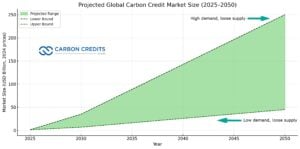
The chart shows the projected global carbon credit market size from 2025 to 2050. The green range shows lower and upper bounds, reaching $50–$250 billion by 2050 (2024 prices). Growth depends on demand: high demand with loose supply drives the market to the upper bound, while low demand with loose supply results in the lower bound.
Another projection says it could reach up to $270 billion by 2050. This prediction of market growth reflects the rising corporate demand for nature-based and technology-based environmental asset solutions. DevvStream and Fayafi are building platforms to tap into this growing market. They focus on linking finance with clear climate results.
DevvStream’s Expanding Role in Climate Assets
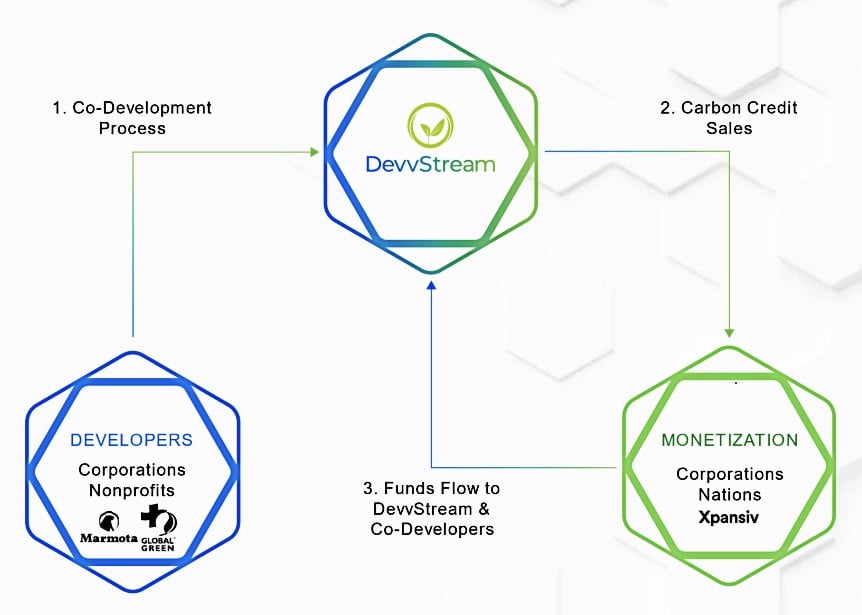
DevvStream started in 2021. It focuses on carbon management and monetizing environmental assets. The company works across three strategic domains:
- Carbon offset portfolios: including nature-based, tech-based, and carbon sequestration credits for sale to corporations and governments.
- Project investment and acquisition: helping to extend its reach into broader environmental markets.
- Project development services: where it structures and manages eligible climate and sustainability activities in exchange for a percentage of generated credits.
This model allows DevvStream to provide full support, from project development to monetization. By teaming up with Fayafi to scale investments, the company can boost its opportunities and increase steady revenue from advisory and asset management roles.
DevvStream has also been active in other strategic moves. In late 2025, it teamed up with Southern Energy Renewables and agreed to merge into a Nasdaq-listed company. This new company will focus on producing low-cost, carbon-negative fuels like sustainable aviation fuel (SAF) and green methanol.
The plan features a $402 million bond allocation for a biomass-to-fuel facility in Louisiana. This move will boost the company’s role in carbon-negative industries.
Market Forces Powering Climate Capital
Many market trends are shaping the launch of climate investment vehicles that DevvStream and Fayafi are creating.
Corporate net-zero commitments are a major driver. Many multinational companies now aim to reach net-zero greenhouse gas emissions by 2050 or sooner. To meet these goals, they mix direct emissions cuts with clean energy buying. They also purchase environmental assets like carbon credits. This corporate demand boosts liquidity. It also supports investment platforms that create and manage climate-aligned assets.
Policy changes and ESG reporting standards are also pushing growth. Governments and regulators in developed and emerging markets are improving climate reporting rules. This trend increases the demand for verified environmental assets that help firms demonstrate progress toward emissions targets.
Another key trend is the rise of carbon markets themselves. Both compliance markets (such as the EU Emissions Trading System) and voluntary markets are expanding. Voluntary markets have challenges with pricing and standardization.
Still, they are vital for companies looking to offset and eliminate residual emissions. Research shows that the ecosystem for environmental asset investment is growing. This growth opens doors for financial products that blend climate impact with returns.
Climate Finance Market: Size, Trends, and Outlook
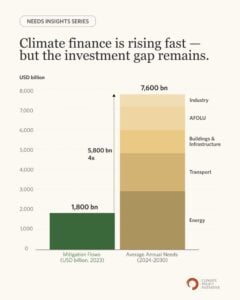
Global climate finance continues to expand, but it still falls short of what is needed. In 2024, global climate finance flows reached over $1.8 trillion in 2023 and will surpass $2 trillion in 2024, based on Climate Policy Initiative (CPI) data. Most of this funding goes to clean energy, transport, energy efficiency, and climate-resilient infrastructure. Private investors now provide more than half of total climate finance.
Despite this progress, the funding gap remains large. Analysts estimate that annual climate investment must rise to $5 trillion to $7 trillion by 2030 to meet global climate goals. This means current funding would need to increase several times within the next few years.
Carbon markets form a smaller but growing part of climate finance. Most future growth is expected in emerging markets, where mitigation costs are lower but access to capital is limited. This has increased interest in structured climate investment vehicles.
In this context, initiatives like DevvStream’s joint platform targeting $100 million by 2027 reflect a broader push to channel private capital into scalable carbon mitigation projects and close global climate finance gaps.
What This Deal Means for Climate Finance
The Fayafi x DevvStream Investment Platform will target:
- Environmental infrastructure
- Carbon solutions
- Technologies that support climate goals
This initiative fits with the growing trend in sustainable investing. Corporations, governments, and financial firms are putting more money into environmental assets. They aim to meet net-zero goals. Though achieving a $100 million target is still a forecast, this partnership is a big step in climate finance growth.