

Colgate-Palmolive’s latest earnings show that it is delivering steady financial performance while adapting to a changing global economy. Beyond the numbers, the results also point to how the company is preparing for a lower-carbon future. This opens the door for a closer look at its net-zero goals, emissions cuts, and long-term climate strategy.
Earnings Snapshot: What the Numbers Say
Colgate‑Palmolive reported its fourth quarter and full-year 2025 results on January 30, 2026. Q4 adjusted earnings were $0.95 per share, above the $0.91 expected. Net sales reached $5.23 billion, up 5.8% from last year. Organic sales rose 2.2%, showing steady growth in oral care and pet nutrition.
For the full year, net sales were about $20.38 billion, up 1.4% from 2024. GAAP diluted EPS was $2.63, while base business EPS grew 3% to $3.69. Gross profit margins stayed above 60%. Operating cash flow hit $4.2 billion, and free cash flow before dividends was about $3.6 billion. The company returned roughly $2.9 billion to shareholders through dividends and share buybacks.
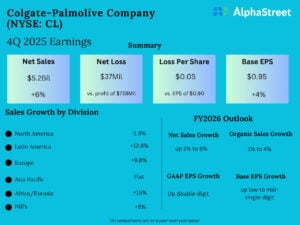
Management expects 2–6% net sales growth in 2026, despite consumer spending pressures. These results show Colgate’s core businesses remain strong while supporting its long-term climate strategy. Following the results, Colgate’s stock price rose sharply, reflecting positive investor reaction.

These financial results are a great way to see how Colgate balances its business performance with its long-term climate strategy.
The Road to Net Zero: Colgate’s Climate Blueprint
Colgate-Palmolive has a detailed climate strategy that guides how it plans to reduce emissions and reach net zero. The company’s climate plan follows the Science Based Targets initiative (SBTi) Net Zero Carbon Standard. This ensures that its emissions targets align with limiting global warming to 1.5 °C above pre-industrial levels.
Colgate’s long-term goal is to achieve net-zero carbon emissions across its full value chain by 2040. This means the company aims to reduce emissions as much as possible and balance any remaining emissions with removals by that year.
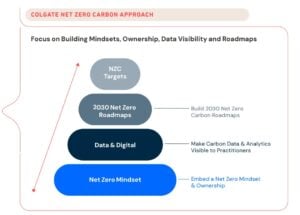
The company’s climate commitment covers a broad range of emission sources, including:
- Scope 1: Direct emissions from fuels and combustion sources under the company’s control.
- Scope 2: Indirect emissions from purchased electricity for operations.
- Scope 3: Upstream emissions such as purchased goods and services, capital goods, logistics, business travel, employee commuting, and leased assets. The strategy excludes only certain optional Scope 3 categories per the SBTi Net Zero Standard.
Targets That Matter: From 2025 to 2040
Colgate aims to reduce emissions with targets for both the near term (2025 and 2030) and a long-term net-zero plan.
-
By 2025:
- Reduce Scope 1 and 2 GHG emissions in operations by 20% versus a 2020 baseline.
- Reduce Scope 3 emissions from purchased goods and services by 20% versus a 2020 baseline.
- Reduce GHG emissions from consumer use of products by 20% versus a 2016 baseline.
- Reduce manufacturing energy intensity by 25% versus a 2010 baseline.
-
By 2030:
- Reach 100% renewable electricity across global operations.
- Reduce Scope 1 and 2 emissions by 42% versus 2020 levels.
- Reduce Scope 3 emissions from purchased goods and services by 42% versus 2020 levels.
-
By 2040:
- Achieve Net Zero carbon emissions across Scope 1, Scope 2, and most Scope 3 categories.
- Reduce Scope 1, Scope 2, and Scope 3 emissions* by 90% from a 2020 baseline (*excludes certain Scope 3 categories per SBTi Net Zero Standard).
Colgate’s climate plan breaks down the net-zero effort into key areas: product design, manufacturing, logistics, and business operations. This way, responsibility is shared among teams.
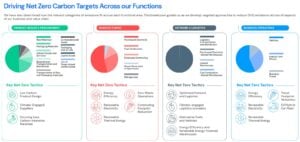
In addition to targets, the plan highlights the distribution of Colgate’s carbon footprint based on its 2024 Scope 1, Scope 2, and Scope 3 data. Most of the footprint comes from using and disposing of products, followed by supplier sourcing. This shows how important it is to involve suppliers and customers in cutting emissions.
These numbers and goals show that Colgate has set measurable, science-based climate targets and continues to develop strategies to reach them. The consumer giant aligns its climate strategy with well-known frameworks like the Task Force on Climate-related Financial Disclosures (TCFD). This adds transparency to how it evaluates climate risks and opportunities.
Where Emissions Come From, and Why It Matters
Colgate has taken steps toward achieving its emissions goals. The company is focusing on all areas, operations, factories, warehouses, and offices, to cut energy use and lower supply chain emissions.
Renewable Electricity and Energy Projects
Colgate plans to reach 100% renewable electricity by 2030. It has started investing in renewable energy projects, including virtual power purchase agreements for wind energy in Europe. These agreements are expected to meet a large part of the region’s electricity needs. This change helps lower emissions from power used at factory sites and main offices.
Supply Chain Engagement
Colgate recognizes that most of its emissions come from its supply chain and purchased goods. The company engages with suppliers to reduce emissions, improve energy efficiency, and support the use of low-carbon materials and processes. This includes encouraging suppliers to set their own science-based climate targets.
Operational Reductions
The consumer product firm aims to reduce energy use and emissions by 2025 and 2030. It seeks to cut energy intensity at factories and lower emissions from purchased goods. The company also reports progress against these goals in annual sustainability reports.
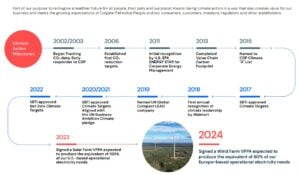
So far, the consumer giant has achieved the following milestones in tackling its climate footprint:
Beyond Carbon: Packaging, Plastics, and Water
Colgate also addresses environmental impacts beyond carbon emissions. The company has clear goals for packaging and resource use:
- Transition all plastic packaging to recyclable, reusable, or compostable materials by 2025.
- Improve water stewardship and reduce waste in operations.
- Achieve zero-waste operations at all manufacturing sites.
- Target net zero water impact at water-stressed sites by 2025 and across all sites by 2030.
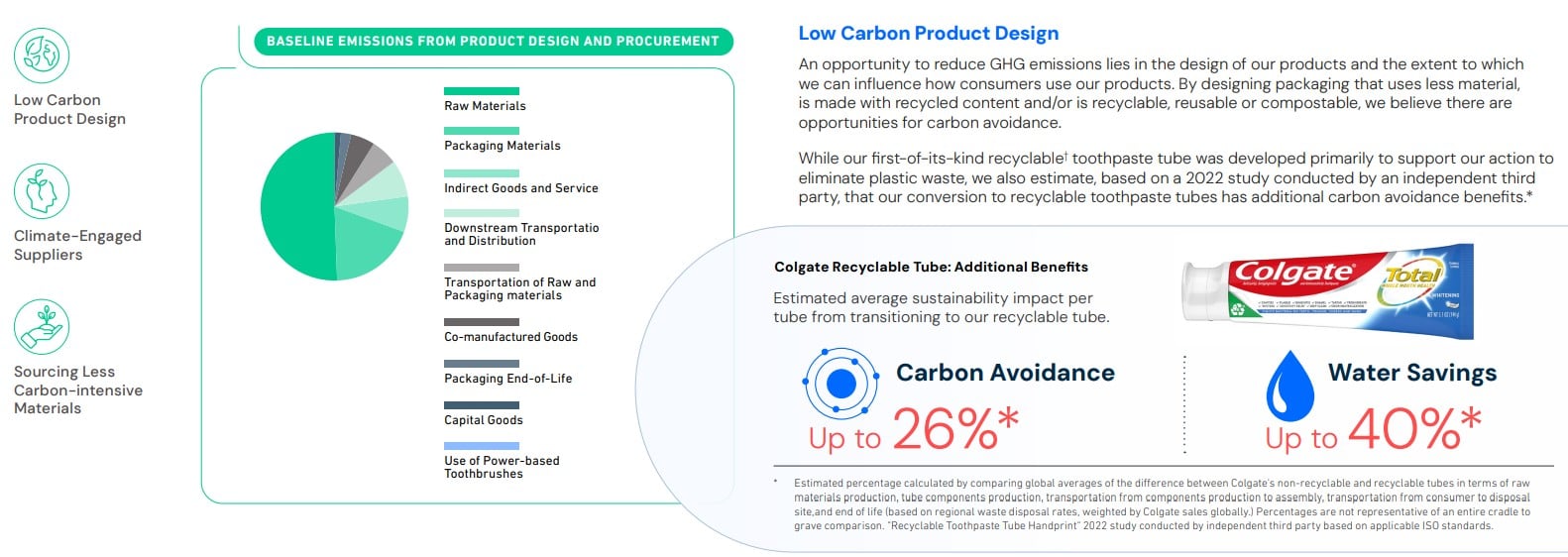
By the end of 2024, about 93% of Colgate’s packaging was recyclable, reusable, or compostable. The company now uses recyclable toothpaste tubes in over 70 countries. It has also boosted the share of sustainable tubes in key markets.
Source: Colgate-Palmolive
Colgate’s Climate Actions Going Forward
Colgate’s climate goals are part of a broader strategy that links environmental sustainability with business performance. The company’s net-zero by 2040 goal shows a long-term focus on reducing emissions across its entire value chain.
Progress follows science-based benchmarks. The company updates its targets to align with changing climate science standards. Colgate faces challenges with indirect emissions from suppliers and products. Still, its targets and actions show a clear path for future reductions.
The sustainability strategy also helps with other goals. These include waste reduction, water conservation, and better packaging. In these areas, measurable progress boosts Colgate’s environmental profile. For example, high recyclable packaging rates play a key role.
Investors, customers, and community partners are increasingly watching how companies like Colgate balance growth with climate action. Colgate’s earnings and environmental efforts show how it stays competitive and supports its long-term climate goals.