


Amazon Web Services (AWS) has signed a power purchase agreement (PPA) with Gentari for an 80-megawatt (MW) wind energy project in Tamil Nadu, India. This agreement is part of Amazon’s broader strategy to achieve net-zero carbon emissions by 2040 and supply its operations with 100% renewable energy.
Once operational in mid-2027, the wind farm could produce about 300,000 megawatt-hours (MWh) of electricity annually. This output can power many local operations and data center tasks. Plus, it helps reduce fossil fuel use.
The project also supports India’s renewable energy growth, which is essential to the country’s 2030 climate targets.
Strengthening Amazon’s Green Portfolio in India
The Gentari deal builds on AWS’s expanding renewable footprint in India. By mid-2025, Amazon had developed 50 large solar and wind projects. It also installed 44 rooftop solar systems at its facilities. Together, these projects represent more than 1.1 gigawatts (GW) of renewable capacity in the country.
This growing portfolio fuels Amazon’s offices, distribution centers, and data centers. It also helps the company aim to be the largest corporate buyer of renewable energy worldwide. The partnership with Gentari adds a strong wind element to its clean energy in India. It works well with the current solar capacity.
Why Wind Matters in AWS’s Net-Zero Game Plan
Amazon has committed to achieving net-zero carbon emissions by 2040, a decade ahead of the Paris Agreement’s target. The company is advancing by using renewable energy, improving energy efficiency, and making operational changes.
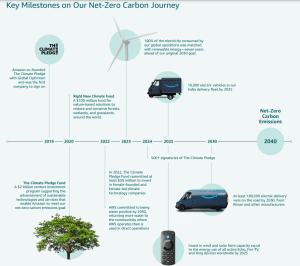
Key highlights include:
- Renewable Energy Leadership:
By 2024, Amazon had more than 500 renewable projects worldwide. Their total capacity was over 30 GW, enough to power millions of homes each year.
- 100% Renewable Energy Goal:
The company aims to match all electricity use with renewable energy by 2025, five years ahead of its original target.

- Electrification of Transportation:
Over 15,000 electric delivery vehicles are now operating globally, part of Amazon’s order for 100,000 EVs from Rivian.
- Emission Reductions:
Between 2021 and 2023, Amazon reported a 7% drop in carbon intensity, meaning emissions per dollar of sales decreased even as operations grew. In 2024, the tech giant emitted a total of over 68 million metric tons of CO2e.

- Carbon Removal Investments:
The company is backing nature-based and technological carbon removal projects, including reforestation and direct air capture.
These initiatives back Amazon’s Climate Pledge. Over 400 companies also signed it. The goal is to reach net zero by 2040.
SEE MORE on Amazon:
- Amazon’s $1 Billion Move Towards Net Zero: Logistics Electrification Across Europe
- Amazon Flies Greener to Net Zero with 9M Liters of Sustainable Fuel from Neste
- Amazon Expands Renewable Energy with 17 New Projects in Spain & First in Portugal
Gentari’s Tamil Nadu Hub: More Than Just a Breeze
Gentari, a clean energy subsidiary of Petronas, is positioning Tamil Nadu’s Karur region as a wind energy hub. The collaboration between Gentari and AWS extends beyond power supply.
In 2023, both companies signed a memorandum of understanding (MoU) to support fleet electrification in India. Gentari has helped deploy over 7,200 electric vehicles for last-mile delivery. This effort has helped Amazon reduce its transportation emissions as the tech giant moves toward net zero.
The partnership tackles two major sources of corporate carbon emissions: energy use and transportation. It does this by combining renewable energy projects with electrified logistics.
India’s Renewable Boom: A Global Leader in the Making
India’s renewable energy sector is growing rapidly. This growth is making the country a global leader in clean energy. In 2023–24, over 70% of new power generation came from renewable sources. This shows that the shift away from coal and fossil fuels is speeding up.
By early 2024, India had over 220 gigawatts (GW) of renewable energy. This total includes solar, wind, hydro, and biomass sources. Solar made up the largest share of recent growth, with over 21 GW of new capacity added in that year alone, followed by 3 GW of new wind projects.

Government targets remain ambitious. India’s National Electricity Plan aims for 500 GW of non-fossil fuel capacity by 2030. This supports its goal to meet 50% of electricity needs from renewable sources by then. This would require adding roughly 30–40 GW of new renewable capacity each year over the next six years.
Industry forecasts say that by 2030, renewable energy will account for about 35% of India’s power generation. This is an increase from around 21% in 2024.

This rapid growth comes from lower technology costs. In India, solar tariffs are very low, around ₹2–₹2.5 per kilowatt-hour (about $0.024–$0.03). State and central government incentives, such as the following, are helping to draw both domestic and foreign investment:
- accelerated depreciation benefits,
- production-linked incentives for solar manufacturing, and
- renewable purchase obligations for utilities.
The International Energy Agency (IEA) says India will likely be the third-largest market for new renewable capacity in the 2030s.
Corporate PPAs: The Hidden Engine of the Energy Transition
Corporate procurement has emerged as a powerful driver of India’s renewable energy expansion. Long-term power purchase agreements (PPAs), such as the AWS–Gentari deal, are popular for growing renewable projects. They offer steady revenue for developers and stable prices for buyers.
These agreements appeal to big energy users like data centers, factories, and logistics hubs. They need cost certainty and want to cut emissions to reach their environmental goals.
India has become a hotspot for corporate renewable energy adoption. BloombergNEF reports that in 2023, India’s corporate clean energy procurement topped 8 GW. This achievement ranks India as one of the top three countries for corporate renewable deals globally.
Top companies like Amazon, Microsoft, and Google, along with Indian giants Tata and Reliance, are signing multi-year PPAs. This helps them secure clean power.
For AWS, the benefits of this approach go beyond energy cost stability. Reaching its 100% renewable energy goal in India by 2025 helps fulfill its global Climate Pledge. This pledge aims for net-zero carbon emissions by 2040.
Opportunities and Obstacles on the Road to 2040
The AWS–Gentari deal shows how corporate partnerships can boost clean energy, but challenges still exist. Integrating variable renewable energy into India’s grid requires careful planning and investment in storage and transmission. Large-scale projects may also face land acquisition hurdles and permitting delays.
Even with these challenges, the outlook for renewable energy in India remains strong. AWS’s expanding presence in the country, along with key partnerships like this, shows how business needs can speed up the shift to a cleaner and stronger power sector.
AWS’s deal with Gentari for 80 MW of wind power in Tamil Nadu is more than buying renewable energy. It’s a smart investment in India’s clean energy system. By linking wind power generation with electric vehicle deployment, Amazon shows how corporate partnerships can deliver economic benefits and net zero progress in one of the world’s fastest-growing energy markets.
READ MORE: