

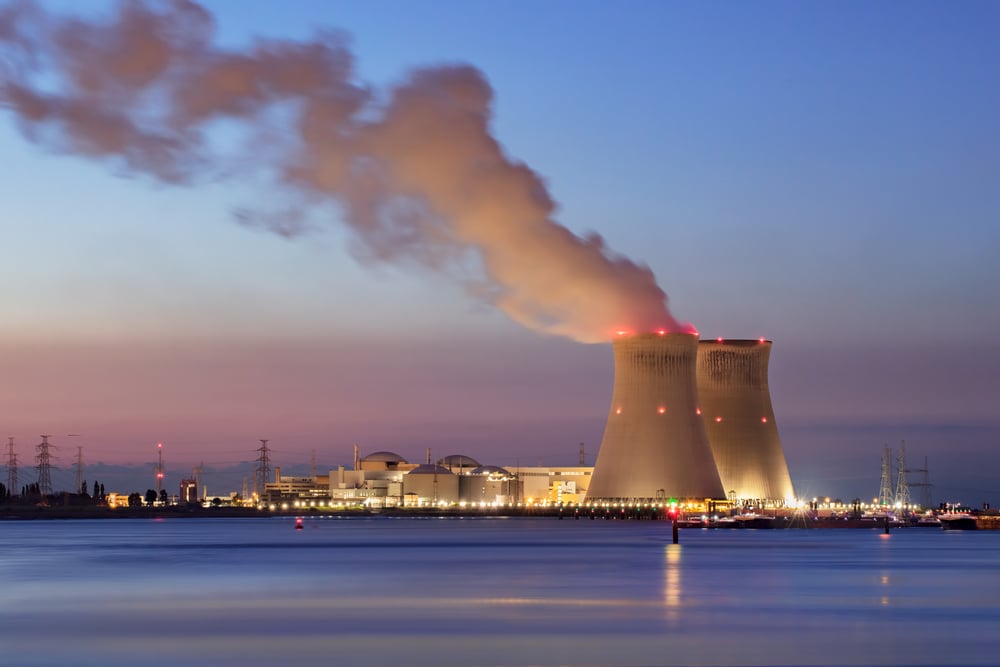
The United States is moving fast to rebuild its nuclear fuel supply chain, revive dormant facilities, and accelerate next-generation nuclear technologies. These efforts come as electricity demand surges from artificial intelligence (AI), data centers, and industrial electrification.
Recent announcements from the U.S. Department of Energy (DOE) show a coordinated push to strengthen uranium enrichment, revive legacy nuclear infrastructure, and deepen international collaboration on fusion power. Together, these developments highlight how nuclear energy is becoming central to U.S. energy security, economic competitiveness, and climate goals.
Hanford’s FMEF Gets a Second Life in the Nuclear Fuel Cycle
The DOE Office of Environmental Management announced a new partnership with American nuclear fuel company General Matter to explore the reuse of the Fuels and Materials Examination Facility (FMEF) at the Hanford Site in Washington State.
FMEF is a 190,000-square-foot facility originally built to support the Liquid Fast Breeder Reactor Program. However, it never operated in a nuclear role and has been idle since 1993 under surveillance and maintenance status.
Under the new lease, General Matter will evaluate the facility for potential upgrades, conduct site characterization, and engage local communities and stakeholders. The goal is to determine whether the facility can be returned to service for advanced nuclear fuel cycle technologies and materials research.
Reviving FMEF could help the U.S. rebuild critical infrastructure that was lost after decades of underinvestment in nuclear fuel production. It also fits into the Trump administration’s broader agenda to expand domestic energy production and reduce reliance on foreign nuclear fuel services.
General Matter CEO Scott Nolan said:
“Rebuilding America’s nuclear fuel capabilities is critical to strengthening our nuclear industrial base, reducing our reliance on foreign providers and lowering energy costs for utilities and consumers. We thank our partners in Hanford and the Department of Energy for supporting us in the development of a stronger, more secure nuclear fuel supply chain built here in the United States.”
General Matter’s Role in Rebuilding U.S. Uranium Enrichment
The Hanford project complements General Matter’s plans to develop a uranium enrichment facility at the former Paducah Gaseous Diffusion Plant in Kentucky. Construction is expected to begin in 2026, with enrichment operations targeted before the end of the decade.
This privately funded facility aims to supply fuel for commercial nuclear reactors, national security reactors, and research institutions. It is part of a broader effort to restore U.S. uranium enrichment capacity, which has declined sharply over the past few decades.
As part of the lease agreement, General Matter will receive at least 7,600 cylinders of uranium hexafluoride (UF6). Reprocessing this material could save U.S. taxpayers about $800 million in avoided disposal costs while providing a reliable domestic feedstock for reenrichment.
General Matter was also selected in October 2024 as one of four companies to provide enrichment services for establishing a U.S. supply of high-assay low-enriched uranium (HALEU). HALEU is a key fuel for advanced reactors and small modular reactors (SMRs), which are expected to play a major role in future power systems.
U.S.–Japan Fusion Partnership Marks a New Era of Cooperation
In another major development, the DOE and Kyoto Fusioneering (KF) announced a landmark partnership to advance fusion power technology and reduce commercialization risks.
The collaboration centers on breeding blanket systems, which produce tritium fuel needed for fusion reactors. A key project is UNITY-3, a next-generation fusion testing facility planned at Oak Ridge National Laboratory (ORNL). This facility will validate breeding blanket performance using realistic neutron environments and component designs.
The partnership also includes Idaho National Laboratory and Savannah River National Laboratory. Together, they will leverage KF’s UNITY-1 and UNITY-2 facilities in Japan and Canada to test thermal systems, tritium fuel cycles, and non-nuclear components.
This coordinated approach aims to systematically increase technology readiness levels and accelerate the path toward commercial fusion power. The initiative has already gained strong industry support, with multiple U.S. fusion companies endorsing the program.
DOE officials described fusion as a transformational opportunity for the energy sector and a critical pillar for long-term competitiveness. The partnership also strengthens U.S.–Japan strategic ties in clean energy and advanced technology.
AI, Data Centers, and Electrification Drive Nuclear Demand
Rising electricity demand is a key driver behind the renewed interest in nuclear power. AI workloads, cloud computing, electric vehicles, and industrial electrification are pushing power consumption to record levels.
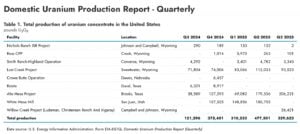
According to the U.S. Energy Information Administration (EIA), total U.S. electricity consumption is expected to increase from 4,198 billion kilowatt-hours (kWh) in 2025 to about 4,256 billion kWh in 2026. This steady growth reflects expanding data centers, manufacturing, and population-driven demand.
Nuclear power remains a critical source of reliable baseload electricity. EIA forecasts that nuclear generation will remain stable through 2026, accounting for roughly 18% to 19% of total U.S. electricity generation. While renewables such as solar and wind are growing rapidly, nuclear continues to provide round-the-clock power that complements intermittent clean energy sources.
This reliability is especially important for AI data centers, which require constant power and cannot rely solely on variable renewable generation.
Uranium Production and Fuel Cycle Challenges
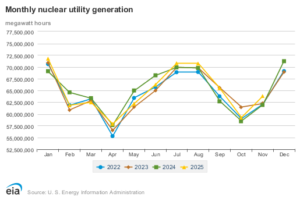
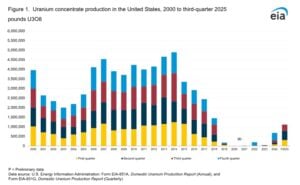
Despite strong policy support, the U.S. nuclear fuel sector faces significant challenges. Domestic uranium production has been volatile, highlighting the difficulty of rebuilding a mining industry after decades of decline.
EIA highlighted that, in the third quarter of 2025, U.S. uranium concentrate production totaled 329,623 pounds of U3O8, a 44% decline from the previous quarter. This drop underscores the need for sustained investment and policy support to stabilize domestic supply.
Beyond mining, the U.S. must also expand conversion, enrichment, and fuel fabrication capacity. Much of the global enrichment market is dominated by foreign suppliers, including Russia, Europe, and China. Rebuilding domestic capabilities will require large capital investments and regulatory approvals.
Trump Targets Massive Nuclear Expansion
U.S. policy is increasingly aligned with nuclear expansion. The United States currently operates 96 nuclear reactors with a total gross capacity of about 102 gigawatts, according to the World Nuclear Association.
In May 2025, President Donald Trump signed executive orders targeting 400 gigawatts of nuclear capacity by 2050. The policy includes uprates at existing reactors, construction of new large reactors by 2030, and major investments in fuel cycle infrastructure.
The strategy also emphasizes domestic supply chains for uranium mining, enrichment, fuel fabrication, and waste management. Building these supply chains is seen as critical for energy security, especially as geopolitical tensions affect global uranium and enrichment markets.
Analysts expect SMRs and advanced reactors to play a growing role, particularly for industrial facilities, hydrogen production, and large data centers seeking long-term power contracts.
Fusion and Advanced Reactors: Long-Term Game Changers
While traditional nuclear reactors are expanding, fusion and advanced fission technologies represent the long-term future of the sector.
Fusion promises abundant, low-waste energy, but it remains technologically complex and expensive. The DOE-Kyoto Fusioneering partnership aims to close key technology gaps and accelerate commercialization timelines.
Advanced fission reactors, including fast reactors and SMRs, are closer to deployment. These designs offer improved safety, lower costs, and flexibility for industrial applications. They also require new fuel types such as HALEU, reinforcing the importance of domestic enrichment capacity.
Why This Matters for US Nuclear Infrastructure
The U.S. push to revive nuclear infrastructure, expand enrichment, and accelerate fusion reflects a strategic shift in energy policy. Nuclear power is becoming a cornerstone of the digital economy and clean energy transition.
For investors, these developments could reshape uranium markets, nuclear technology companies, and infrastructure spending. Rising electricity demand from AI and electrification could support long-term growth in nuclear capacity, even as renewables continue to scale.
With AI, data centers, and electrification driving record electricity demand, nuclear power is emerging as a strategic asset for reliable, low-carbon energy. Policy support is strong, but rebuilding the full nuclear fuel cycle will require sustained investment, regulatory reform, and public acceptance.
In conclusion, the DOE’s recent partnerships with General Matter and Kyoto Fusioneering highlight a coordinated effort to rebuild the U.S. nuclear ecosystem—from mining and enrichment to advanced reactors and fusion research.