


ExxonMobil, a pioneer in carbon capture and storage (CCS) helps the U.S. industries, mainly steel, ammonia, and hydrogen reduce their carbon emissions while meeting growing demand for lower-carbon products. But this time they are targeting the power-hungry U.S. data centers, as mentioned in their press release.
The oil giant is developing a groundbreaking plan to provide low-carbon power to the U.S. data centers which are vital hubs for the booming artificial intelligence (AI) sector. The proposal outlines a first-of-its-kind facility that would produce electricity with natural gas while capturing over 90% of associated CO2 emissions. The captured emissions would then be safely stored deep underground.
Dan Ammann, president of Exxon’s Low Carbon Solutions Business said,
“We’re in a unique position to provide low-carbon power at large scale on a very competitive and accelerated timeline.”
ExxonMobil’s Natural Gas Equipped Carbon Capture for Data Centers
ExxonMobil’s CCS technology supports key industries like steel, ammonia, and hydrogen. The company has already secured agreements to transport and store up to 6.7 million tons of CO2 annually for these sectors. They proudly claim this scale is more than any other competitor.
However, with data centers tapping into CCS, Exxon has a different plan to decarbonize them.
So, here’s what makes the project stand out:
- Low-carbon fuel: The facility plans to use low-carbon-intensity natural gas, like what ExxonMobil produces in the Permian Basin.
- Grid independence: Operating off-grid allows for faster deployment, unlike traditional grid-dependent systems or slower alternatives like nuclear power.
- Accelerated timelines: ExxonMobil’s expertise and scale enable swift action to meet the urgent demands of AI growth, which could account for 20% of the CCS market by 2050.
This innovative solution highlights how CCS can support industries beyond heavy manufacturing and create a sustainable pathway to decarbonize emerging sectors like AI.
As new solutions are urgently needed to support AI growth, Exxon wants to move fast. They are leveraging their strengths in integration, operational scale, and project expertise. Significantly, the front-end engineering design (FEED) for this project is already in progress, and currently, the company is engaging with potential customers.
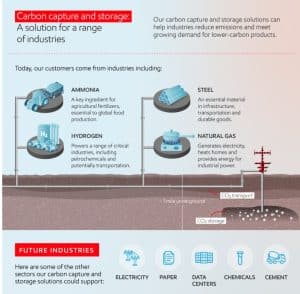 Source: Exxon
Permian Basin: A Key Pillar in ExxonMobil’s Net-Zero Vision
Exxon has a strong focus on expanding energy supplies from the Permian Basin to meet the global demand for reliable energy. This vast region, covering southwest Texas and southeast New Mexico, plays a critical role in the company’s operations and Exxon is one of the most active operators in this area.
In 2021, ExxonMobil became the first integrated energy company to join a program that certifies natural gas production. The pilot program is based in Poker Lake, New Mexico, a key area of its Permian Basin operations. There they use MiQ’s standards—set by a nonprofit organization focused on verifying and mitigating methane emissions.
This certification program is part of Exxon’s broader strategy to reduce emissions and achieve Scope 1 and 2 net-zero goals as a certified natural gas supplier.
Empowering U.S. Industry with CCS Technology
Exxon bets on the U.S. Gulf Coast for its CCS projects. This is because that particular region offers some unique advantages like a dense industrial base, existing CO2 pipeline infrastructure, and proximity to large storage sites.
The company further disclosed that Texas, Louisiana, and Mississippi are the key states for their CCS portfolio. They also drive U.S. exports, which hit a record $1.6 trillion in 2023. By integrating CCS, industries like steel and ammonia production Exxon expects to gain a competitive edge in global markets.
For instance, Exxon signed its fourth carbon capture and storage agreement with a major customer, CF Industries just a few months back. The deal will involve transporting and permanently storing up to 500,000 metric tons of CO2 annually from CF’s nitrogen production complex in Yazoo City, Mississippi. They expect to roll on by 2028 and cut CO2 emissions by about 50%.
With this new agreement, the company can now store a total of 5.5 million metric tons of CO2 annually for customers. Well, this is equivalent to removing about 2 million gasoline-powered cars from the road.
Exxon Sets a Major Milestone in Emissions Reduction
Carbon capture and storage (CCS) is crucial for the energy transition. Both the UN and the IEA agree that CCS is one of the most cost-effective ways to reduce emissions in industries with heavy emitters, such as chemicals, refining, cement, and steel.
It’s also one of the few technologies capable of achieving negative CO2 emissions, especially when paired with bio-energy or direct air capture.
The Center for Climate and Energy Solutions says that CCS can capture over 90% of emissions from power plants and industrial facilities.
Keeping all these facts intact in its net zero goals, ExxonMobil’s investments in CCS highlight its commitment to emissions reduction and sustainability. Additionally, supporting U.S. economic growth.
Greenhouse Gas and Performance Data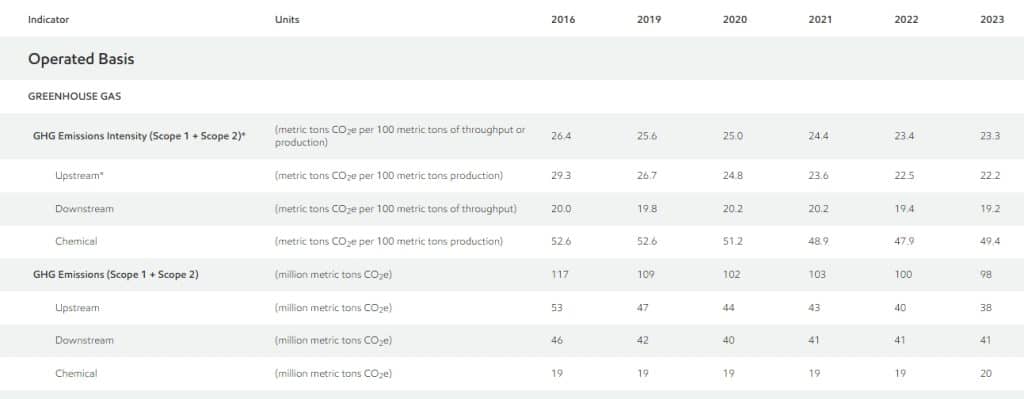
Source: Exxon’s sustainability report
By expanding into AI and data centers, ExxonMobil is proving that carbon capture is crucial to decarbonizing vital sectors and securing America’s leadership in innovation.