


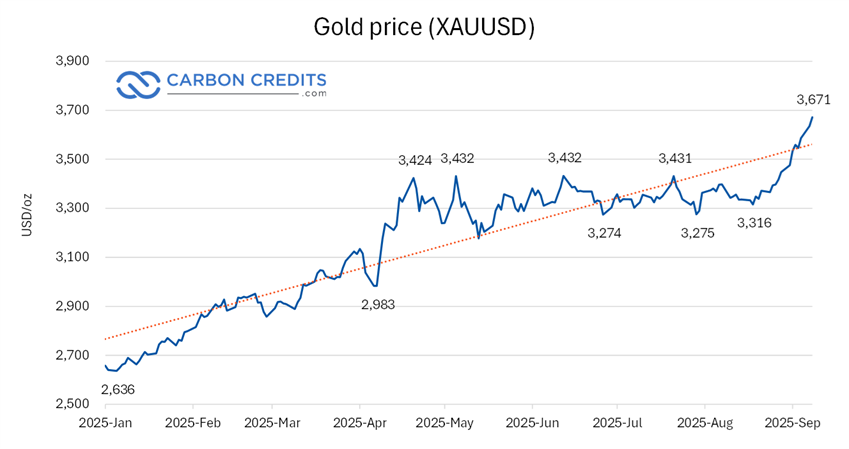
On September 9, 2025, the gold price set a new all-time high with an intraday peak of $3,671.38 per ounce. The rally shows strong investor demand. It also reflects rising geopolitical tensions and record central bank purchases.
At the same time, the gold industry is undergoing a transformation. Mining companies are committing to renewable energy, carbon reduction, and net-zero targets. Together, record prices and sustainability strategies are reshaping how gold is valued by both investors and communities.
Why Gold Price Today Reaches Historic Levels
Gold’s role as a safe-haven asset has been reinforced by global economic uncertainty. Inflation, supply chain issues, and conflicts have led investors to seek safety in gold. At $3,671/oz, prices are up more than 20% since the start of 2025.
Central banks have played a major role. In 2024, they bought more than 1,050 metric tons of gold, the second-largest annual increase ever recorded.
China, India, and Turkey led the purchases as part of their strategy to diversify away from the U.S. dollar. Exchange-traded funds (ETFs) also recorded a rebound, with inflows of $6.8 billion in the first half of 2025.
Retail demand is strong, even with high prices. This is especially true in India and China, where jewelry makes up a big part of what people buy.
The gold price surge reflects more than short-term speculation. At a glance, here are the structural trends that support gold’s long-term appeal:
-
Currency diversification: Central banks are reducing reliance on the U.S. dollar, boosting demand for gold reserves.
-
Inflation hedge: With global inflation averaging 4.7% in 2024, gold continues to act as a store of value.
-
Geopolitical risk: From conflicts in Eastern Europe to supply chain disruptions, gold offers security in times of instability.
Analysts suggest that if these conditions continue, gold could rise toward $3,800 per ounce by the end of the year. While prices climb, the gold mining industry faces a major sustainability challenge.
The Carbon Footprint of Gold Mining
Gold production is energy-intensive, often relying on fossil fuels for power and processing. According to the World Gold Council (WGC), here are some facts about gold emissions:
-
The average emissions intensity of gold mining is ~0.9 metric tons of CO₂ per ounce of gold produced.
-
Gold mining accounts for roughly 0.3% of global greenhouse gas (GHG) emissions, a significant share for one sector.
-
Electricity and diesel fuel make up more than 80% of mining-related emissions.
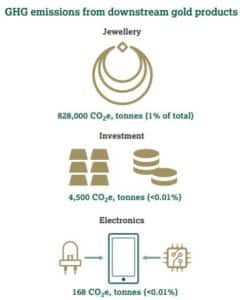
These numbers highlight the importance of industry-wide decarbonization efforts. Without action, rising production could undermine global climate goals. Let’s get to know the top gold companies promoting sustainable mining.
Gold Miners Expanding ESG and Net-Zero Efforts
Several leading gold companies have committed to aggressive climate goals. Below is a closer look at how the biggest players are progressing.
Newmont Corporation
As the world’s largest gold miner, Newmont has pledged to reach net zero by 2050. The company reduced Scope 1 and 2 emissions by 6% in 2024, thanks to a mix of renewable power agreements and efficiency upgrades. Boddington mine in Australia and Peñasquito mine in Mexico are switching to solar and wind energy.
Newmont has also invested in battery-electric haul trucks to replace diesel fleets. By 2030, Newmont aims to cut absolute Scope 1 and 2 emissions by 32% and Scope 3 emissions by 30% compared to 2018 levels.
IAMGOLD
The Canadian miner has also made significant strides. Its Côté Gold mine in Ontario is powered primarily by hydropower, giving it net-zero Scope 2 emissions.
IAMGOLD aims to cut emissions intensity by 30% by 2030. They are also testing electric equipment in North America. Beyond emissions, IAMGOLD has invested in water conservation and biodiversity projects, positioning itself as a leader in responsible mining.
B2Gold
B2Gold has been recognized for its bold renewable energy strategy in Africa. The company built a 7 MW solar power plant at the Fekola mine in Mali, which reduces diesel use by 13 million liters annually. This saves about 39,000 tons of CO₂ emissions every year.
B2Gold is evaluating hydrogen pilot projects. They are also expanding solar infrastructure at other sites. Their goal is to cut emissions intensity by 30% across all operations in the next decade.
Nova Minerals
Based in Australia, Nova Minerals is exploring some of the most advanced decarbonization technologies in the sector. It is testing green hydrogen systems to power off-grid mining operations. It is also looking into carbon capture options in mine waste.
These steps aim not only to reduce emissions but also to position the company as an innovator in low-carbon mining solutions. Nova has announced plans to achieve carbon neutrality by 2035, earlier than most of its peers.
Gold Fields
Gold Fields, headquartered in South Africa, has set a net-zero by 2050 goal with interim targets to reduce Scope 1 and 2 emissions by 30% by 2030. The company is already producing tangible results.
At its South Deep mine in South Africa, it installed 40 MW of solar capacity, supplying about 25% of the site’s power needs. Across its global operations, Gold Fields’ renewable projects prevent an estimated 250,000 tons of CO₂ annually.
Together, these initiatives show how miners are transforming their business models to meet climate goals. Importantly, they also lower operating costs by reducing dependence on volatile fossil fuel prices.
The Gold Industry’s Green Makeover
Beyond individual companies, the entire gold sector is moving toward sustainability. The World Gold Council’s “Net Zero by 2050” framework guides miners. It emphasizes using renewable energy, electrification, and engaging the supply chain.
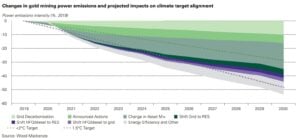
By 2024, about 35% of electricity used by the gold industry came from renewables, up from 15% in 2019. Carbon credits are also becoming part of the transition. Many miners buy top-notch forestry and renewable energy offsets. They do this to balance emissions they can’t eliminate yet.
If current trends continue, the WGC projects that the sector could reduce total emissions by 30–40% by 2035, with deeper cuts possible through new technologies.
Soaring gold price is boosting revenues, but investors are increasingly focused on ESG credentials. A 2025 MSCI survey found that 72% of institutional investors consider ESG performance when evaluating mining companies. This is especially relevant as ESG-focused funds are projected to manage over $50 trillion globally by 2030.
For miners, this means profitability is no longer enough. Companies that show strong sustainability progress are more likely to secure financing and attract long-term investors. This dual focus – financial strength and ESG performance – will shape the industry’s outlook in the coming decade.
Gold’s Future: Shining Brighter, Greener, and Pricier
The future of gold is being shaped by two powerful forces: market momentum and sustainability. On one hand, record demand and central bank purchases are pushing gold prices higher, with forecasts pointing to $3,800/oz by the end of 2025.
On the other hand, the industry is undergoing a deep transformation. From Newmont’s electrified fleets to B2Gold’s solar-powered mines, gold companies are proving that it is possible to align profitability with climate responsibility. These moves not only reduce emissions but also make operations more resilient and cost-efficient.
The gold price today at $3,671 per ounce is a milestone for the industry, but the bigger story lies in how miners are responding to climate pressures. With carbon-intensive operations under scrutiny, leading companies are committing to ambitious net-zero goals and rolling out renewable energy projects across the globe.
For investors and policymakers alike, gold’s future will be measured not just in ounces and dollars, but in how sustainably those ounces are produced. In this sense, the industry is writing a new chapter – one where gold shines both as a financial safe haven and as a driver of responsible growth.