

Hanwha Qcells, a subsidiary of South Korea’s Hanwha Corp has set a world record for tandem solar cell efficiency. The company’s innovative M10-sized cell, featuring a perovskite-silicon structure, reached an impressive efficiency of 28.6%.
This incredible output surpasses the 27% efficiency of crystalline silicon cells and the 21% typical of standard commercial solar panels. They achieved this milestone just one year after starting large-scale tandem development, promising project size and cost reduction.
Danielle Merfeld, Global CTO at Hanwha Qcells.
“The tandem cell technology developed at Hanwha Qcells will accelerate the commercialization process of this technology and, ultimately, deliver a great leap forward in photovoltaic performance,” said “We are committed to advancing the next generation of solar energy efficiency and will keep investing significantly in research and development to drive progress in this field, as every kilowatt counts on the path to building a more sustainable future.”
Hanwha Qcells Redefines Solar Efficiency
The press release mentioned that the R&D team began groundwork in 2016 to develop a commercially feasible tandem solar cell using perovskite top-cell technology and Hanwha Qcells flagship silicon bottom-cell technology.
Eventually, in 2019, the solar giant launched an advanced research center in Pangyo, Korea that would complement their well-established R&D hub in Bitterfeld-Wolfen, Germany. After achieving success with small-area tandem cells, the focus shifted to large-area designs that finally culminated in the record-breaking 28.6% tandem solar cell efficiency.
Designing the Future of Solar
The certified record was verified by the CalLab at the Fraunhofer Institute for Solar Energy Systems (ISE). The high efficiency comes from an innovative design that pairs a perovskite-based top cell with Hanwha Qcells’ proprietary Q.ANTUM silicon bottom-cell technology.
This measurement, taken on a full-area M10-sized cell (approximately 0.36 square feet or 330.56 cm²) used a standard industrial silicon wafer that could be interconnected into an industrial module. The tandem technology stacks a perovskite top cell and a silicon bottom cell to optimize energy capture. Simplifying the technique, the top cell absorbs high-energy light while low-energy light passes through to the bottom cell to maximize power output per module.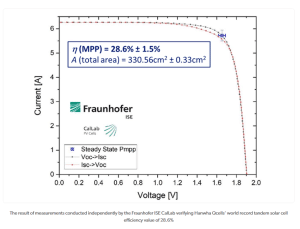
So, what’s the advantage? Well, fewer panels generate the same power, which further reduces costs and land use for solar projects.
Significantly, Hanwha Qcells developed this tandem technology with commercial manufacturing in mind. They are focused on going beyond lab-scale demonstrations. With their scalable processes and tools, the company is all geared up for the next generation of efficient, cost-effective solar energy solutions.
Thus, this milestone moves the solar industry closer to the widespread commercialization of more powerful and affordable solar technology.
Robert Bauer, Head of Hanwha Qcells R&D in Germany noted,
“Hanwha Qcells is excited to announce this new world record in tandem cell efficiency based on our in-house developed perovskite technology as a top cell, and cost-efficient Q.ANTUM silicon technology as a bottom cell. The champion cell is a typical cell from our R&D pilot line in Germany and has been fabricated exclusively using processes that are feasible for mass production. This result is laying the groundwork for future commercialization of this exciting technology.”
Global Partnerships Drive Innovation
Hanwha Qcells’ is a global leader in solar energy. This unit manufactures high-performance solar modules and innovative storage systems. They have headquarters in Seoul and South Korea, and manufacturing hubs in the U.S., South Korea, and Malaysia. The company offers end-to-end clean energy solutions for utility, commercial, and residential markets worldwide.
Qcells’ R&D efforts have received significant support. The Pangyo R&D Center recognized as a national research institute, benefits from Korean government funding. Meanwhile, the Bitterfeld-Wolfen center is backed by a global network, including the German Federal Ministry for Economic Affairs and Climate Action, the EU Commission, and the state of Saxony-Anhalt. Collaborative initiatives like the EU’s PEPPERONI project have further fueled progress.
Danielle Merfeld also added,
“We are fortunate to have outstanding global R&D teams and to have received invaluable support from our partners in Korea and Europe, leveraging their resources and expertise. We deeply appreciate everyone dedicated to driving innovations that bring us closer to achieving our climate goals.”

DOE Backs Qcells with $1.45 Billion Loan for Solar Supply Chain
The U.S. Department of Energy’s (DOE) Loan Programs Office (LPO) has finalized a $1.45 billion loan to support Qcells’ solar manufacturing facility in Cartersville, Georgia. Initially, in August 2024, DOE announced it as a conditional commitment but with this confirmation, the funding will help build a robust solar supply chain in the U.S.
The company noted that over the past decade, solar installations have surged. The U.S. alone had over 5 million installations, with a target of reaching 10 million by 2030. According to the U.S. Solar Market Insight 2023 Year in Review, total U.S. solar capacity is projected to hit 673 GW by 2034, enough to power over 100 million homes.
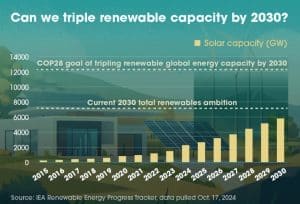
Furthermore, the IEA’s Renewables 2024 report predicts that global renewable energy will add 5,500 GW of capacity by 2030, with solar PV technologies driving 80% of this growth.
Energizing U.S. Solar Innovation
Qcells, a global leader in solar solutions and the largest silicon-based solar panel producer in the Western Hemisphere plans to invest $2.8 billion in this groundbreaking project. The Cartersville facility will produce ingots, wafers, cells, and panels on a multi-gigawatt scale.
Furthermore, on completion, the plant will have a production capacity of 8.4 GW, or approximately 46,000 solar panels per day. Rebuilding these critical parts of the domestic solar supply chain is a huge contribution to the U.S. energy independence and reduced carbon emissions.
Hanwha’s Commitment to Net Zero
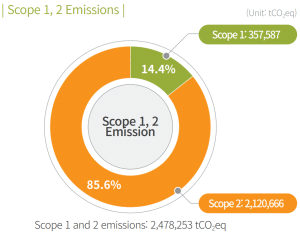
Hanwha Solutions 2050 Net Zero goals align with the global target of limiting temperature rise to below 1.5°C. As per its latest sustainability report, it plans to cut Scope 1 and 2 emissions by 35% by 2030 and 60% by 2040, using 2018 as the baseline.
Some strategies include:
- improving energy efficiency
- adopting renewable energy
- utilizing by-product hydrogen as fuel
- incorporating carbon capture and utilization (CCU) technologies
The solar giant also purchases renewable energy through KEPCO’s Green Premium program. In 2023, the Chemical Division secured 53.7 GWh, and the Qcells Division obtained 27 GWh.
Notably, Qcells maximizes on-site renewable energy generation. Solar panels installed on rooftops and parking lots now produce 3.9 MW, with plans to add 2 MW in 2024. Last year, these facilities supplied 3.2 GWh of clean energy.
In conclusion, the DOE’s loan is a testament to the solar industry’s vital role in helping American manufacturers compete globally and succeed long-term. And Hanwha Qcells is just doing the job right. It’s advancing scalable manufacturing and high-efficiency solar cells, driving affordable and sustainable solar solutions.