

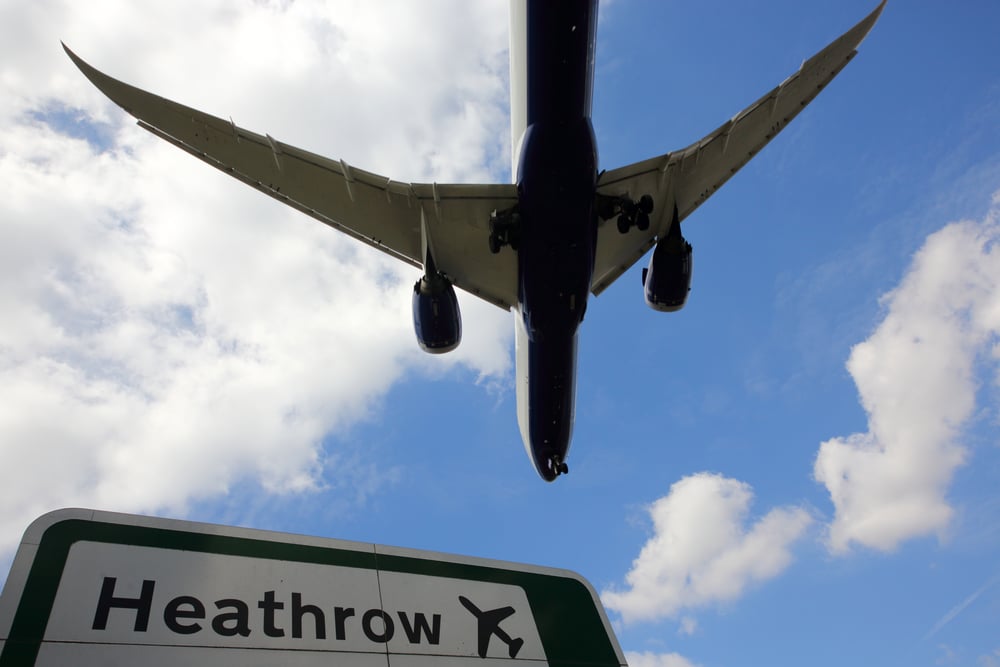
Heathrow Airport is raising its climate ambition once again. In 2026, the airport plans to use Sustainable Aviation Fuel (SAF) at levels 2% higher than the UK government’s mandate. This means total SAF use at Heathrow could reach 5.6% of all jet fuel next year.
The UK requires 3.6% SAF blending in 2026. Heathrow’s extra incentive pushes that figure higher, which could translate into around 350,000 tonnes of SAF being used at the airport. About 124,000 tonnes of that would come directly from Heathrow’s own incentive scheme.
To support this effort, Heathrow has set aside more than £80 million to help airlines cover the higher cost of SAF compared to traditional jet fuel. SAF remains more expensive to produce, so this financial support helps narrow the price gap and makes cleaner fuel more attractive for carriers.
This is the fifth year in a row that Heathrow has expanded its SAF support program, showing a consistent push toward lower-carbon flying.
How SAF Cuts Aviation Emissions
Sustainable Aviation Fuel works in today’s aircraft without major changes. Airlines can blend it with regular jet fuel and use existing engines and infrastructure. The key difference lies in how SAF is produced.
It can be made from waste oils, agricultural residues, household waste, or through synthetic processes that combine renewable electricity with captured carbon. Because of these production methods, SAF can reduce lifecycle greenhouse gas emissions by more than 70% compared to fossil jet fuel, according to the UK government.
If Heathrow achieves its 5.6% SAF target in 2026, the airport estimates emissions could fall by around 600,000 tonnes in one year.
To understand the scale:
- A round-trip economy flight from London Heathrow to New York JFK produces about 612 kilograms of CO₂ per passenger, based on ICAO calculations.
- Cutting 600,000 tonnes would equal roughly 950,000 return passenger journeys on that route.
That level of reduction highlights how even small percentage increases in SAF use can create large carbon savings.
Understanding the UK SAF Mandate
The UK introduced the SAF Mandate to ensure steady growth in cleaner aviation fuel. Instead of relying only on voluntary airline commitments, the policy legally requires fuel suppliers to blend increasing amounts of SAF into their total jet fuel supply.
The system includes two parts. The main obligation requires suppliers to meet a rising SAF percentage each year.
- It started at 2% in 2025 and will increase to 10% by 2030 and 22% by 2040. A second requirement, known as the Power-to-Liquid obligation, focuses on advanced synthetic fuels made using renewable electricity. This part begins at 0.2% in 2028 and grows to 3.5% by 2040.
Suppliers earn certificates based on how much carbon savings their SAF delivers. The greater the emissions reduction, the more certificates they receive. They can use these certificates to prove compliance, trade them with others, or pay a buy-out fee if they fail to meet targets. The buy-out price is designed to encourage real SAF supply rather than paying the penalty.
- By 2040, the UK government estimates the mandate could deliver up to 6.3 megatonnes of carbon savings each year.
Matt Gorman, Heathrow’s Director of Sustainability, said,
“Sustainable Aviation Fuel is not a hypothetical concept for the future, it’s already producing real impact in 2026. Heathrow is leading the way globally, with 17% of the world’s SAF supply in 2024 used at the airport. SAF is a key lever on aviation’s journey to net zero by 2050, and a key element of Heathrow’s Net Zero Plan. Our incentive delivers real progress today, as well as a future promise for tomorrow.”
- FURTHER READING: Greening the Aviation: Lufthansa and Airbus Team Up to Cut Business Travel Emissions Using SAF
Heathrow’s SAF expansion fits into a larger strategy to reach net-zero emissions. As one of the world’s busiest international hubs, the airport is working to cut carbon both in flight operations and in ground activities.
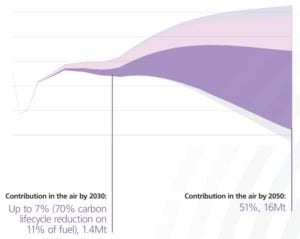
By 2030, Heathrow aims to reduce flight-related emissions by up to 15% compared to 2019 levels. Achieving this depends heavily on scaling up SAF use and improving aircraft efficiency.
Looking further ahead, the airport targets at least an 80% reduction in emissions by 2050. The remaining emissions would need to be removed from the atmosphere to achieve full net zero.
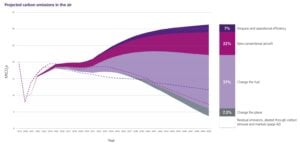
Heathrow’s main roadmap assumes three key developments: continued improvements in aircraft efficiency, introduction of zero-carbon aircraft from the mid-2030s, and large-scale replacement of fossil jet fuel with SAF. In its lead scenario, SAF could replace up to 90% of remaining kerosene by 2050, delivering major lifecycle carbon savings.
There is also a more ambitious scenario in which fully synthetic fuels with near-zero lifecycle emissions replace all fossil-based jet fuel by mid-century.
Use of Hydrogen and Drop-in SAF
Hydrogen-powered aircraft could also play a role in aviation’s future. These planes may use hydrogen in fuel cells or burn it directly in turbines. However, experts expect hydrogen aircraft to serve mainly short-haul routes by 2050.
Shorter flights represent about 30% of global aviation emissions. Long-haul flights, which account for roughly 70%, will likely continue to depend on liquid fuels for decades. For those routes, drop-in SAF remains the most practical and scalable solution.
Heathrow says it must prepare its infrastructure to support hydrogen aircraft while keeping a strong focus on expanding SAF use for conventional planes.
Global SAF Market Reaches a Turning Point
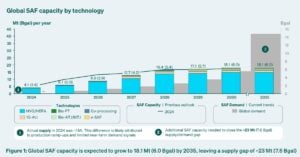
The year 2025 marks a major shift for the global SAF market. Blending mandates in both the European Union and the UK have begun to drive demand growth. SAF demand in the EU could reach about 0.9 million tonnes in 2025, while the UK could require around 0.25 million tonnes. Globally, total demand may approach 2 million tonnes this year.
Industry report says, by 2030, global SAF demand could climb to 15.5 million tonnes. Around 4.4 million tonnes of that would come from existing mandates, while the rest would depend on new policies, incentives, and voluntary airline commitments. Nearly 60 airlines have pledged to use 10% SAF by 2030, creating additional market momentum.
However, supply remains fragile. Announced global SAF production capacity for 2030 stands at about 18 million tonnes. While this appears enough on paper, delays and project cancellations in Europe, the UK, and the United States have raised concerns. Lower fossil fuel prices, policy uncertainty, and broader economic pressures have slowed some investments.
Beyond 2030, the challenge grows even larger. By 2035, global SAF demand could reach 40 million tonnes. Meeting that level will require rapid expansion of production capacity over a short period.
A Strong Signal to the Aviation Industry
Heathrow’s decision to exceed the national SAF mandate sends a clear message. Airports can influence the pace of decarbonization, not just governments and airlines.
By offering financial incentives and committing to higher SAF uptake, Heathrow strengthens confidence in the long-term growth of sustainable aviation fuel. Whether supply can scale fast enough remains the key question. For now, the airport’s 5.6% SAF target for 2026 marks a bold and practical step toward cleaner aviation.