

Equinor, long viewed as a global leader in carbon capture and storage (CCS), is slowing its near-term investment plans. The company said market conditions are not yet strong enough to support new large-scale CCS commitments, even though it has decades of technical expertise in the field.
As per reports, during its latest earnings call, CEO Anders Opedal acknowledged that CCS demand is developing more slowly than expected. As a result, Equinor will wait before approving new projects. The company remains willing to invest, but only when it sees clear customer demand, stable policy frameworks, and commercially viable contracts that can deliver solid returns.
In short, the technology is ready. The market signals are not.
Equinor Shifts Focus From Carbon Capture to Core Oil and Gas Returns
The reassessment is now visible in the company’s capital allocation plans. Equinor confirmed it will reduce capital expenditure by about $4 billion across 2026 and 2027 in its latest earnings report. Most of the reductions will affect its low-carbon solutions and power segment, which includes CCS, hydrogen, and ammonia.
At the same time, the company is sharpening its focus on profitability and cash flow. It plans to further develop the Norwegian Continental Shelf, pursue targeted growth in international oil and gas, and build an integrated power business.
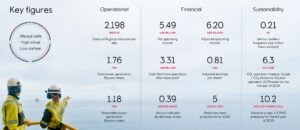
- Equinor also aims to reduce operating costs by 10% in 2026 and deliver around 3% oil and gas production growth that year.
- For 2026 and 2027, it is targeting a return on average capital employed of roughly 13%.
However, the company’s financial performance has been solid. It reported 6% production growth in the fourth quarter and 3.4% growth for the full year. Portfolio “high-grading” and cost discipline remain central to its strategy. In this context, projects must compete for capital based on returns and risk. At present, large-scale CCS expansion does not yet meet those thresholds.
Low-Carbon Growth and Net-Zero Path
In its sustainability report, the company revealed that it has plans to keep investing in strong upstream projects while cutting emissions. It will prioritize existing infrastructure and factor carbon intensity into every portfolio decision. By producing cost-efficient barrels with lower emissions, Equinor aims to protect long-term value and maintain its license to operate responsibly.
At the same time, the company is investing in the energy transition. It is building renewable power, expanding low-carbon solutions, and applying its offshore engineering and subsurface expertise beyond oil and gas.
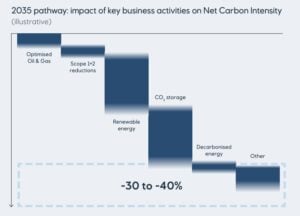
- It targets10–12 GW of installed renewable capacity by 2030 and aims for 30–50 million tonnes of CO₂ transport and storage capacity by 2035.
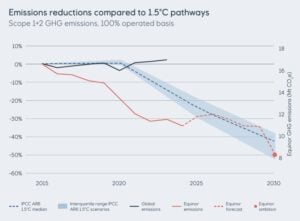
- It also plans to reach net zero across Scope 1, 2, and 3 emissions by 2050, with a 50% cut in operated emissions by 2030 from 2015 levels.
CCS remains central to these efforts. Equinor has safely stored millions of tonnes of CO₂ offshore Norway and continues developing transport networks connecting European industry to North Sea storage sites. Scaling CCS further will depend on stable policies, strong government support, and clear industrial demand.
Norway’s Storage Potential Remains Strong
Equinor has spent more than 20 years developing CCS capabilities and has participated in over 40 research projects. Norway’s offshore geology provides a natural advantage. The seabed beneath the North Sea is considered highly suitable for long-term CO₂ storage and could potentially hold the equivalent of 1,000 years of Norway’s emissions.
Technically, the country is well-positioned to serve as a major European CO₂ storage hub. However, geology alone does not guarantee investment. Storage capacity must match real and committed capture volumes. Without enough industrial CO₂ flows secured under contract, storage sites cannot operate at scale.
Carbon Capture and Storage: A Growing Market With Real Barriers
As per Fortune Business Insights, the global carbon capture and sequestration market is still projected to expand. In 2025, the market was valued at around $4.51 billion. It is expected to approach $20 billion by 2034, reflecting strong long-term growth projections. North America currently leads the sector, supported by government incentives and operational CCS facilities.

CCS technology captures carbon dioxide from industrial sources or power plants, transports it by pipeline or ship, and stores it deep underground in geological formations. Storage often takes place in saline aquifers or depleted oil and gas reservoirs. In some cases, CO₂ is used for enhanced oil recovery, increasing oil production while storing emissions underground.
Despite this momentum, the industry faces clear challenges. CCS infrastructure requires high upfront capital. Projects involve complex regulation, long development timelines, and cross-border coordination. Most importantly, they require dependable revenue streams backed by firm customer commitments.
Equinor’s decision reflects these economic realities.
Decarbonization Delays Weaken Near-Term CCS Demand
The company emphasized that one of the biggest challenges is changing customer timelines. Just a few years ago, many industrial buyers of natural gas were actively exploring hydrogen supply and CO₂ transport and storage services. Decarbonization plans appeared urgent.
Today, that urgency has softened. Many of those same customers continue to buy gas, but they have pushed major emissions reduction commitments further into the future. Instead of focusing on projects before 2030, companies are now extending targets beyond that date.
This shift has weakened near-term demand for CCS services. Large storage projects depend on aggregating significant volumes of captured CO₂ under long-term contracts. Without those volumes, it becomes difficult to justify multi-billion-dollar infrastructure investments.
Although regulatory frameworks for CO₂ transport and storage have improved, progress on capture facilities and permitting has slowed. Policies are advancing, but the pipeline of ready-to-build projects is not growing at the same pace. For CCS to work commercially, capture projects, transport networks, storage hubs, and long-term contracts must move forward together. Right now, those pieces are not fully aligned.
A Reality Check for the CCS Sector
Equinor’s cautious stance highlights a broader reality facing the carbon capture industry. CCS is widely seen as essential for decarbonizing hard-to-abate sectors such as cement, steel, and chemicals. Many global net-zero pathways depend on large-scale deployment before 2030.
Yet technical readiness is not enough. Projects require predictable carbon pricing, stable long-term policy support, and customers willing to sign binding agreements. Without those elements, even experienced developers will hesitate.
The slowdown does not signal the end of CCS. Market forecasts still point to significant expansion over the next decade. However, deployment may not move as quickly as earlier expectations suggested.
Equinor’s message is clear. Climate ambition must translate into commercial commitment. Until customer demand strengthens and revenue visibility improves, capital will remain cautious. And for now, it is choosing discipline over speed. The company stands ready to invest when the economics make sense. But it will not move forward on optimism alone.