

Google announced a major new project: it will support a U.S. power plant outfitted with carbon-capture and storage (CCS) technology. The plant, owned by Broadwing Energy in Decatur, Illinois, will capture about 90% of its CO₂ emissions. The tech giant agreed to buy most of the electricity the plant produces.
By backing this plant, Google aims to help build a reliable, low-carbon power source for its data centers in the U.S. Midwest. It also hopes to speed up the use of CCS technology globally.
The Science of Trapping Carbon: How CCS Works
CCS stands for carbon capture and storage. It involves three main steps:
- Capture: Pulling CO₂ from a power plant or factory.
- Transport: Moving the CO₂, often via pipelines.
- Store: Injecting the CO₂ deep underground where it can’t escape.
This technology is especially important for power plants that burn natural gas or coal. It is also key for factories in heavy industries, like steel and cement, which produce large emissions.
Global experts such as the International Energy Agency (IEA) and the Intergovernmental Panel on Climate Change (IPCC) say CCS will play a major role in reaching climate goals.
Google’s deal highlights this role. By linking a power plant deal to its own data center needs, the company is showing how big tech can strengthen the clean energy transition.
Inside Google’s Illinois CCS Project
The Illinois plant will be a natural 5gas power facility built by Broadwing Energy. It will capture up to 90% of the CO₂ it produces. Google will buy the bulk of its electricity output.
The plant is sized at more than 400 megawatts (MW). It will include advanced equipment and a large carbon-capture unit. The deal was announced by Google and infrastructure partner I Squared Capital (through its affiliate Low Carbon Infrastructure).
Google said the project will feed power to its data centers in the region, help reduce emissions, and make clean “firm power” (power available around the clock) more affordable. This is important because many renewable sources like wind and solar have variable output.
Google stated:
“Today we’re excited to announce a first-of-its-kind corporate agreement to support a gas power plant with CCS. Broadwing Energy, located in Decatur, Illinois, will capture and permanently store approximately 90% of its CO2 emissions. We hope it will accelerate the path for CCS technology to become more accessible and affordable globally, helping to increase generating capacity while enabling emission reductions.”
How Big is the CCS Market?
The CCS market has grown rapidly. One estimate values it at $8.6 billion in 2024, with a projected annual rate of 16% through 2034. At that pace, the market could reach $51.5 billion by 2034.
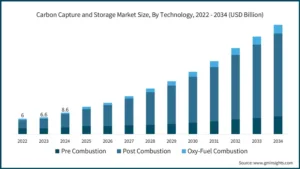
Another estimate places the market size in 2024 at $3.68 billion, with growth to $5.61 billion by 2030. The power generation sector is a major part of the market. One report says 37% of the market was from power generation in 2024.
For data centers and tech companies like Google, CCS offers reliable low-carbon power. Given that global data center emissions may reach 2.5 billion tons of CO₂ through 2030, major tech firms are under pressure to decarbonize.
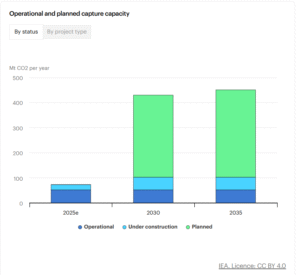
Experts also project that global CCS capacity will quadruple, reaching around 430 million tonnes of CO₂ per year from today’s 50 million tonnes. Investments of about $80 billion are expected over the next five years. North America and Europe currently lead, holding roughly 80% of growth projects, while China and other regions also scale up.

CCS currently addresses only 6% of the emissions needed for net-zero by mid-century. Experts still see it as key for hard-to-decarbonize industries like cement, steel, and hydrogen production.
Breaking New Ground in Clean Firm Power
This is the first time a major tech company has agreed to buy electricity from a power plant using CCS at this commercial scale in the U.S.
The deal brings several important benefits:
- Google secures “firm” power for its data centers, reducing risks from intermittent renewable supply.
- CCS gives a path to cut emissions from fossil fuel plants rather than shutting them down entirely.
- It creates a business model for future CCS deals, making the technology more accessible and scalable.
For Google, the deal advances its goal of running on clean energy and especially 24/7 carbon-free power by 2030. For the broader industry, it sends a signal that large corporations support CCS and are willing to back it financially.
Hurdles Ahead for Carbon Capture
Despite the promise, CCS still faces hurdles. The upfront cost is high, and many projects require government incentives or strong contracts to make economic sense.
Another challenge is scale. According to a 2024 study, CCS capacity by 2030 may reach only 0.07–0.37 gigatonnes (Gt) CO₂ per year, which is just a small part of what’s needed to meet climate goals.

For Google’s project and others like it to succeed, they will need strong regulation, clear carbon pricing, and reliable storage sites. Also, transparency and long-term monitoring are critical to ensure the CO₂ stays underground.
The Illinois plant is a start. If it runs successfully, it could spawn many more projects in power generation and industry. Corporations, utilities, and governments may replicate the model.
The Big Picture: From Data Centers to Decarbonization
Tech companies are building ever-larger data centers to fuel artificial intelligence, cloud computing, and global connectivity. This drives huge electricity demand. Google’s CCS deal shows one way to manage that demand while cutting carbon.
CCS combined with clean power can help sectors that cannot easily switch to renewables. Power plants that run on natural gas or industries like cement and steel may use CCS to reduce emissions.
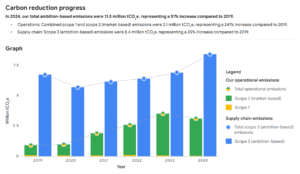
For Google, the new deal helps it reach its sustainability targets, supports its data-center operations, and sets an example for other firms. The chart below shows the company’s emission reduction progress. For the climate, it offers a template for building low-carbon power systems at scale.
Final Thoughts: A Pivotal Moment for Clean Power
Google’s agreement signals a shift: clean, firm power is becoming a business reality, not just a promise. By backing a CCS-enabled gas power plant, Google is aligning business needs with carbon reduction goals.
The global CCS market is expanding fast. Estimates show billions of dollars flowing into the technology. But scaling remains challenging — cost, policy, and geology all play a role.
If the Illinois plant succeeds, it may influence how corporations, utilities, and governments design power systems in the future. It could help unlock CCS as one of the tools in the broader energy transition toolbox.