

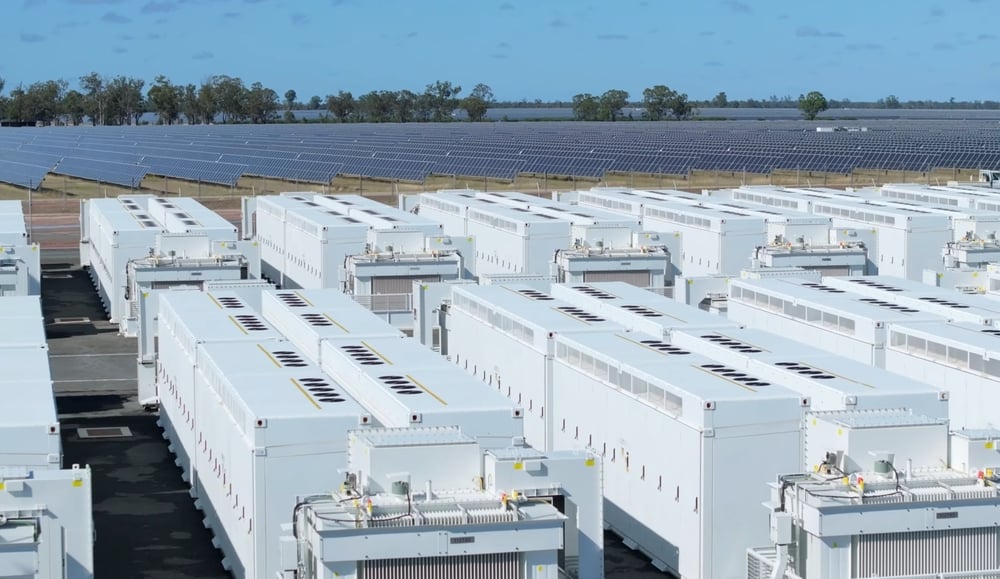
The clean energy industry has reached another major milestone. Abu Dhabi Future Energy Company (Masdar) has secured financial close for the world’s first gigascale renewable energy project capable of delivering clean electricity around the clock. The landmark project combines one of the world’s largest solar power plants with a massive battery energy storage system, proving that renewable energy can provide reliable power 24 hours a day.
The project represents a total investment of US$6.1 billion, including a US$5.1 billion financing package backed by a group of 13 leading international and local banks. The deal highlights growing investor confidence in large-scale renewable energy projects that can supply continuous electricity while reducing dependence on fossil fuels.
A New Era for Round-the-Clock Clean Energy
Renewable energy has expanded rapidly over the past decade. However, one challenge has remained—solar panels only generate electricity when the sun shines. As countries increase their use of renewable energy, storing excess electricity has become essential to ensure a stable power supply.
Masdar’s new project addresses this challenge.
Developed in partnership with the Emirates Water and Electricity Company (EWEC), the project combines:
- 5.2 gigawatts (GW) of solar photovoltaic (PV) capacity with a 19 gigawatt-hour (GWh) battery energy storage system (BESS).
- Together, these facilities will provide 1 GW of uninterrupted clean electricity, day and night
This makes it the largest and most advanced integrated solar-plus-storage project built to date.
The project demonstrates that renewable energy is no longer limited to producing electricity only during sunny or windy periods. Instead, large battery systems can store surplus solar power during the day and release it when demand remains high after sunset.
As electricity demand continues to grow worldwide, this model could become increasingly important for future power systems.
Strong Financial Backing
The project’s financial close also marks an important achievement for renewable energy financing.
Masdar secured a US$5.1 billion financing package from a consortium of 13 banks, while contributing US$1 billion in equity, bringing the total project investment to US$6.1 billion.
The participating lenders include:
- Abu Dhabi Commercial Bank
- Abu Dhabi Islamic Bank
- BNP Paribas
- Bank of China
- Crédit Agricole Corporate and Investment Bank
- Dubai Islamic Bank
- First Abu Dhabi Bank
- HSBC
- KfW IPEX-Bank
- Natixis
- Sumitomo Mitsui Banking Corporation
- Standard Chartered Bank
- Société Générale
The participation of both regional and global financial institutions reflects growing confidence that large renewable energy projects with integrated storage have become commercially viable.
Unlike earlier renewable developments that depended heavily on government support, this financing shows investors increasingly view next-generation clean energy infrastructure as a stable long-term investment.
Masdar’s Solar and BESS Project Sets a New Standard
Electricity demand is growing faster than ever. Artificial intelligence, cloud computing, hyperscale data centers, electric vehicles, advanced manufacturing, and digital infrastructure are all increasing power consumption across the world.
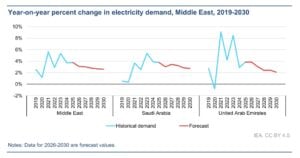
According to the IEA, electricity demand in the Middle East grew by 3.8% in 2025, slightly faster than the 3.7% increase recorded in 2024. The UAE contributed about 12% of the region’s total demand growth.
At the same time, governments are working to reduce greenhouse gas emissions and replace fossil fuel generation with cleaner alternatives. This creates a major challenge: power grids need electricity every hour of every day—not just when renewable resources are available.
Bridging the Gap
And this Large-scale battery storage helps bridge that gap. By storing excess solar electricity during daylight hours and supplying it overnight, projects like Masdar’s can improve grid reliability while reducing carbon emissions.
The Abu Dhabi project is expected to serve as a model for future renewable developments seeking to provide baseload-style clean electricity.
Apart from this, Masdar has invested in several storage technologies over the years. One of its early projects was Spain’s Gemasolar concentrated solar power facility, which became the world’s first commercial renewable plant to use molten salt thermal storage.
In 2022, the company also acquired UK-based battery storage developer Arlington Energy, with plans to expand battery storage capacity across the United Kingdom.
The Abu Dhabi project builds on those earlier investments. It is expected to serve as a model for future renewable developments seeking to provide baseload-style clean electricity.
- ALSO SEE: TotalEnergies and Masdar’s $2.2 Billion Deal Signals a Big Push into Asia’s Renewable Energy Boom
Aligning with UAE’s Clean Energy Target
Masdar officially broke ground on the project in October 2025, with commercial operations expected to begin in 2027. Once completed, it will become a key part of the United Arab Emirates’ clean energy strategy, supporting both energy security and economic diversification.
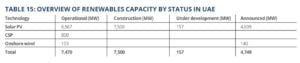
The project also aligns with the UAE’s long-term efforts to increase renewable energy generation while reducing dependence on conventional fuels. Currently, the country’s total installed capacity is more than 7.4 GW at the end of 2025, and 7.5 GW are under construction.
Renewable Energy Ambitions
Currently, Masdar has expanded its renewable energy portfolio significantly over the past few years.
- Its renewable generation capacity increased from 20 GW in 2022 to more than 51 GW in 2024, spanning projects across solar, onshore wind, offshore wind, battery storage, and hybrid renewable systems.
It further plans to nearly double that figure, targeting 100 GW of renewable energy capacity by 2030 through investments across established and emerging markets.
The company says this expansion reflects its commitment to providing affordable, reliable clean electricity while supporting global decarbonization efforts.
Masdar Is Cutting Millions of Tonnes of Carbon Emissions
Beyond generating electricity, Masdar’s renewable portfolio is delivering measurable climate benefits.
In 2024, the company’s operating renewable assets displaced approximately 15.5 million tonnes of carbon dioxide annually. This demonstrates the growing role that utility-scale renewable projects can play in reducing global greenhouse gas emissions.
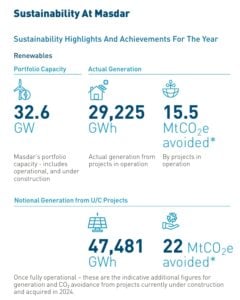
Masdar also reports its emissions using internationally recognized Greenhouse Gas (GHG) Protocol standards. The company tracks emissions under both the equity share and financial control reporting approaches to improve transparency.
Alongside emissions reporting, Masdar continues to focus on improving energy efficiency, conserving water resources, and reducing environmental impacts across its operations.
The company is also developing a broader sustainability strategy that includes its long-term pathway toward achieving net-zero emissions, supported by renewable energy use, greater operational efficiency, and carbon reduction initiatives.
A Blueprint for Future Renewable Projects
The successful financial close sends an important message to global investors and policymakers.
Large renewable energy projects that combine solar generation with advanced battery storage are no longer experimental concepts. They are becoming commercially bankable infrastructure capable of attracting billions of dollars in private financing.
As countries seek to meet growing electricity demand while reducing emissions, similar integrated renewable projects are likely to become more common.
For Masdar, the project reinforces its position as one of the world’s leading clean energy developers. For the broader renewable energy industry, it demonstrates that reliable, 24/7 clean electricity is moving from ambition to reality.
With operations expected to begin in 2027, the Abu Dhabi project could establish a new global benchmark for utility-scale renewable energy, showing how solar power and battery storage can work together to provide dependable, low-carbon electricity every hour of every day.