

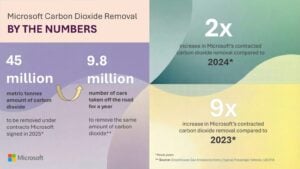
Microsoft sharply expanded its carbon removal activity in 2025. The company announced that it signed agreements covering 45 million metric tonnes of carbon dioxide removal in a single year. This total is more than double the volume the tech giant contracted in 2024 and marks its largest annual increase to date.
The new figure reflects a rapid scale-up in Microsoft’s climate strategy. Since launching its carbon-negative goal, the company has steadily increased its purchases of carbon removal credits.
Microsoft states that these agreements focus on high-quality carbon removal, not avoided emissions. The company prioritizes methods that physically remove carbon dioxide from the atmosphere and store it for long periods.
Phil Goodman, Director of the carbon removal portfolio at Microsoft, remarked:
“With any form of carbon removal, you need someone out there to buy the credits so that the economic model works. By securing that forward demand commitment, suppliers can actually go raise financing, hire staff, and build out their projects. We buy only a fraction of a project’s total credits, and we hope other companies can make faster procurement decisions knowing that projects in our portfolio underwent deep due diligence.”
Mixing Nature and Tech: How Microsoft Removes Carbon
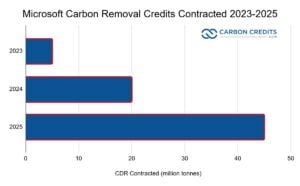
In 2023, Microsoft contracted about 5 million tonnes. In 2024, that number rose to roughly 20 million tonnes. The jump to 45 million tonnes in 2025 signals a shift from pilot-scale deals to long-term market building.
The 45 million tonnes come from a wide range of carbon removal pathways. Microsoft spreads its purchases across both engineered and nature-based solutions. This approach helps reduce risk and supports multiple technologies at once.
Key removal methods in Microsoft’s portfolio include:
- Direct Air Capture (DAC), where machines pull CO₂ directly from the air and store it underground
- Bioenergy with carbon capture and storage (BECCS), which captures emissions from biomass energy and locks them away
- Enhanced weathering, which accelerates natural rock processes that absorb carbon
- Afforestation and reforestation, which store carbon in trees and soils
- Soil carbon projects, which increase carbon stored in farmland
Microsoft confirmed that a growing share of its 2025 agreements came from durable removals, meaning storage lasting hundreds to thousands of years. This includes DAC, BECCS, and mineralization projects.
The company also works with suppliers across North America, Latin America, Europe, Asia, and Africa. This global spread helps scale carbon removal beyond a few regions. As noted by Microsoft, the goal of all these efforts is to:
“…help restore carbon balance lost through carbon dioxide emissions generated by modern life – from agriculture and construction to chemical and energy production.”
Why Microsoft Is Scaling Carbon Removal So Fast
Microsoft’s emissions have risen in recent years. The company reported that its Scope 1, 2, and 3 emissions were up more than 30% from 2020 levels by the early 2020s. The main driver is rapid growth in data centers, cloud services, and AI computing.
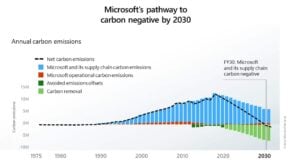
AI systems require large amounts of electricity and hardware. This has made it harder for Microsoft to reduce emissions through efficiency alone. Carbon removal now plays a key role in balancing residual emissions that cannot be eliminated quickly.
Microsoft’s climate targets are clear:
- Carbon negative by 2030, removing more CO₂ than it emits each year
- 100% renewable electricity for operations
- Net-zero water use in stressed regions by 2030
- Remove all historical emissions by 2050
The company sees carbon removal as essential to meeting these goals. Microsoft states that emissions reductions remain the priority. Carbon removal comes after efficiency, clean energy, and supply-chain action.
SEE MORE:
- Microsoft’s Mega Move: 18 Million Carbon Credit Deal with Rubicon Carbon
- Microsoft’s $800M Carbon Removal Deal Sets Record in Climate Fight
- Microsoft Buys 2 Million Tons of Carbon from Rubicon Carbon’s Uganda Forestry Project
Microsoft Anchors a Growing Market
Microsoft leads the carbon removal market, but other large buyers are also active. In the first half of 2025, companies signed at least 61.5 million tonnes of carbon removal offtake agreements worldwide. Microsoft accounted for about 56.3 million tonnes, or roughly 91% of that total. This shows how concentrated demand still is among a few major buyers.
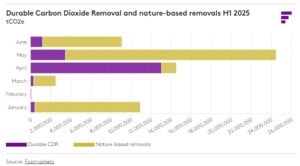
Other tech firms are contributing at smaller scales. Google signed carbon removal agreements totaling about 728,300 tonnes of CO₂ across multiple projects.
Financial institutions such as JPMorgan Chase have also purchased durable removal credits, including BECCS and DAC. In addition, companies including Google and Stripe are part of a coalition that plans to spend $1 billion on carbon removal by 2030.
Nature-based removal also plays a role. Large firms, including Microsoft, Google, Meta, and Salesforce, have committed through joint initiatives to secure up to 20 million tonnes of nature-based carbon removal credits by 2030. These projects focus on forests, soils, and other land-based solutions.
The carbon removal market remains small but is growing fast. In 2024, total carbon removal purchases reached nearly 8 million tonnes, up 78% from 2023. Most purchases still come from repeat buyers with long-term climate targets.
Looking ahead, McKinsey & Company estimates the carbon removal market could reach $40 billion to $80 billion per year by 2030. If the industry scales to meet climate needs, annual revenues could rise to between $300 billion and $1.2 trillion by 2050. These forecasts depend on falling costs, strong standards, and broader corporate participation.

Overall, demand is expanding, but leadership remains concentrated. Microsoft’s scale helps anchor the market, while smaller commitments from other firms show early signs of wider adoption.
Trust in the Numbers: MRV Matters
Microsoft places strong emphasis on Measurement, Reporting, and Verification (MRV). Each project must prove how much carbon it removes and how long it stays stored. The big tech firm works with independent third-party verifiers and recognized carbon standards.
The company also applies internal quality criteria. These include permanence, additionality, and low risk of reversal. Projects that fail to meet these benchmarks do not qualify.
Microsoft states that improving MRV systems remains a priority. Accurate data builds trust and supports long-term market growth. This focus also reflects broader industry concerns about credibility in voluntary carbon markets.
Hurdles Ahead: Costs, Supply, and Permanence
Despite rapid growth, carbon removal faces several hurdles:
- High costs: DAC and other engineered methods can cost hundreds of dollars per tonne
- Limited supply: Most technologies remain early-stage
- Long development timelines: Infrastructure takes years to build
- Risk of reversals in nature-based projects
Microsoft acknowledges these limits. The company says large early purchases help push costs down over time through learning and scale. This mirrors how renewable energy prices fell after early corporate and policy support.
The Future of Corporate Carbon Removal
Microsoft plans to continue expanding its carbon removal portfolio beyond 2025. The company expects annual contracting volumes to remain high as AI and cloud growth continue.
Other large firms are following similar paths. Technology companies, airlines, and consumer brands are increasingly signing long-term removal contracts. However, none yet match Microsoft’s scale.
The 45 million tonnes contracted in 2025 mark a turning point. Carbon removal is shifting from niche pilots to a recognized climate tool. Microsoft’s approach shows how corporate demand can help build an entirely new climate industry.
As global emissions remain high, the role of carbon removal is likely to grow. Microsoft’s strategy offers one of the clearest examples to date of how large buyers are shaping this emerging market.