


NVIDIA’s latest earnings report shows the scale of the AI boom. The chipmaker reported record revenue and became the fourth U.S. tech company to exceed $100 billion in annual profit. Alongside financial growth, Nvidia continues to push renewable energy use and efficiency gains. The results highlight the growing link between AI expansion and sustainability challenges.
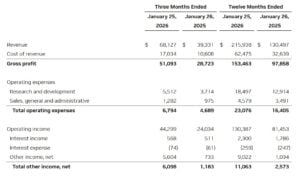
NVIDIA reported record revenue of $68.1 billion for the fourth quarter of fiscal 2026, ending January 25, 2026. This figure was up 73% from a year earlier and up 20% from the prior quarter. Data center sales, which fuel artificial intelligence (AI) growth, were $62.3 billion, or about 91% of total revenue in the quarter.
For the full fiscal year, NVIDIA posted $215.9 billion in revenue, a jump of 65% from the prior year. Net income reached tens of billions, $120,067 million for the full year and $42,960 for the 4th quarter. Earnings per share also grew significantly.
These results exceeded most analysts’ expectations and underscored NVIDIA’s continued leadership in AI compute hardware. The company also forecast strong revenue for the first quarter of fiscal 2027.
NVIDIA’s Sustainability Commitments at a Glance
NVIDIA has increasingly highlighted its environmental and sustainability goals in recent years. For the fiscal year 2025, the company achieved 100% renewable energy use for all offices and data centers it directly controls.
The renewable supply came from a mix of:
- On-site generation
- Purchased renewable electricity
- Energy attribute certificates (EACs)
- Power purchase agreements (PPAs)
This milestone eliminates the company’s market-based Scope 2 emissions tied to electricity use in those facilities.
While operational emissions from electricity have been addressed, total emissions figures remain complex. NVIDIA reported that its total greenhouse gas emissions increased. This includes Scope 3 emissions linked to its supply chain and purchased goods. Scope 3 emissions accounted for the bulk of its emissions inventory, and they rose significantly year-over-year.
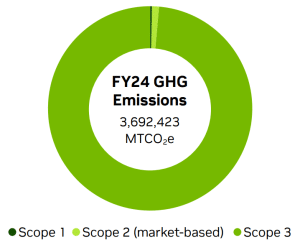
NVIDIA has also incorporated science-based targets and reduction plans into its public disclosures. The company aims to cut direct (Scope 1) and electricity-related (Scope 2) emissions by about 50% by 2030. This is based on its baseline figures. These science-based targets are consistent with internationally recognized climate frameworks.
Beyond energy use, NVIDIA has implemented other environmental actions. Closed-loop liquid cooling systems in data centers help cut water use. Also, there are significant increases in recycling electronic waste each year.
AI Performance Per Watt: NVIDIA’s Efficiency Edge
NVIDIA’s technology can influence emissions well beyond its own operations. The company’s GPUs and systems power AI infrastructure around the world. Many of these systems are designed to be energy efficient.
For example, NVIDIA-based systems dominate rankings of the most energy-efficient supercomputers globally. The Green500 list ranks systems based on energy efficiency.
Many top entries use NVIDIA GPUs, especially the advanced Grace Hopper architecture. These systems deliver high computing performance per watt of power, helping labs and data centers run complex workloads with less energy.
Record Profits, Cautious Market Reaction
Despite the strong financial performance, NVIDIA’s share price movement highlights market nuances. Some reports noted that after an initial uptick in after-hours trading, the stock’s gains flattened or reversed. This response came even as NVIDIA beat revenue and profit expectations.
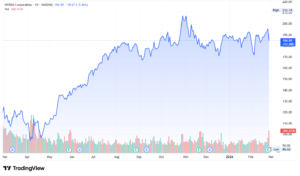
Analysts point to broader concerns about the valuation of high-growth AI stocks. Investors are cautious despite strong earnings. They worry about how fast AI demand will grow and whether valuations show future risks.
In early 2026, NVIDIA’s stock had also seen uneven performance year-to-date. Some analysts believe the trading pattern after earnings shows sector sentiment more than the company’s actual results.
NVIDIA’s profit scale also stands out compared with other major U.S. tech firms. For fiscal year 2026, the tech giant reported $120 billion in net income. This made it the fourth U.S. tech company ever to exceed $100 billion in annual profit, joining Alphabet, Apple, and Microsoft.
- NVIDIA’s result trails only Alphabet’s $132 billion profit in 2025, which remains the largest annual profit ever recorded by a U.S. company.
The speed of NVIDIA’s rise is also notable. Just three years ago, the company’s annual net income was $4.4 billion. In its most recent quarter, the chipmaker generated that amount in less than 10 days.
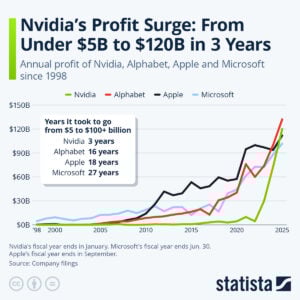
By comparison, Apple took 18 years to grow from $5 billion in annual profit to $112 billion, beginning around the launch of the iPhone in 2007. Microsoft took 27 years to move from $5 billion to more than $100 billion in annual profit. Alphabet first crossed the $100 billion mark in 2024. NVIDIA hit this milestone in under three years. CEO Jensen Huang pointed out the company’s AI gains in May 2023.
Efficiency Gains vs. Expanding Energy Footprint
NVIDIA’s external ESG ratings are similar to those of other tech companies for environmental and governance metrics. However, the scores vary in social and supply chain areas. These ratings consider things like how well companies disclose information, their plans for cutting emissions, and their governance. They also look at challenges related to wider supply chain emissions.
One sustainability ranking highlighted a “paradox” in NVIDIA’s performance. It noted that NVIDIA’s chips are among the most energy-efficient in the world, which boosts its sustainability profile. The quick rise in total energy use for AI infrastructure is increasing overall environmental impacts. This happens even as per-unit efficiency improves.
NVIDIA’s renewable energy goals and efficiency gains have positioned it as a leader. It combines strong finances with sustainable growth. For instance, in a 2026 list of top firms for sustainable growth, NVIDIA stood out. It achieved 100% renewable energy for its offices and data centers. Plus, its GPU platforms are energy efficient.
Can AI Hypergrowth Align With Climate Targets?
NVIDIA’s sustainability strategy focuses on three key areas:
- Reducing direct and indirect emissions.
- Improving energy use.
- Enhancing reporting transparency.
The company has achieved important goals. It now uses renewable energy for its facilities. It has also improved chip efficiency. These steps show progress toward environmental goals.
Still, rising Scope 3 emissions and the booming demand for AI compute make tackling environmental impacts more complex. NVIDIA’s sustainability reports highlight that energy use in data centers is a major barrier. This limits both digital infrastructure growth and climate progress.
Energy-intensive “AI factories” — large data centers running training and inference workloads — require large power supplies, often on par with traditional industrial factories. This growth in demand puts pressure on energy systems to shift toward low-carbon sources.
NVIDIA’s efforts to work with suppliers on emissions targets and its investments in energy efficiency aim to address parts of this challenge. But the company has not yet announced a full net-zero emissions target with a fixed date.
So, What Comes Next for NVIDIA?
In the near term, NVIDIA will likely continue to be a focal point for both earnings performance and ESG debate. Future earnings releases and sustainability reports will show whether the company’s actions keep pace with its growth.
Investors and stakeholders will watch how NVIDIA manages AI demand, emissions challenges, and energy efficiency together.
On the sustainability side, developing and reporting progress on Scope 3 emissions, supplier engagement, and potential net-zero pathways will shape ESG evaluations. As AI energy use rises worldwide, companies like NVIDIA will face more scrutiny over how they balance growth with their emissions and climate impact.
Overall, NVIDIA’s record earnings and sustainability efforts highlight its role in tech innovation and environmental change. The company balances rapid AI growth with a commitment to lowering its environmental impact.