

Royal Philips has entered the European green bond market with a €650 million issuance that marks a significant step for sustainable finance in the healthcare industry.
The health technology company has priced fixed-rate notes due in 2034 under its European Medium Term Note program. More importantly, Philips says the issuance is the first green bond from the healthcare industry to be issued under the European Union’s European Green Bond Standard, or EuGB.
The move gives Philips access to green financing while setting a higher bar for how healthcare companies can connect debt financing with measurable environmental objectives.
A New Standard for Green Financing
The European Green Bond Standard was created by the European Union to strengthen credibility and reduce greenwashing in the rapidly expanding sustainable finance market.
Unlike conventional green bonds, an EuGB must meet specific requirements linked to the EU Taxonomy. The framework requires issuers to direct bond proceeds toward economic activities that meet defined environmental criteria. It also introduces detailed disclosure requirements and external review.
The standard is voluntary, but it is designed to provide investors with a more consistent way to assess whether green bonds are actually financing environmentally sustainable activities. The European Commission describes the framework as a “gold standard” for green bonds.
The regulatory framework has also continued to develop. In 2025 and 2026, the EU introduced additional rules covering external reviewers, reporting templates and other implementation requirements, strengthening the infrastructure around the EuGB market.
For Philips, issuing under the standard therefore represents more than a green label. It places the company’s financing plans within one of Europe’s most closely defined sustainable finance frameworks.
Where Philips Will Put the Money
The press release revealed that the company plans to use an amount equivalent to the gross proceeds to finance economic activities aligned with the EU Taxonomy.
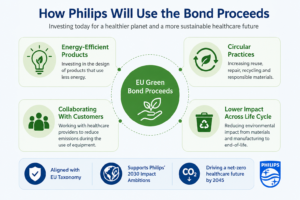
- Its green bond framework focuses heavily on the circular economy and on reducing the environmental impact of healthcare products and operations.
- It includes supporting the design of more energy-efficient products, increasing the use of circular practices, and working with customers to reduce emissions generated during the use of Philips equipment.
This approach is particularly relevant to healthcare because medical equipment can remain in service for many years. Energy consumption, materials, maintenance and end-of-life treatment can therefore influence a product’s environmental footprint long after it leaves the factory.
Philips has been incorporating these considerations into its product development strategy through its EcoDesign approach. The company says its product design work focuses on areas including energy efficiency, packaging, materials and circularity.
The green bond can help bring that strategy closer to the company’s capital allocation decisions.
The Financing Fits Philips’ Broader Climate Strategy
The bond comes as Philips begins implementing its new 2030 Impact Ambitions.
The company aims to reduce its absolute environmental impact across its value chain while moving toward net-zero greenhouse gas emissions by 2045. Its 2030 targets include a 90% reduction in Scope 1 and 2 emissions from a 2015 baseline and a 42% reduction in Scope 3 emissions from a 2020 baseline.
The focus on Scope 3 is particularly important.
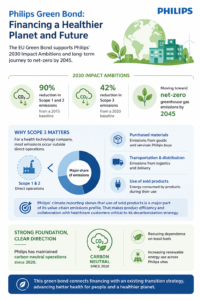
For a health technology company, a large share of emissions can sit outside its direct operations. Purchased materials, transportation, distribution and the energy consumed by products during their use can all contribute to the overall footprint.
Philips’ climate reporting shows that use of sold products is a major part of its value-chain emissions profile. That makes product efficiency and collaboration with healthcare customers important components of its longer-term decarbonization strategy.
The company has also said it has maintained carbon-neutral operations since 2020 while working to reduce its dependence on fossil fuels and increase renewable energy use across its sites.
The new green bond therefore connects financing with an existing transition strategy rather than creating a standalone sustainability initiative.
Strong Investor Backing Could Boost EU Green Bond Market
Investor demand for the issuance was another notable feature. The 2034 notes carry a 4% coupon and were priced at 99.655%, producing a yield of 4.055%. The transaction was 2.7 times oversubscribed, indicating demand for the offering exceeded the amount Philips planned to issue.
The demand is significant because the EuGB market is still developing. A large order book for a healthcare issuer using the new standard could help demonstrate that investors are willing to support bonds with stricter environmental requirements.
For companies, this could eventually make credible green financing a more attractive way to fund capital-intensive sustainability investments.
Philips also said the transaction is not expected to increase net debt. Gross debt will temporarily rise before the company’s 2027 bond maturity is repaid. The notes are scheduled to settle on August 28, 2026, with an application made for listing on the regulated market of the Luxembourg Stock Exchange.
Why Healthcare Matters
The issuance comes at a time when healthcare systems face pressure to improve patient outcomes while managing rising costs, resource consumption and climate risks. Healthcare itself has a substantial environmental footprint. Hospitals consume large amounts of electricity and materials, while medical equipment, pharmaceuticals, transportation and supply chains add further emissions.
That creates an opportunity for health technology companies to reduce emissions not only within their own facilities but also through the products they sell. Philips has positioned energy-efficient and circular products as part of that opportunity. The company says its sustainability strategy is designed to help healthcare customers lower environmental impacts while improving efficiency and maintaining quality of care.
Green financing could reinforce this model by directing capital toward technologies and product development that support those goals.
A Potential Blueprint for Other Companies
The bigger significance of the transaction may extend beyond Philips.
The EU green bond framework is designed to make sustainable debt easier for investors to compare and assess. Its taxonomy requirements, transparency rules and external-review provisions aim to reduce uncertainty around what qualifies as genuinely green investment.
Philips’ transaction demonstrates how the framework can be applied to an industry where environmental benefits are not limited to renewable energy or clean infrastructure. Healthcare companies can also use green finance to support energy efficiency, circular economy models, sustainable product design and lower-carbon supply chains.
That could broaden the role of green bonds as companies across traditionally hard-to-decarbonize sectors look for financing mechanisms that support their transition plans.
For Philips, the €650 million bond provides capital for its sustainability strategy while giving investors exposure to a new category of EU-regulated green debt.
As the European green bond market develops, the transaction could become an important reference point for how healthcare companies use sustainable finance to connect climate commitments with real-world investment.