

Nuclear energy is back in focus in the U.S., fueled by rising power demand, data centers, and new government support. In May 2025, President Trump signed executive orders (EOs) to boost the nuclear industry.
The goal is clear: expand capacity to 400 gigawatts (GW) by 2050, up from about 100 GW today. That would mean building 250–300 new reactors, a scale unseen in decades.
In the near term, the plan targets 10 new reactors by 2030. The EOs also speed up NRC licensing, expand DOE and DOD roles in plant siting, and release government uranium reserves. Additionally, to ease fuel shortages, the White House will also provide 20 metric tons of HALEU to private industry.
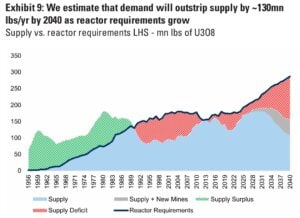
And all these steps could change the course of the U.S. nuclear sector, which is just starting to recover after decades of stagnation. More nuclear reactors will also mean higher demand for nuclear fuel — uranium, the yellow metal.
Nuclear Ambitions and America’s Uranium Supply Gap
A Goldman Sachs report pointed out that the U.S. is the world’s largest uranium consumer, using 29% of global supply each year. Its ~100 reactors represent a quarter of the world’s nuclear capacity.
Much of today’s demand is being fueled by tech giants. Hyperscale data centers require massive amounts of electricity, making clean and reliable power a business necessity. This shift is putting nuclear energy back in focus.
Furthermore, private sector demand is now aligning with government ambitions. Nuclear is increasingly viewed as the only scalable clean energy source that can run 24/7 while meeting both grid needs and the energy appetite of digital industries.
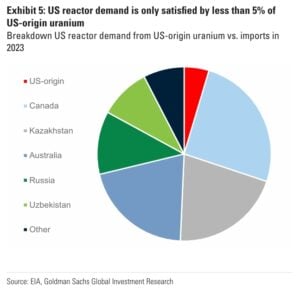
Yet domestic supply tells a different story. The report also says that in 2024, the U.S. produced just 0.7 million pounds of U₃O₈. Production may climb to 3.1 million pounds in 2025, but that still covers only a fraction of the nation’s needs.
This heavy reliance on foreign uranium has long been seen as a national security risk, especially amid geopolitical tensions and fragile supply chains.
Now, with Washington pushing to secure critical minerals, the tide is turning. As America works to build a self-sufficient nuclear fuel cycle, domestic suppliers like Uranium Energy Corp (UEC) will play a pivotal role.
Why Uranium Energy Corp Stands Out
Against this high uranium demand scenario, Uranium Energy Corp (UEC) has emerged as an important player. The company is already America’s largest and fastest-growing uranium supplier. It is focused on In-Situ Recovery (ISR) mining projects in the U.S., as well as high-grade conventional assets in Canada.
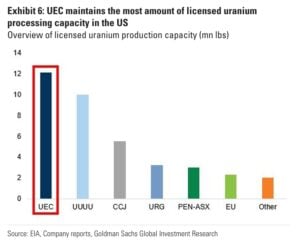
UEC operates three hub-and-spoke platforms across South Texas and Wyoming, with a combined licensed production capacity of 12.1 million pounds of U₃O₈ per year. This gives the company a strong foundation to scale as U.S. nuclear demand accelerates.
More importantly, as a pure-play uranium producer, the company is positioned to directly benefit from federal policies that aim to rebuild a domestic nuclear fuel supply chain. The company’s growth is tied to both rising uranium demand and pricing power in a market where U.S. supply has long fallen short.
UEC Launches Refining and Conversion Subsidiary to Secure U.S. Nuclear Future
In a major step forward, UEC recently announced the creation of the United States Uranium Refining & Conversion Corp (UR&C). The wholly owned subsidiary will explore building a state-of-the-art uranium refining and UF₆ conversion facility in the U.S.
Key Highlights:
- Full Nuclear Supply Chain – UR&C would make UEC the only American firm with the capability to move uranium from mining and milling through refining, conversion, and delivery of natural UF₆ to enrichment plants for LEU and HALEU production.
- Aligned with Federal Policy – The initiative directly supports Trump’s executive orders that call for quadrupling U.S. nuclear capacity and reducing reliance on foreign sources. The plan also leverages the Defense Production Act (DPA) to prioritize an onshore fuel cycle.
- Tight Market Dynamics – UF₆ conversion pricing remains near record highs, with spot prices at $64–66/kgU and long-term contracts at around $52/kgU. The lack of U.S. conversion capacity is a key bottleneck in the supply chain.
- Designed for Scale – The proposed plant would be the largest and most modern UF₆ conversion facility in the U.S., capable of producing 10,000 metric tonnes of uranium per year. That represents more than half of U.S. demand, currently estimated at 18,000 MtU annually.
- First-Mover Advantage – UEC has already completed a year of engineering and design work with Fluor Corporation, a Fortune 500 EPC firm with deep nuclear experience. This partnership gives the project a significant head start.
- Phased Development – The project will advance in stages, with updates as government partnerships, regulatory approvals, and utility contracts progress.
If successful, the UR&C initiative would close one of the biggest gaps in America’s nuclear fuel cycle while cementing UEC’s role as a strategic supplier.
Advancing Production Across Hubs
UEC continues to expand production across its three hubs.
- Wyoming Hub – With a measured and indicated resource base of 54 million pounds, the hub supports a 14-year mine life at full capacity of 4 million pounds per year. The Irigaray Processing Plant is already active, processing, drying, and drumming yellowcake.
- Texas Hub – Holds 13 million pounds of measured and indicated resources. Expected to start production in late fiscal Q1 2026, the hub has a licensed capacity of 4 million pounds but a physical capacity of 2 million pounds per year, giving it a 6.5-year mine life.
- Sweetwater Hub – Recently acquired, it brings 4.1 million pounds of licensed capacity. The company is preparing a technical report to define resources by July 2025, with ISR production projected as early as 2029 under fast-track permitting.
Combined, these assets provide UEC with a path to 10.1 million pounds of annual physical capacity (12.1 million licensed). That makes it the largest American uranium producer by scale.
Strategic Positioning in a Tight Market
The uranium market is tightening as global nuclear expansion accelerates. North America, Europe, and Asia are all ramping up nuclear plans in response to energy security concerns and net-zero commitments.
UEC’s focus on ISR mining—considered more cost-effective and environmentally friendly than traditional methods—adds another advantage. The company is positioned not only as a volume supplier but also as a potential price-setter as U.S. utilities look to secure domestic contracts.
With conversion and refining capacity also in play through UR&C, UEC is on track to offer utilities a vertically integrated solution, reducing reliance on foreign intermediaries.
UEC Stock Holds Strong Buy Ratings
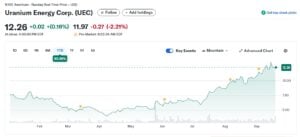
UEC currently trades at $12.26 per share, with a market cap of $5.45 billion. Analysts maintain a “Strong Buy” consensus, with price targets clustered between $10.65 and $13 over the next year.
The company remains unprofitable, with negative EPS and no dividend, but the trajectory is improving. Analysts expect uranium demand and prices to strengthen in tandem with new reactor builds, restarts, and life extensions.
Short-term volatility remains a factor, with bearish reports occasionally weighing on sentiment. However, the structural drivers of the market—domestic energy security, rising nuclear capacity, and tight supply chains—suggest a favorable long-term outlook.
A Strategic Bet on Nuclear Fuel Security
The U.S. nuclear industry is entering a new era. With government mandates, private sector demand, and rising global momentum, nuclear is positioned for its strongest growth in decades.
Uranium Energy Corp sits at the center of this shift. Its ISR mining hubs, refining and conversion ambitions, and alignment with federal policy make it a strategic asset for America’s nuclear future.
As the U.S. works to close its uranium supply gap and build a self-sufficient fuel cycle, UEC offers investors exposure to both the near-term upswing in uranium prices and the long-term buildout of nuclear capacity.
In short, in many ways, UEC is not just supplying uranium—it is shaping the foundation of American energy security for decades to come.