

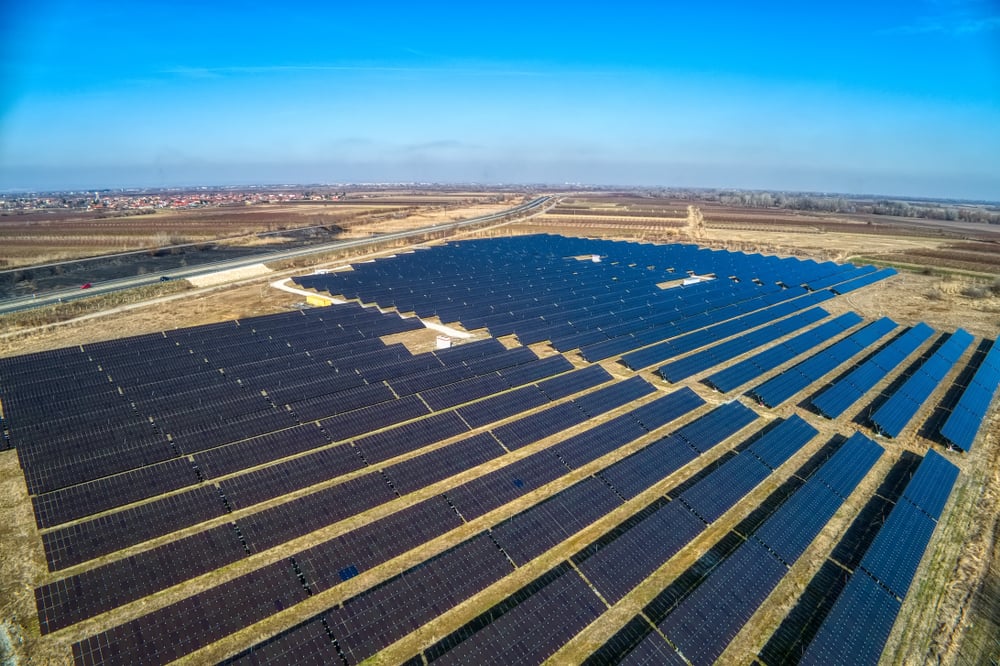
Verra approved the first carbon credits under its new digital monitoring, reporting, and verification (DMRV) pilot. This move signals a major shift in how carbon credits are issued. Instead of waiting for annual verification cycles, projects can now receive high-frequency issuances, including monthly or bi-monthly approvals. As a result, the carbon market may become faster, more transparent, and more data-driven.
The first credits under this pilot came from the Foumbouni-Mitsamiouli solar farm project (Verra Project 3788) in the Union of Comoros.
Foumbouni-Mitsamiouli Solar Project Leads Verra’s Digital Carbon Shift
In addition, the project integrates 1 MW/2 MWh of battery storage. This storage system allows the solar plants to operate in hybrid mode and islanding mode. In simple terms, the plants can stabilize the grid and export clean power even when grid conditions fluctuate.
This development marked a turning point for the island’s energy system. Before the solar farms came online, the national utility SONELEC relied almost entirely on diesel-fired power plants. Electricity access remained below 60%, and supply was often unreliable. Diesel imports were costly and exposed the country to fuel price volatility.
Now, each plant generates around 12.7 gigawatt-hours (GWh) of electricity per year. On average, the bundled project reduces 9,384 tons of carbon dioxide equivalent annually. Beyond emissions cuts, the project strengthens national energy security and creates local employment opportunities.
Most importantly, it replaces fossil fuel-based electricity with renewable solar power. For a country that depended heavily on diesel generation, this shift is significant.
SustainCERT acted as the validation and verification body (VVB). It conducted a fully digital verification process. Project developers submitted monitoring data electronically, and the verification process took place entirely online. This marked the first successful digital verification under Verra’s DMRV pilot.
Verra Project Hub Powers a New Digital Era
Verra launched the DMRV pilot as part of a broader plan to digitize its entire project cycle. The organization aims to improve efficiency, reliability, speed, and transparency across the voluntary carbon market.
At the center of this transformation is the Verra Project Hub. This online platform serves as a comprehensive tool for creating and managing projects under Verra’s standards programs. It allows project proponents to submit validation, monitoring, and verification documents digitally. It also integrates directly with the Verra Registry, enabling faster issuance once approvals are granted.
The platform simplifies several steps in the project lifecycle. For example:
- It enables the digital submission of monitoring data.
- It automates calculations of emission reductions and removals using built-in engines aligned with approved methodologies.
- It allows VVBs to access project records and submit verification reports directly.
- It tracks milestones, deliverables, and reviews progress in real time.
As a result, stakeholders can collaborate more efficiently. Communication between project developers, VVBs, and Verra becomes smoother. At the same time, the system enhances transparency because documentation and data are centrally managed and traceable.
Verra is also digitalizing its most widely used methodologies. Templates collect all required project information in a structured format. A built-in calculation engine then computes emission reductions or removals for a given crediting period. This reduces human error and improves consistency across projects.
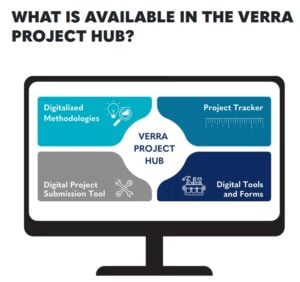
Digital Project Submission Tool for QC
In parallel, the Digital Project Submission Tool strengthens quality control. It checks data consistency and completeness using automated validation logic. If data is missing or incorrect, the system flags it immediately. Corrections can be made quickly, and all changes are logged for traceability. This improves auditability and builds trust among credit buyers.
Safeguards and Phased Credit Issuance
Under the DMRV pilot, Verra introduced a phased issuance structure to manage risks.
If a DMRV-based verification request for a high-frequency issuance installment is approved, the project proponent may request 80% of the approved credits. Verra withholds the remaining 20% as a safeguard during the pilot phase.
After one year of high-frequency issuances, the project must undergo a full traditional verification. This broader review covers additional elements such as safeguards, stakeholder engagement, and other non-digitized parameters. If Verra approves this non-DMRV-based verification request, the proponent can request issuance of the remaining 20%.
This structure balances innovation with risk management. It allows projects to benefit from faster cash flow while maintaining environmental integrity.
Verra is currently piloting this digital process for other project types as well. These include carbon capture and storage (CCS) activities and clean cookstove projects. If successful, the DMRV approach could expand across multiple sectors.
LATEST:
- Verra Greenlights Record 3 Million Soil Carbon Credits From Mexico Grasslands
- Why South Africa’s Verra-Certified Grassland Carbon Credits Matter for Voluntary Markets
Carbon Market Supply and Demand Shift in 2025
While Verra pushes digital innovation, the broader carbon market also experienced notable changes in 2025.
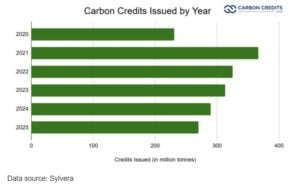
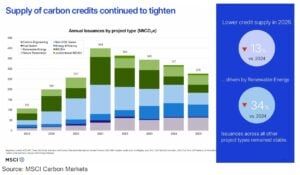
As of December 31, 2025, more than 10,200 projects were registered across 18 major carbon credit registries tracked by MSCI. During the year, these projects issued 294 million tonnes of carbon dioxide equivalent (MtCO2e). Since the Paris Agreement was signed in late 2016, cumulative issuances have surpassed 2.6 billion credits.
Also, according to Sylvera, new issuances declined to roughly 270 million tonnes in 2025. This marked the lowest annual issuance level since 2020.
On the supply side, renewable energy credits saw the sharpest drop. For years, market participants debated their additionality. Many buyers increasingly viewed grid-connected renewable projects as having limited incremental climate impact, especially in markets where renewables are already competitive. As confidence weakened, fewer new renewable credits entered the market.
Nature-based projects still dominate overall volumes. Forestry and land-use projects remain the largest sources of issued and retired credits. However, even within this segment, the mix is evolving. Buyers now focus more on quality, permanence, and robust monitoring systems.
On the demand side, retirements fell slightly in 2025. Yet this does not necessarily signal declining corporate interest. The number of buyers remained relatively stable. What changed was purchasing behavior.
Companies became more selective. They scrutinized methodologies, co-benefits, and verification standards more closely. In many cases, they shifted toward higher-integrity credits, even if volumes were lower. At the same time, price sensitivity increased in some segments.
Therefore, the market is not shrinking. Instead, it is maturing. Buyers demand stronger transparency, clearer impact, and better data.
Digitalization Could Restore Confidence
In this context, Verra’s DMRV initiative arrives at a critical moment. As the voluntary carbon market faces scrutiny over quality and additionality, digital monitoring and automated calculations can improve credibility.
High-frequency issuance also benefits project developers. Faster approvals improve cash flow and reduce administrative delays. Meanwhile, automated systems reduce manual paperwork and the risk of calculation errors.
For buyers, digital verification enhances confidence. Real-time data submission and traceable logs create a clearer audit trail. Over time, this may help rebuild trust in segments where credibility has weakened.
Ultimately, the Foumbouni-Mitsamiouli solar project represents more than just a renewable energy investment. It marks the beginning of a new digital chapter for carbon markets. If Verra successfully scales DMRV across sectors, the VCM could become more transparent, efficient, and resilient in the years ahead.