

Lafarge, Canada’s largest cement and building solutions provider, inked a tri-party deal with Dimensional Energy and Svante to produce synthetic wax from captured carbon dioxide.
The agreement will bring a demonstration of Dimensional Energy’s carbon utilization technology to Lafarge’s cement facility in Richmond, British Columbia.
The deal is part of Lafarge’ 3-phased carbon capture project. Noting on the project, Stephanie Voysey from Lafarge Canada said:
“Carbon capture is an important lever in our net zero roadmap… If this pilot can be scaled to capture and use all facility emissions, it would be a first of its kind project for Lafarge and advance export and global adoption of this technology.”
Lafarge and Its 3-Phased Carbon Capture Project
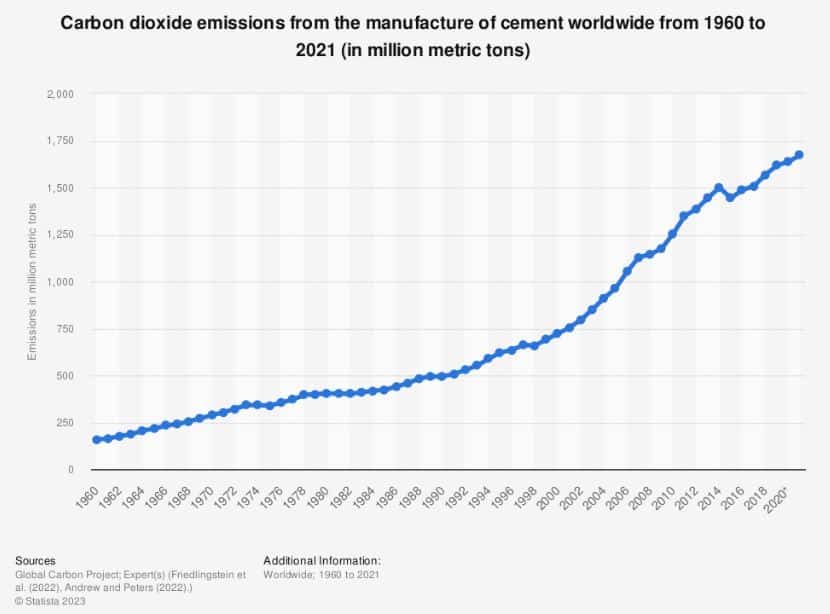
Cement production releases a lot of CO2. Studies say that about 621 kg of CO2 is produced for each metric ton of cement manufactured.
Emissions from making cement stood at 1.7 billion metric tons of CO2 in 2021. Here’s how the sector’s CO2 emissions grow over the years.
Decarbonizing its cement production in Richmond is a major part of Lafarge’s commitment to sustainable development. By nature, producing cement is an energy-intensive process that leaves few areas for carbon reduction.
But Lafarge is always finding ways to help decarbonize the sector and reach a net zero future. Capturing carbon and storing or using it is one of those ways.
In 2019, Lafarge entered into a joint industry deal with Total and Svante that started its CO2MENT Project. It’s a demonstration of a carbon project that aims to capture 1 tonne per day (1TPD) of carbon emissions from Richmond’s cement plant.
The project involves 3 phases:
- Pre-treatment
- Carbon Capture
- Carbon Utilization
Lafarge’s major project contribution is in kind-support via the provision of land, operational support, as well as utilities needed for the demonstration.
It also provides a use case for Svante’s patented carbon capture technology with its advanced adsorbent nanomaterial. The novel capture material acts as a sponge with a high CO2 absorbing ability
All throughout the project’s lifeline, the cement producer directed efforts to find an applicable end use for the captured gas.
Since there’s no carbon sequestration and transport infrastructure available in southern BC, learning how to put the captured carbon into good use is crucial in Lafarge’s net zero journey in the region.
Some key updates of the CO2MENT project are as follows:
- Over 2,400 hours with 90%;
- CO2 recovery and a CO2 purity of 95%; and
- On-stream factor of more than 75%;
The data will be used in designing a study that will assess the project’s commercial feasibility to capture 1.5 million tonnes of CO2 per year. This initiative is part of Holcim circular economy efforts in the U.S.
The new tri-party agreement brings the CO2MENT project into its phase 3.
Phase 3: Turning CO2 into Wax
Using CO2 to make products that have commercial value is a choice that Lafarge took in starting Phase 3.
At this last stage of the project, Lafarge will turn the daily captured carbon to make about 1.5 barrels of synthetic wax every day. This goal would put the carbon utilization expertise of Dimensional Energy into action.
Dimensional Energy Carbon Utilization Process
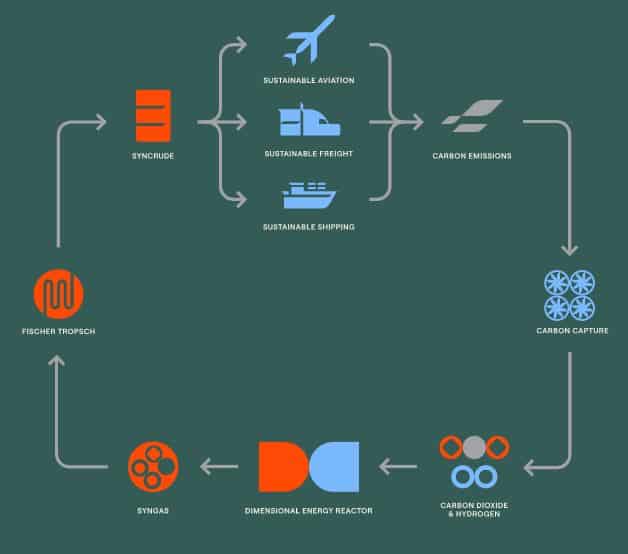
As seen above, Dimensional Energy’s patented technology converts the captured CO2 with green hydrogen to syngas. This syngas will go through more processes to become liquid hydrocarbons – a premium grade wax.
Aside from carbon neutral fuels, the waxes can also be used in making other products people use every day. Common examples include cosmetics, plastics, and lubricants, among others.
Lafarge’s CO2 capture and utilization project will take advantage of Dimensional Energy technology. Once successful, the project will cement the common goal of the three companies involved – reduce carbon emissions.
Commenting on their ground-breaking initiative, Dimensional Energy’s CEO, Jason Salfi noted that:
“Together, we will transform carbon emissions from one of the world’s most persistent problems of our time to one of our greatest assets to grow a circular economy in better harmony with nature.”
Salfi also said that as tech providers, they’re leveraging existing infrastructure in hard-to-abate sectors like cement to reduce CO2 emissions.
Other industry players, like Rick Fox’s startup Partanna, for instance, are cutting their carbon footprint by replacing the use of Portland cement with a mixture of natural and recycled ingredients.
Lafarge Canada has pledged a monetary commitment to Dimensional Energy to promote the project’s success for the industry.