


Nature-based solutions are among the go-to options in fighting climate change and REDD+ always comes on top of the list. Individuals and organizations alike tend to prefer this solution while critics continue to doubt its credibility in reducing carbon emissions.
So, to help you clarify the confusion surrounding REDD+ and its corresponding emissions reduction claims, popularly known as carbon credits, we’re going to talk about the essence of this program.
From its origin to its current role in protecting our world’s forests as well as the challenges it faces, this article will explain REDD+ and everything that comes along with its successful implementation.
Let’s start with the current state of the forests.
How are Our Forests Right Now?
The state of forests worldwide varies depending on the region and certain factors such as deforestation rates, forest management practices, and natural disturbances like wildfires.
The world’s forests account for 92% of all terrestrial biomass globally and store about 400 gigatons (Gt) of CO2. They take up carbon via photosynthesis and store it below- and above-ground. Different forest types store varied amounts of carbon, depending on the climate present in the particular location of the forest.
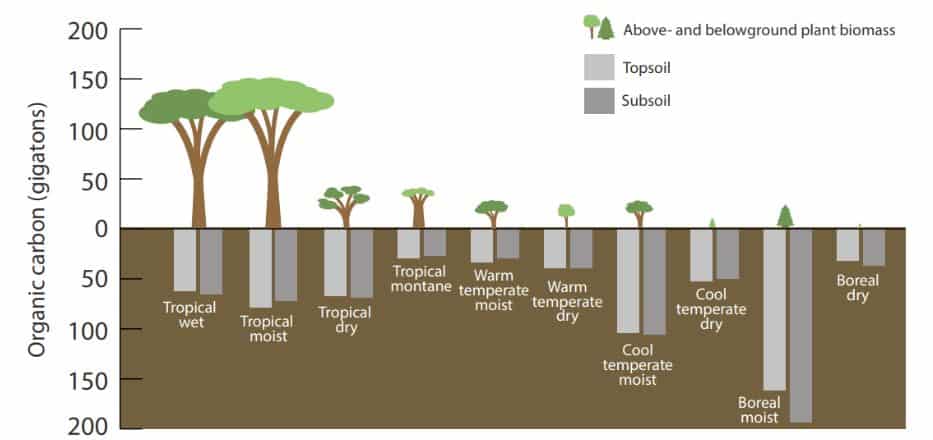
These forests are one of our great allies in preventing global temperatures from going up. Unfortunately, forest trees are cut down or burned drastically around the world.
Deforestation is the biggest culprit of forest loss.
Forests are cleared mainly for agriculture, urbanization, and logging, collectively called land use change. This causes not only deforestation but also rising carbon emissions, biodiversity loss, and a decline in wildlife species.
- Deforestation is responsible for releasing as much as 5 GtCO2 a year, which is equal to about 10% of the global GHG emissions.
The worst-case scenario? Deforestation and degradation cause some forests to release more carbon than they sequester.
Alarming wildfires are burning millions of hectares of forests in the U.S., Canada, and other parts of the globe. The record-breaking wildfires that engulfed boreal forests in North America and Eurasia emitted almost 2 billion tons of CO2.
The worst-case scenario? Forest loss will continue at the scale that will make the 1.5°C climate goal an impossible dream. This will happen if people find forest land conversion more profitable than keeping the trees standing.
If deforestation in tropical forests were a country, it would rank third in CO2 emissions.
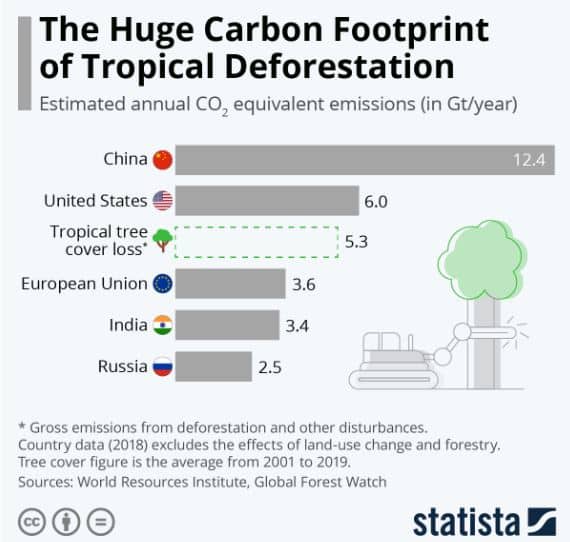
All this means that if we don’t end deforestation as early as this decade, we won’t be able to stop climate change from wreaking havoc on our planet.
Climate experts said that curbing deforestation is humanity’s biggest chance to immediately reduce carbon emissions. Many agree but others don’t.
Still, governments devised various policies to bring financial incentives to conserve forests and avoid forest loss. They’re formally referred to as REDD – Reducing Emissions from Deforestation and Degradation.
How REDD+ Evolve to Protect Forests
The history of REDD can be traced back to the international efforts to fight climate change and preserve forests.
Two tropical countries brought the concept of REDD to global climate summits known as COP – Conference of Parties. Costa Rica and Papua New Guinea formally placed this topic on the table during COP11 in 2005.
Their idea received huge interest from other countries as a way to conserve forests by prompting performance-based incentives at scale. Why won’t it be if the initiative will promote sustainable forest management practices while making trees more valuable standing than logged?
So, monetizing the carbon stored in forests through carbon credits provides local communities revenue for sustainably managing their forests. The income from the credits will deter them away from livelihoods that cause deforestation such as illegal logging, crop cultivation, and livestock raising.
Here’s the timeline, and some dates to remember, of how REDD came about and expanded to REDD+.
- Global climate talks began in the ‘90s. The United Nations Framework Convention on Climate Change (UNFCCC), formed in 1992, gave birth to several international and national strategies to reduce GHG emissions.
- First REDD discussions in the early ‘20s. Pilot discussions and projects exploring means to cut emissions from deforestation started to emerge in the early 2000s. Costa Rica and PNG were responsible for these first initiatives, calling for the need to develop a comprehensive framework.
- Bali Action Plan in 2007 (COP13): The UN COP13 in Bali, Indonesia, in 2007 was a significant milestone in the development of REDD. The conference put forward the importance of REDD in developing countries and emphasized the need for financial support to implement it.
The COP13 parties added the “+”, expanding the term to REDD+. The plus simply refers to the co-benefits of protecting forests from destruction. It means the role of “conservation, sustainable management of forests and enhancement of forest carbon stocks in developing countries”.
- The Warsaw Framework for REDD+ in 2013 (COP19). The 19th session of the COP in Warsaw, Poland in 2013 formally adopted the framework for REDD+. It laid out key principles, guidelines, and safeguards that REDD+ projects and activities should follow. The framework also rang the bell for financial and technical support needed by developing nations to implement REDD+.
Following the Warsaw Framework, many countries have established and developed their national REDD+ strategies and implemented projects on the ground.
What’s even better is that several organizations have shown support to REDD+ initiatives through financing and capacity development programs.
REDD+ in the Carbon Credit Markets
At the end of 2023, there are over 650 individual REDD+ projects and programs implemented. Most of them are funded by international donor organizations, such as the UN-REDD and the World Bank.
REDD+ countries are now focusing on operationalizing both their REDD+ strategies and proposals for bigger forestry programs. Their ultimate goal is to build investment packages that will result in carbon emissions reductions through results-based finance.
Though they only represent a smaller chunk of REDD+ financing, the voluntary carbon markets (VCMs) have been recognized as a good source of investments with REDD+ carbon credits.
- As of 2023, almost 500 million REDD+ credits have been issued on the VCM, representing a quarter of the total credits issued in the market. Also, REDD+, along with renewable energy credits, has dropped nearly 20% as a share of total credit issuances from 72% in 2021 to 53% in 2023.
The majority of REDD+ projects are in South America, where forested regions are found, including the Amazon. Other forest projects are also in Sub-Saharan Africa, Asia-Pacific, and Central America.
By country, Indonesia has by far issued the most REDD+ carbon credits in 2023 with 76 million, according to Sylvera. That issuance is only from four REDD+ projects operating in the Asian country.
What makes REDD+ carbon credits, also categorized as nature-based credits, desirable is that most of them deliver co-benefits. These are other societal and environmental benefits that forest projects provide apart from carbon reductions.
- In context, only less than a quarter of credits in the VCM have co-benefits while REDD+ projects have over 60%.
It’s no surprise, therefore, that REDD+ is always at the forefront of international climate change talks as a solution to avoid global temperatures shooting up.
However, it is not immune to critics and skeptics. So, let’s take an inventory of the major issues surrounding the initiative.
What is Shaking up REDD+?
Accounting for the carbon reduced or removed by a REDD+ project is not that easy. And one of the most important things that affect how effective the project is is baseline setting.
Simply put, the baseline scenario is the condition of the forest without implementing the project. It’s often determined by observing deforestation activity in the adjacent areas and using it as a reference point.
Getting this proxy correctly, or as accurate as possible, is critical. It dictates how much carbon reduction the REDD+ project achieves.
In a sense, projects must have baseline emissions that are conservative and not too aggressive so as not to overstate their climate benefit. It is for this very reason that REDD+ projects are criticized for underperforming, ineffective, and generating worthless carbon credits.
And then came the market’s biggest blow – The Guardian publication. The media’s article put a study questioning the forest projects certified by Verra, accusing them of using inaccurate baselines.
The published article claimed that over 90% of the REDD+ carbon credits are “largely worthless” and are “phantom credits”. In other words, they likely don’t represent real emission reductions.
The main point of the study’s contention is the overstated baseline emissions used in calculating the projects’ net climate impact. And that’s by a factor of 400%.
But of course, despite it being an academic investigation, it’s crucial to also note that the way the researchers take the “baselining” method doesn’t match Verra’s crediting program for REDD+ projects.
Verra was quick to respond to such a big accusation…
The world’s largest carbon standard worked closely with the publication to explain why their findings are not true. Verra responded that the article is “incorrectly claiming that REDD+ projects are consistently and substantively over-issuing carbon credits.”
Verra also noted that the studies were using “synthetic controls” that don’t account for project-specific factors that cause deforestation. Thus, they largely miscalculated the impact of the projects that Verra certified.
Other key market players and stakeholders also responded.
For instance, a carbon rating agency, Sylvera, fired back by citing their own research on the subject matter. Their findings showed that the publication’s claim on worthless credits didn’t consider the biggest factor in the baseline setting – the proximity to the active front of deforestation.
The rater asserted that forests need protection to help achieve the world’s climate goals. They said that we “must not sabotage the financing of projects that are delivering sound climate, social, and biodiversity benefits”.
Likewise, a climate tech startup Pachama that has been evaluating over 150+ deforestation projects commented. The company is using artificial intelligence (AI) in determining baseline scenarios of the projects they support.
This brings us to the next section – the solutions to these major issues:
- Inflated baselines,
- Underreporting of deforestation, and
- Forest loss causing permanence risk
Addressing the Issues with Technologies and Innovations
At the onset of REDD+ projects, advanced technologies like AI, satellite data, remote sensing, and algorithms weren’t yet around. That means companies rely on manual tools and systems to establish baseline scenarios.
But now that digital technologies and even AI are publicly available, improvements are being made in setting baselines.
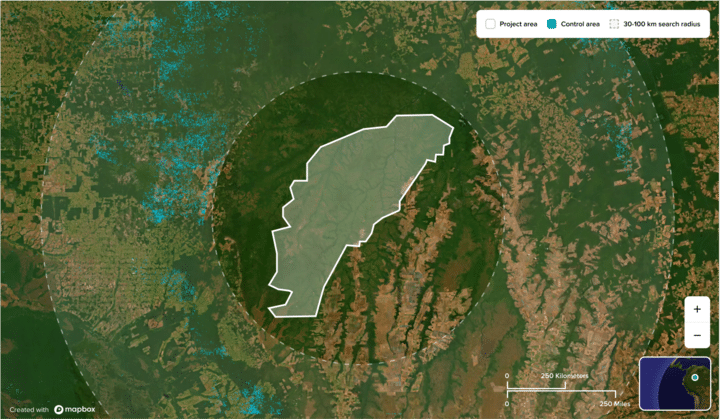
For example, Pachama’s technology called “Dynamic Control Area Baseline” ensures that carbon credits accurately represent real emission reductions. They observe forest loss in the control area using remote sensing data and then compare it with what they’ve observed in the project reported.
The following image shows the project area in white and the control area in blue.
Carbon rating agencies that focus on nature-based projects like REDD+ are also using innovative technologies to provide more quality assurance.
Another unpopular solution is the application of blockchain in the monitoring, reporting, and verification (MRV) of forest projects. Blockchain-based MRV can help improve the verifiability of REDD+ carbon credits and ensure their permanence. Yet, further research is necessary in this field.
Additionally, the current trend in the REDD+ sector is transitioning initiatives from a project-level to a jurisdictional or “nested” approach. This approach follows the same concept as REDD+ but covers national forests.
The case of the Amazon in Brazil is an example. This jurisdictional REDD+ has a single reference baseline for deforestation.
Plus, this new approach has not been used to issue voluntary carbon credits. Rather, it generates a new asset in the carbon market – sovereign carbon credits. The only concern with this solution is enforcement by political leaders.
When it comes to financing, carbon credits help fund REDD+, be it on a project-level or jurisdictional basis.
Everland’s Forest Plan, in particular, will help the development and long-term financing for 75 REDD+ projects in threatened forests. Here’s the plan’s outlook for REDD+ from 2022 to 2030.
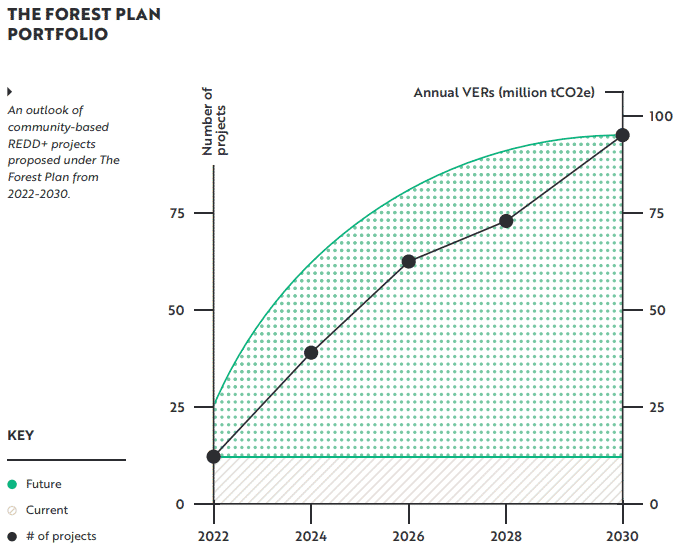
Everland’s forest projects will cover around 23 million hectares. The Forest Plan’s aims may be ambitious but they’re a part of a bigger, collective effort to end deforestation.
What Comes Next for REDD+?
While no one can predict or calculate 100% accurate baseline scenarios, improvements in practices will bring better results. This will enhance the accuracy of calculating how much carbon credits are due for REDD+ projects.
Advanced technologies and new innovations will enable the market to correct itself.
Following the bad press coverage for REDD+ earlier this year, misconceptions about them and their associated carbon credits continue to bring the market down.
But as major industry experts pointed out, not all forestry projects are the same. Some may have poor quality but many others still deliver significant positive climate benefits and sustainable development goals.
Ultimately, there’s no single silver bullet for ending deforestation but carbon markets do have a crucial role to play here. They direct major investments and support toward REDD+ projects and programs worldwide. With that, REDD+ remains a vital tool in fighting climate change.