

In the second quarter of 2024, the U.S. saw an unprecedented surge in solar panel imports, setting a new record as shipments flooded into the country.
The significant rise in imports follows President Joe Biden’s decision to grant a two-year tariff waiver on solar cells and modules from Southeast Asia in 2022. This waiver allowed the industry to bypass duties that had previously been imposed on Chinese-made PV shipments that were found to be circumventing U.S. tariffs.
Since the waiver’s implementation, the volume of solar component imports has tripled, reflecting the industry’s response to the relaxed restrictions.
As the waiver approached its expiration in June 2024, manufacturers and developers hurried to import as many panels as possible. They do so as they’re anticipating potential new tariffs.
Vietnam led the charge, shipping about 7.3 GW of solar panels to the U.S. in the second quarter. This accounted for 41.6% of total imports during that period. This was a significant increase from the 5.4 GW imported in the first quarter.
Thailand followed with 3.8 GW, or 22.1% of the total imports, while Malaysia, India, and Cambodia contributed 12.5%, 11%, and 6.4%, respectively. Major importers during this period included affiliates of China-based Trina Solar Co. Ltd. and Arizona’s First Solar Inc.
Amid this surge, the U.S. solar industry is witnessing a wave of new domestic factories, spurred by Biden’s Inflation Reduction Act of 2022, which are now competing for a share of the growing market. However, U.S. manufacturers, who have invested billions of dollars, raised concerns about the sharp increase in imports. They argued that the spike in crystalline-silicon cell and panel imports from Southeast Asia, particularly Thailand and Vietnam, poses a severe threat to the survival of U.S. producers.
The U.S. Solar Industry’s Battle: Domestic vs. Imported
The American Alliance for Solar Manufacturing Trade Committee, with members including major players like First Solar and Qcells, filed a “critical circumstance” petition with the U.S. Commerce Department.
The petition requests a rapid assessment to determine whether the sudden influx of imports warrants retroactive duties before the department completes its ongoing investigation into Southeast Asian imports. The group argues that these imports are rushed into the country to avoid the imposition of antidumping and countervailing duties.
Dumping is a practice where products are sold on a market at unfairly low prices, below the cost of production.
This petition comes at a time when the U.S. is attempting to establish a strong domestic supply chain for its rapidly expanding solar industry, which is still heavily reliant on imports. In response to these challenges, President Biden recently increased the cap on the volume of solar cells that can be imported without triggering a 14.25% tariff.
The new cap, raised from 5 GW to 12.5 GW, was implemented in response to a September 2023 petition from domestic industry representatives. They argued that US cell production was insufficient to meet demand, making reliance on imports necessary in the short term.
Following the Alliance’s petition, Clean Energy Associates (CEA) predicted that a successful outcome could lead to a bottleneck in the supply of solar cells in the U.S. This shortage could increase the prices of both domestically produced and imported solar modules by up to $0.15/watt. The U.S. heavily relies on SEA countries for its solar cell supply, making the potential impact of these tariffs significant.
Rising Prices, Falling Costs and the Shifting Landscape of U.S. Solar Manufacturing
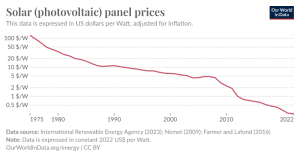
Despite these potential challenges, it’s worth noting that prices across the PV supply chain have decreased significantly over the past years. Thus, solar modules now represent a smaller portion of the overall cost of a solar project than they once did. This price drop could help mitigate the impact of any price increases on the solar market.
The U.S. solar industry is in a state of transition, with domestic module manufacturing expanding rapidly. A report identified 31 GW of US module manufacturing capacity that is either online or in the process of ramping up. This includes facilities from First Solar and Qcells, as well as U.S. affiliates of China-based PV companies like Trina Solar (U.S.) Inc.
However, the report also highlighted the absence of U.S. manufacturing for solar cells and wafers. Qcells plans to address this gap by bringing an integrated 3.3-GW ingot, wafer, cell, and panel complex online in Georgia later this year.
As the U.S. navigates these complex dynamics, the outcome of the ongoing trade disputes and the future of domestic manufacturing will be crucial in determining the nation’s ability to build a resilient and self-sufficient solar industry.