

Google has taken a significant step in its sustainability efforts with a forest carbon removal deal from a Brazilian startup Mombak. The tech giant aims to buy 50,000 metric tons of carbon credits by 2030 to bolster its fight against climate change.
Google Embraces Reforestation: A New Step in Carbon Removal Strategy
Last year, Microsoft committed to buying up to 1.5 million credits from Mombak, highlighting a growing trend of companies incorporating nature-based carbon removal into their sustainability strategies.
Dan Harburg, Mombak’s Chief Technology Officer, remarked,
“As we scale our operations, this collaboration with Google is a major milestone in our mission to become the world’s largest and most impactful carbon removal project developer. We look forward to working with Google and other leading organizations to further develop the field of nature-based carbon removal, ensuring that our projects continue to meet the highest standards for climate impact, transparency, and community engagement.”
Notably, Google, Microsoft, Meta, and Salesforce are co-founders of the Symbiosis Coalition. This collective has committed to buying 20 million tons of nature-based carbon removal credits by 2030.
Previously, Google had invested in carbon capture and storage (CCS) carbon credits. However, this new deal signals a shift toward nature-based solutions like reforestation thereby joining other biggies Microsoft and Meta to meet their climate goals. Earlier this week, Meta also announced purchasing up to 3.9 million carbon offset credits from Brazilian bank BTG Pactual’s forestry division.
Randy Spock, Google’s Carbon Removal Lead, said:
“We’re pleased to partner with Mombak on our first purchase of forestry-based carbon removal credits, with an eye to solving a central challenge of this field: ensuring certainty of climate impact. Looking ahead, we’re excited to build on this deal via our participation in the Symbiosis Coalition.”
Aiming for Net-Zero by 2030
To achieve its goal, the company aims to cut 50% of its combined Scope 1, Scope 2 (market-based), and Scope 3 absolute emissions by 2030, using 2019 as the baseline. To offset remaining emissions, it plans to invest in both nature-based and technology-driven carbon removal solutions.
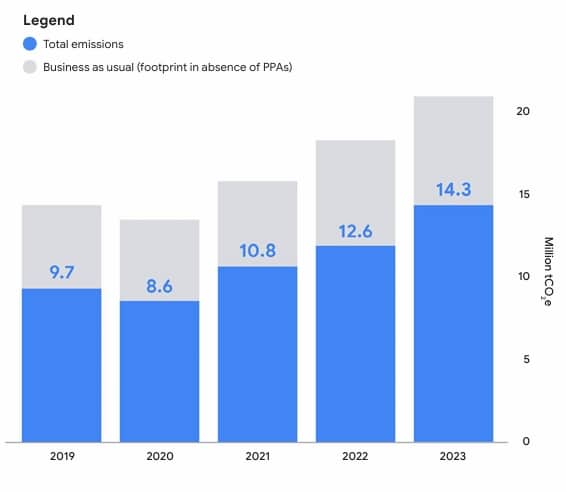
Google’s sustainability report highlights its commitment to the Science Based Targets initiative (SBTi) to validate this highly ambitious emissions reduction target. The company’s 2023 progress indicates:
- Emissions Reductions: Total GHG emissions reached 14.3 million tCO₂e, reflecting a 48% increase compared to 2019.
- Residual Emissions: The company signed offtake agreements for approximately 62,500 tCO₂e of removal credits.
 Source: Google
Can Mombak Solve Google’s Carbon Problem?
Mombak is on a mission to become the world’s largest carbon removal company, focusing on large-scale reforestation and carbon sequestration from the atmosphere. The company mainly focuses on native, biodiverse reforestation projects in the Amazon rainforest.
They restore degraded pastureland with native trees and assist regeneration to reduce carbon, boost biodiversity, and improve ecosystems. Apart from environmental benefits, their projects impact local communities by improving water resources, creating jobs, and uplifting their social standards.
Private-sector involvement in carbon reduction drives Mombak’s high-impact reforestation. Significantly, the startup’s innovative approach has caught the attention of global corporations like Microsoft and now of course Google. They use advanced technology and data to guarantee the highest quality carbon removal credits in the market while minimizing carbon leakage.
Thus, it’s pretty much evident that Mombak’s robust plan can potentially help Google achieve its carbon removal goals while restoring the vital ecosystem of the planet.
This is why Harburg noted that Google’s involvement sends a strong vote of confidence for both Mombak and the carbon removal sector as a whole, describing it as a very positive signal. He also hopes that the growing market for nature-based carbon removal will trigger more deals in the future.
Although Mombak and Google did not disclose the financial details of the agreement, Mombak’s credits sold for more than $50 per ton when McLaren Racing purchased in 2023. This pricing sets a potential benchmark for the future value of nature-based credits, especially as demand grows among companies eager to offset their emissions.
The Growing Demand for Nature-Based Carbon Credits
Carbon offsets help companies reduce their environmental impact by funding projects that remove greenhouse gases. Each carbon credit represents one ton of CO2 removed from the atmosphere. By purchasing these credits, companies like Google, Microsoft, and Meta aim to offset their emissions while supporting global sustainability initiatives.
Speaking about Amazon rainforests, they absorb vast amounts of carbon and are crucial to global climate efforts. Google’s investment in nature-based solutions or forest carbon credits through reforestation efforts in the Amazon with startups like Mombak, offers immediate benefits. By supporting Mombak, Google not only offsets emissions but also aids in preserving this essential ecosystem.
However, there’s a catch. As more companies enter the carbon credit market, transparency and accountability will be key to ensuring these projects deliver measurable results. Many environmentalists and sustainability experts predict that the future of carbon offsets may shift towards more personalized, localized solutions.
On the flip side, the rising demand for carbon offsets is subjected to substantial criticism. Groups like Greenpeace argue that offsets can allow companies to delay direct actions like adopting renewable energy. Critics claim relying on credits could slow the transition to cleaner technologies and energy efficiency.
Google’s Strategy to Strengthen its Carbon Markets
Source: Google
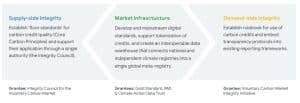
Google boats of investing over $6 million to enhance carbon markets, digitize infrastructure, and establish standards for high-quality carbon credits. Recently, they committed $35 million to carbon removal credits, becoming the first major company to support the US DOE’s push to build a robust and credible carbon removal market.
Google’s partnership with Mombak marks a critical step in advancing carbon removal strategies while showcasing trust in nature-based carbon credits.