

Tesla’s profits took a hit in 2024, dropping 23%. But one revenue stream kept surging—carbon credit sales. The carmaker reached a new record in selling regulatory credits, recording a 54% jump from 2023. As the EV market evolves and emissions rules tighten, can Tesla keep profiting from carbon credits?
Tesla’s 2024 Performance: Profits Slide, Credits Rise
Tesla wrapped up 2024 with another year of declining profits, reporting $8.4 billion in net income attributable to common stockholders—a 23% drop from 2023 and a steep 40% decline from its 2022 record of $14.1 billion.
In Q4 alone, Tesla generated $25.7 billion in revenue, missing analyst expectations of $27.3 billion. Despite this, the company’s annual revenue still saw a slight 1% increase, reaching $97.7 billion.
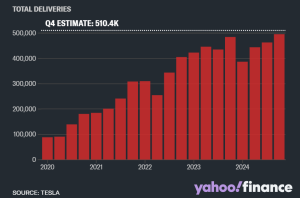
In terms of delivery, Tesla delivered 1.78 million vehicles in 2024, a 1% drop and its first year-over-year decline. Rising competition, shifting demand, and economic conditions may be impacting the company’s growth.
Looking ahead, Tesla expects its core vehicle business to return to growth in 2025. It also announced plans to begin production of its driverless “Cybercab” taxi and more affordable EV models in the first half of the year.
- While Tesla shares initially dropped 5% after the earnings release, they later rebounded by 3% as investors reacted to the company’s long-term growth plans.
Analysts remain cautiously optimistic, predicting an 80% surge in free cash flow by 2025 and a further 50% rise in 2026. While Tesla’s profits declined, one revenue stream remained a powerful lifeline—carbon credit sales.
Tesla’s Carbon Credit Boom: How Emissions Trading Kept Cash Flowing
In Q4 2024 alone, Tesla earned $692 million from selling regulatory credits or carbon credits, accounting for nearly 30% of its quarterly net income of $2.33 billion.
More impressively, the company’s total carbon credit revenue for 2024 surged to $2.76 billion, marking a 54% year-over-year increase from $1.79 billion in 2023. This substantial boost underscores the ongoing demand for emissions credits as legacy automakers struggle to meet regulatory targets.
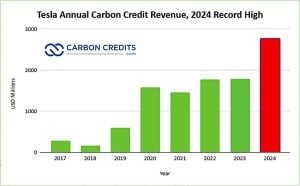
Since 2017, Tesla’s total earnings from these transactions have soared to over $10.4 billion. It has become one of the most lucrative aspects of its business.
This revenue comes at a minimal cost to Tesla, making it a near-pure profit stream. Unlike other automakers that must purchase credits to comply with emissions regulations, Tesla generates them simply by selling zero-emission vehicles.
Amid declines in profit margins, the sharp rise in carbon credit revenue came to the rescue, highlighting the importance of this business model to Tesla’s financial health.
Defying Expectations: The Carbon Credit Market’s Resilience
Many analysts once predicted that Tesla’s carbon credit windfall would shrink as other automakers ramped up EV production. In 2020, then-CFO Zachary Kirkhorn warned investors against relying too heavily on regulatory credit revenue.
Yet, contrary to expectations, Tesla’s earnings from this segment have remained strong, surpassing previous records and hitting new highs.
This resilience is due in part to the slow transition of legacy automakers to electric vehicles. While companies like Ford and General Motors have made strides in EV production, many still rely on Tesla’s credits to meet tightening emissions standards in the U.S., Europe, and China.
With increasingly stringent regulations worldwide—such as the European Union’s plan to ban new gasoline and diesel car sales by 2035—the demand for carbon credits is unlikely to disappear anytime soon.
In fact, Tesla’s carbon credits are helping automakers meet strict EU emission targets. Companies like Stellantis, Toyota, Ford, Mazda, and Subaru buy Tesla’s credits to offset their emissions and avoid hefty fines.
- READ MORE: EU’s 2025 Emission Rules Led Tesla and Mercedes to Pool Carbon Credits to Avoid $15.6 Billion Fine
With EU regulators imposing penalties of up to €300 million per missed EV sales percentage, pooling with Tesla provides a financial lifeline. This strategy enables automakers to comply while transitioning to electric models, ensuring a smoother shift toward sustainability.
Meanwhile, stricter emissions rules in Europe and the U.K., combined with increased federal funding for EV infrastructure in the U.S., could accelerate the adoption of electric vehicles across the industry. If competitors produce enough zero-emission vehicles to meet compliance requirements, Tesla’s carbon credit revenue could decline.
However, Tesla is not solely reliant on carbon credits for future growth.
Supercharged Sustainability: Tesla’s Energy, AI Breakthroughs, and Emission Reductions
Beyond carbon credit sales, Tesla remains a leader in sustainability efforts. The company’s mission is to accelerate the world’s transition to sustainable energy, and its initiatives go beyond just producing EVs.
Renewable Energy and Energy Storage
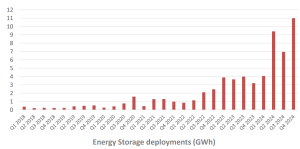
Tesla’s energy business achieved record deployments in 2024, with Powerwall and Megapack installations reaching a combined 11.0 GWh as shown below. This milestone resulted in record gross profit in Q4, driven by lower material costs at the Lathrop Megafactory. As demand for energy storage products grows, Tesla plans to ramp up production at its new Shanghai Megafactory in Q1 2025.
Tesla’s Supercharger network also saw rapid expansion. In 2024, Tesla added over 10,000 new Supercharger stalls, growing the network by 19% year-over-year to surpass 65,000 stalls globally.
- The company delivered 5.2+ TWh of energy through its network, offsetting more than 5.5 billion kg of CO₂ emissions and replacing 2.4 billion liters of gasoline.
Additionally, Tesla unveiled its V4 Supercharger, capable of charging passenger vehicles at up to 500 kW and Tesla Semis at 1.2 MW. The EV giant continued to welcome more automakers to its North American Supercharger network, integrating the NACS charging standard into new vehicles.
Tesla’s AI Advancements and Manufacturing Innovations
Tesla made significant strides in AI and vehicle software in Q4. The company deployed Cortex, a 50,000-unit H100 training cluster, at Gigafactory Texas, powering FSD V13 (Supervised) with a 4.2x increase in data and improved safety features. Tesla’s Autopilot vehicles achieved 5.94 million miles between accidents, the best Q4 on record.
On the manufacturing side, Tesla processed its first spodumene lithium concentrate just 18 months after breaking ground on its lithium refinery. The company also ramped up production of its in-house 4680 battery cells, reaching a rate exceeding 2,500 Cybertrucks per week.
Tesla’s Full Self-Driving (FSD) technology plays a role in sustainability by optimizing traffic flow and reducing idle time, which can lead to lower energy consumption. The company’s AI-driven approach aims to improve transportation efficiency, reducing congestion and unnecessary energy use.
Emissions Reduction Impact
Tesla’s EVs have prevented over 20 million metric tons of CO₂ emissions from entering the atmosphere since their introduction. The company reported that in 2023 alone, its vehicles helped avoid 5 million metric tons of CO₂ emissions.
Tesla also leads in vehicle efficiency, with the Model 3 achieving an energy consumption rate of 13.1 kWh per 100 km, making it one of the most efficient EVs on the market. Meanwhile, Tesla’s semi-truck fleet is projected to cut freight emissions by 50% compared to diesel trucks.
Overall, Tesla’s carbon credit business remains a financial powerhouse, providing billions in revenue that bolster its bottom line amid declining profit margins. Whether this revenue stream continues to thrive will depend on the pace of EV adoption by other automakers and the evolution of global emissions policies. For now, Tesla’s carbon credit sales remain a critical pillar of its financial success.