

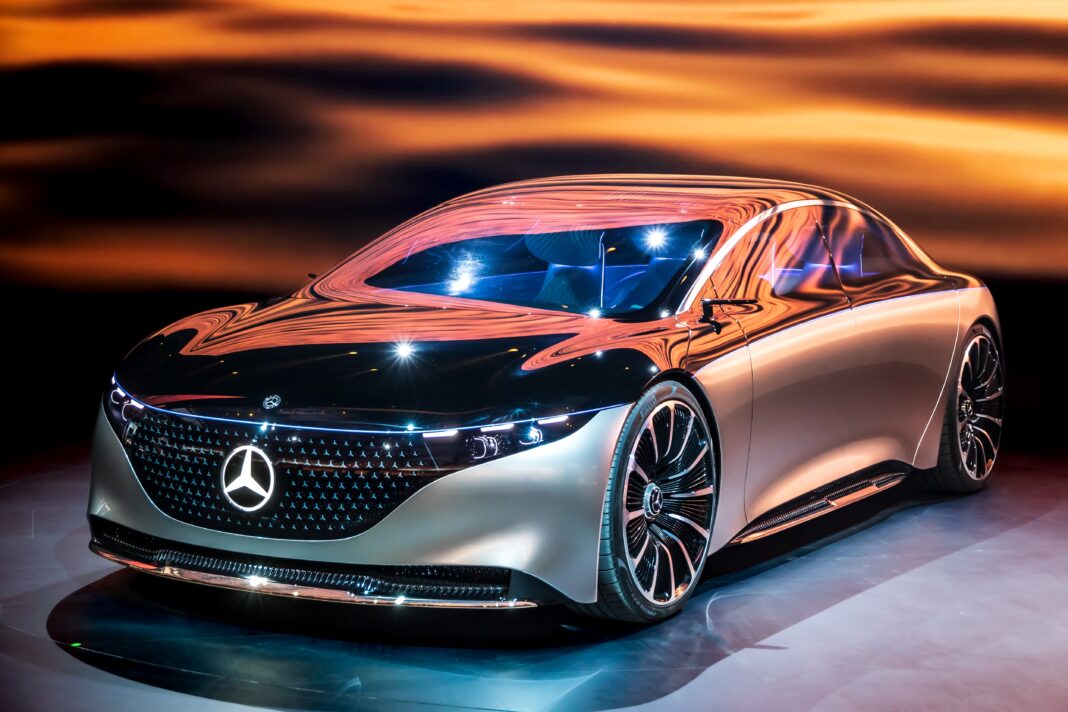
After a 3% sales dip in 2024 and 6.2% in early 2025, Mercedes-Benz is going all-in on electrification. As per media reports, the company plans to launch 18 new models in 2026—many of them fully electric—in what it calls the biggest product rollout in its history. The goal is to revive interest by merging classic luxury with clean, future-ready tech.
Mercedes-Benz’s Strong Electric Vehicle Commitment
The company plans to make at least 50% of its vehicle sales fully electric or plug-in hybrid by 2030. This shift positions Mercedes-Benz to stay ahead of regulations and consumer trends, especially in regions tightening emissions standards.
Entry-Level EVs Kick Off the Shift
In 2025, Mercedes will introduce two compact electric crossovers—likely EV versions of the GLA and GLB—targeting urban drivers. These models are built for efficiency and practicality, but also sustainability.
Core Models Go Dual-Track
In the mid-range “Core” segment—including the C-Class and GLC—the company will offer both refreshed gas versions and new EVs. A fully electric C-Class will join the lineup with better range and performance.
- By 2027, a new Core EV built on a dedicated electric platform will mark a deeper shift toward full electrification.
Luxury EVs Take the Spotlight
Mercedes’ high-end “Top End” line gets five new EVs in 2026, including a revamped EQS. The S-Class also receives a major update, with the EQS expected to match its luxury and tech upgrades.
- Through 2027, five more luxury EVs will follow, including the “Little G,” a compact electric version of the iconic G-Wagon, blending off-road ruggedness with zero emissions.
GLC EV Redefines Design
Replacing the EQC, the new electric GLC debuts at Munich’s IAA show this fall. It retains a bold grille, a nod to tradition, while boasting upgraded styling and charging tech.
- The design aims to bring character back to EVs, countering criticism of previous models.
AMG Joins the EV Push
Mercedes-AMG is developing an electric super sedan and SUV based on the GT XX concept, delivering high performance without emissions. A new V8 is also in development for gas holdouts, though the updated C63 may switch to a six-cylinder model. The challenge is honoring AMG’s legacy while embracing electric speed.
Mercedes is moving away from the minimalist EQ design language. Instead, future EVs and gas vehicles will share a cohesive, luxurious aesthetic. The aim is to make electric models feel just as familiar and desirable as their combustion counterparts.
- READ MORE: Volvo Gives Carbon Pricing a Go While Audi, BMW, Mercedes-Benz Also Lead the Green Charge
Mercedes-Benz Drives Toward a Greener Future
Sustainability is extremely vital for Mercedes-Benz Group’s corporate strategy. Last year, the company sharpened its focus, identifying six priority areas that align with both environmental and stakeholder expectations.
From decarbonization to digital trust, Mercedes-Benz is not only adapting to global climate goals but aiming to lead the way in clean, ethical, and responsible mobility.
Six Strategic Pillars of Sustainability
Mercedes-Benz updated its materiality assessment in line with the Corporate Sustainability Reporting Directive (CSRD) and European Sustainability Reporting Standards (ESRS). This evaluation factored in the views of all key stakeholders—customers, investors, employees, suppliers, and society at large.
As a result, the company established six key focus areas:
- Decarbonization
- Resource Use & Circularity
- Human Rights
- Digital Trust
- People (Employees)
- Traffic Safety
Each of these areas includes defined targets and is tracked using internal scorecards, ensuring progress remains measurable and transparent.
Net-Zero Goals: Ambition 2039
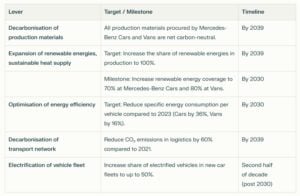
Under the “Ambition 2039“ roadmap, Mercedes-Benz aims for its new vehicle fleet to be net carbon-neutral across its entire lifecycle, including production, logistics, and supply chain, by 2039.
The company is taking bold steps to cut emissions and increase clean energy usage across all business segments.
Major Progress in Carbon Emissions Reduction
The company reports greenhouse gas emissions under Scopes 1, 2, and 3, including biogenic emissions.
- Scope 1 & 2: Emissions from direct operations and purchased energy. The company calculates biogenic CO₂ emissions separately from fossil sources using standardized factors.
- Scope 3: Indirect emissions across the value chain. The majority—around 75%—come from vehicle use (tank-to-wheel) and fuel/electricity production (well-to-tank).
MB’s 2024 Emissions Report
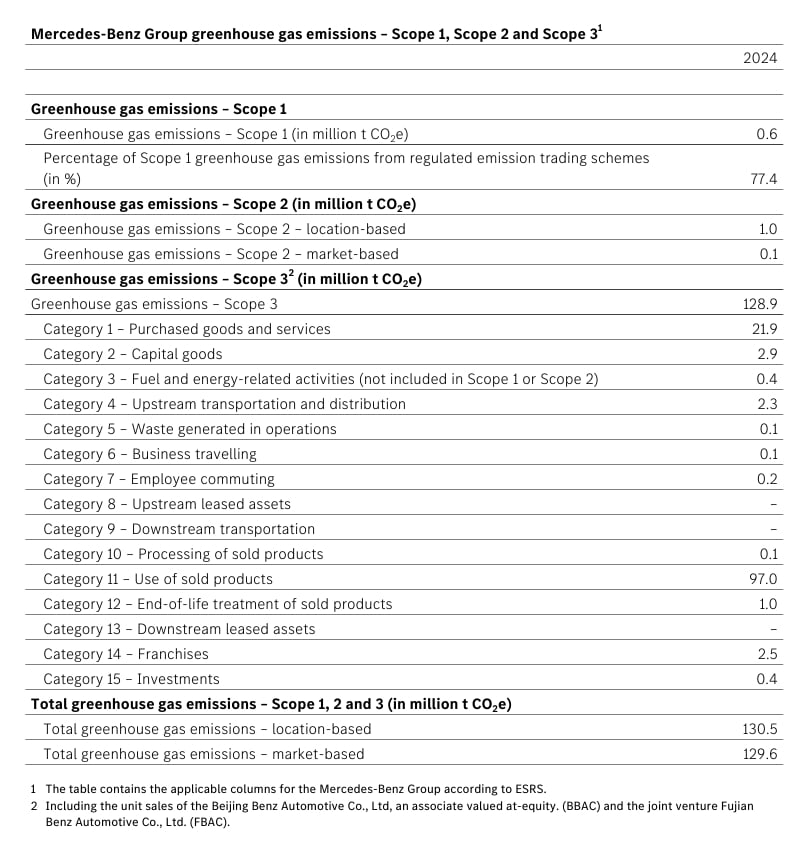
It has significantly lowered its carbon footprint in recent years. The company’s decarbonization strategy revealed:
- Factory Emissions: All production facilities have operated on 100% renewable electricity since 2022. Between 2018 and 2023, production-related CO₂ emissions fell by 72%.
- Vehicle Lifecycle Emissions: Emissions per vehicle dropped to 46.3 tonnes in 2023, down from 49.7 tonnes in 2020. The target is to achieve a 50% reduction by 2030.
- Green Supply Chain: From 2025, Mercedes will integrate CO₂-free “green steel” into vehicle production. More than 85% of its supplier base has now committed to carbon-neutral materials.
Advancing Circularity and Recycling
Circularity is another core focus. The company launched a battery recycling plant in Kuppenheim, Germany, which aims to recover up to 96% of materials. By 2030, Mercedes targets 40% recycled material usage across its vehicle lineup.
Smart Carbon Credit Strategy
To meet stringent EU carbon limits, Mercedes-Benz has already transitioned to carbon-neutral production since 2022. It also utilizes emissions pooling with partners such as Polestar, Volvo, and Smart to balance the average emissions of its fleet while transitioning toward full electrification.
Spotlight: The New Electric CLA
Mercedes-Benz’s new fully electric CLA model showcases the company’s shift to climate-smart design. This next-gen EV reduces its carbon footprint by 40% over its lifecycle compared to its internal combustion predecessor. With further supply chain and battery optimizations, total reductions could reach up to two-thirds.
Key sustainability measures in the CLA include:
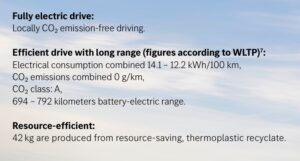
This comprehensive environmental check demonstrates the brand’s commitment to integrating sustainability into every vehicle component—from raw materials to end-of-life.
Overall, Mercedes-Benz is transforming from a traditional luxury automaker to a sustainability-driven mobility leader. With concrete goals, significant achievements, and a growing EV lineup, the company is aligning with global calls for cleaner transportation.