


Google has released new data showing the energy, carbon, and water use linked to its Gemini AI system. The report is one of the most detailed disclosures from a major tech company about the environmental footprint of artificial intelligence.
The numbers per query seem small, but the rise of AI worldwide makes these findings crucial. They help us grasp the larger sustainability challenge. Let’s examine Google’s report findings.
From Queries to Carbon: Measuring AI’s True Cost
Artificial intelligence systems require powerful data centers to process user prompts. These data centers run on large amounts of electricity and water for cooling. To provide more transparency, Google calculated the average environmental cost of a single Gemini AI text query.
The company reported that one prompt:
- Uses about 0.24 watt-hours of electricity (similar to watching TV for less than nine seconds)
- Produces about 0.03 grams of CO₂ equivalent (CO₂e)
- Consumes about 0.26 milliliters of water (roughly five drops)
Google looked at the energy used to run AI and also considered the electricity used when the system is idle. Additionally, it factored in the extra infrastructure that supports data centers.
The chart below shows how much energy different AI models use for each prompt. The results come from two types of data: estimates (gray) and direct measurements (black, red, and blue).
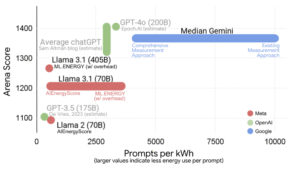
It also shows that results can vary a lot depending on how the energy use is measured. For example, the model Llama 3.1 (70B) was found to handle anywhere from about 580 prompts to 3,600 prompts per kilowatt-hour, depending on the method used.
By comparison, Google’s Gemini Apps prompts had a narrower and more consistent range of results. By releasing these figures, the company hopes to create a standard way of reporting AI’s environmental impact.
Smarter, Faster—But Still Energy Hungry
Google reported that Gemini has become much more efficient compared to earlier versions. On a per-query basis, the AI now uses about 33 times less energy than it did a year ago. This improvement comes from advances in hardware, optimized algorithms, and better data center operations.
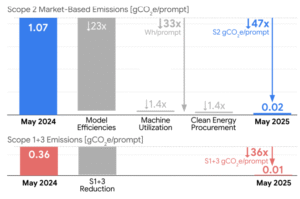
However, efficiency gains do not necessarily mean lower overall emissions. The demand for AI services is growing rapidly, leading to more total queries. As a result, even though each prompt is cheaper in energy terms, the combined usage continues to increase.
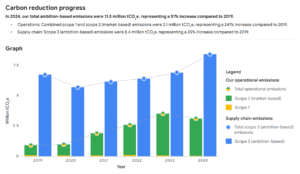
This trend is an example of the “Jevons paradox,” where greater efficiency can lead to higher total consumption when demand rises quickly. Google’s own environmental report shows this effect. The company’s total greenhouse gas emissions have risen 51% since 2019, with AI being a key driver.
Data Centers and Their Rising Power Needs
Google’s data centers are at the heart of AI operations. In 2024, these facilities consumed 30.8 million megawatt-hours of electricity, more than double the amount in 2020. This sharp rise highlights the scale of resources required to support AI growth.
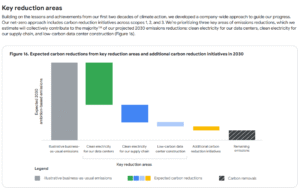
At the same time, Google has made efforts to reduce the climate impact of its facilities. Even as electricity demand increased by 27%, the company cut its direct data center emissions by 12%. This was achieved through clean energy contracts, efficiency upgrades, and improved cooling technologies.
Google has made deals with utilities in Indiana and Tennessee. These agreements enable Google to lower data center power use when grid demand is high. This strategy, known as demand response, helps prevent blackouts and lowers stress on local power systems.
Beyond Wind and Solar: Google’s Nuclear Bet
While renewable energy remains central to Google’s strategy, the company is also exploring new approaches to meet the constant power needs of AI. Key actions include:
- Advanced nuclear power: The company partners with Kairos Power and the Tennessee Valley Authority. This will support molten salt nuclear reactors. They can deliver reliable, low-carbon energy.
- Demand-response agreements: Reducing electricity use during peak times in states like Indiana and Tennessee to ease grid strain.
- Expanded clean energy contracts: Securing renewable sources to match rising data center demand.
These steps show that Google is pursuing a mix of solutions beyond traditional renewables. Nuclear power, in particular, is seen as a stable complement to solar and wind for 24/7 operations.
Transparency or Greenwashing? The Debate Over Metrics
Google’s decision to share detailed per-query metrics has been praised as a step toward industry-wide accountability. Few tech companies have provided such clear data. This transparency helps policymakers, researchers, and the public see the real costs of AI.
At the same time, experts have raised concerns about what the report leaves out. Some argue that Google’s calculations do not fully account for indirect emissions or the impact of where electricity is sourced. Others note that per-query figures, while helpful, may downplay the large-scale effects of billions of queries worldwide.
The contrast between small individual costs and large overall emissions illustrates the complexity of the issue. It shows why companies need efficient technology and broad strategies. They have to manage total demand and align with climate targets.
Can AI Innovation Outpace Emissions?
Google’s disclosure highlights the balancing act facing the entire AI industry. On one hand, new technology can drive efficiency, reduce per-query energy use, and open pathways to sustainable power. On the other hand, the sheer scale of AI adoption risks outpacing these improvements.
For AI to grow in a sustainable way, companies will need to combine efficiency gains with renewable energy, nuclear solutions, and smarter grid management. Transparency will also play a central role in building trust and creating common standards across the sector.
As more companies adopt AI and integrate it into daily life, the question of energy and carbon costs will become even more urgent. Google’s report is an early attempt to measure and address this challenge.
Whether the industry can keep total emissions in check while meeting growing demand will shape the future relationship between AI and the environment.
Google’s new data provides a clearer picture of what it takes to run AI systems like Gemini. One prompt uses just a few drops of water and a tiny bit of carbon. But when billions of people interact, the environmental impact grows massively.
By being transparent about these numbers, Google has set a benchmark for the industry. The next challenge will be to turn these insights into broader changes that ensure AI grows without driving emissions sharply higher. The path forward will require innovation, investment, and cooperation across the technology and energy sectors.