

The 2024 edition of the International Atomic Energy Agency’s (IAEA) Climate Change and Nuclear Power report has been released. It emphasizes the need to significantly boost investments in nuclear energy to meet global climate goals.
The report, launched during the Clean Energy Ministerial (CEM) in Brazil, provides a detailed roadmap for expanding nuclear power and underscores its crucial role in helping countries achieve net-zero emissions by 2050.
How Nuclear Power Could Transform Global Energy
With climate change and energy security concerns intensifying, countries are increasingly looking toward nuclear power as a viable solution. The report highlights that, to reach net zero emissions by mid-century, a rapid expansion of clean energy technologies is essential.
The International Energy Agency (IEA) estimates that achieving net zero carbon dioxide (CO₂) emissions by 2050 will demand annual energy sector investments of $4.7–$5 trillion from 2030 to 2050. This represents a significant increase compared to the $2.8 trillion invested in 2023.
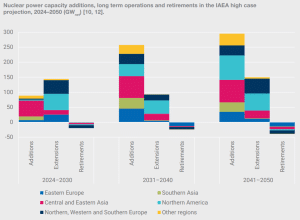
The IEA also projects that achieving net zero by 2050 will require more than doubling the installed capacity of nuclear power. This aligns with the IAEA’s high-case scenario, which, while not a direct net zero pathway, shows similar growth.
In this case, nuclear energy is expected to play a key role, contributing to a diverse and resilient energy mix. According to the IAEA’s high-case scenario, nuclear power capacity needs to increase by 2.5x its current levels by 2050.
This would provide a reliable source of low-carbon energy, complementing other renewable sources like wind and solar.
The IAEA report stresses that nuclear energy can deliver a steady baseload of clean power, which is particularly important as more intermittent renewable sources come online. This stable power generation can help integrate other renewable energies into the grid more effectively. As such, it ensures that energy supplies remain consistent even when wind or solar resources are low.
Moreover, nuclear power is seen as a critical tool for decarbonizing industrial sectors and supporting advanced energy systems like hydrogen. However, achieving those ambitious nuclear power targets will need substantial investment.
How Much Investment Nuclear Energy Needs
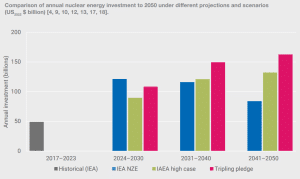
The IAEA estimates that global investment in nuclear energy needs to increase to $125 billion annually. This is up from the current investment of around $50 billion per year between 2017 and 2023. The funding is necessary to build new reactors, upgrade existing infrastructure, and ensure safe operation.
Such a shift is deemed essential for meeting the IAEA’s high-case projection for nuclear capacity expansion by 2050.
For a more aspirational goal of tripling nuclear capacity, which over 20 countries pledged to pursue at COP28, annual investment would need to reach upwards of $150 billion.
These funds would support three key actions crucial for achieving nuclear power capacity goals:
- the construction of new nuclear power plants,
- the development of advanced reactor technologies, and
- the deployment of small modular reactors (SMRs).
SMRs are particularly attractive for emerging markets and developing countries due to their smaller size, lower upfront costs, and potential for use in remote areas.
IAEA Director General Rafael Mariano Grossi highlighted that while nuclear power plants are cost-competitive and affordable over their long operational lifespans, securing the necessary upfront capital remains a challenge. This is especially true in market-driven economies and developing nations, where access to financing can be limited.
Grossi further noted that:
“The private sector will increasingly need to contribute to financing, but so too will other institutions. The IAEA is engaging multilateral development banks to highlight their potential role in making sure that developing countries have more and better financing options when it comes to investing in nuclear energy.”
Unlocking Private Sector Financing
The report also explores strategies to unlock private-sector finance, a topic that has gained significant attention worldwide.
Last month, during New York Climate Week, 14 major financial institutions, including some of the world’s largest banks, expressed their readiness to support nuclear power projects. These institutions recognize the potential of nuclear energy in achieving climate goals and are willing to contribute to financing new-build projects.
The financial community’s growing interest in nuclear energy is partly driven by recent developments in sustainable finance frameworks. The European Union’s (EU) taxonomy for sustainable activities, which includes nuclear power, has opened the door for new funding opportunities.
- In 2023, the first green bonds for nuclear projects were issued in Finland and France – a significant milestone in sustainable nuclear financing.
These developments show a growing recognition that nuclear energy can be a sustainable part of the clean energy transition. By including nuclear power in green finance frameworks, countries can attract more investment to support new projects and refurbish existing reactors.
To bridge the financing gap, the IAEA’s report emphasizes the need for policy reforms and international cooperation. It suggests that countries must develop strong regulatory frameworks and new delivery models to make nuclear projects more attractive to investors.
Additionally, fostering partnerships between governments, financial institutions, and the private sector is essential for mobilizing the necessary capital.
Addressing the Challenges Ahead
Despite the promising outlook, the IAEA’s 2024 report acknowledges the challenges in expanding nuclear power, including:
- the need for skilled labor,
- supply chain development, and
- stakeholder engagement to ensure that new projects are implemented smoothly.
The report also notes the importance of public acceptance and community engagement in advancing nuclear energy projects. In particular, transparent communication about the safety, environmental benefits, and economic impact of nuclear power is essential to gain public support and overcome misconceptions about nuclear technology.
Ultimately, the report highlights that a successful transition to a global clean energy mix will require unlocking the full potential of nuclear power with the right investments and collaboration.