

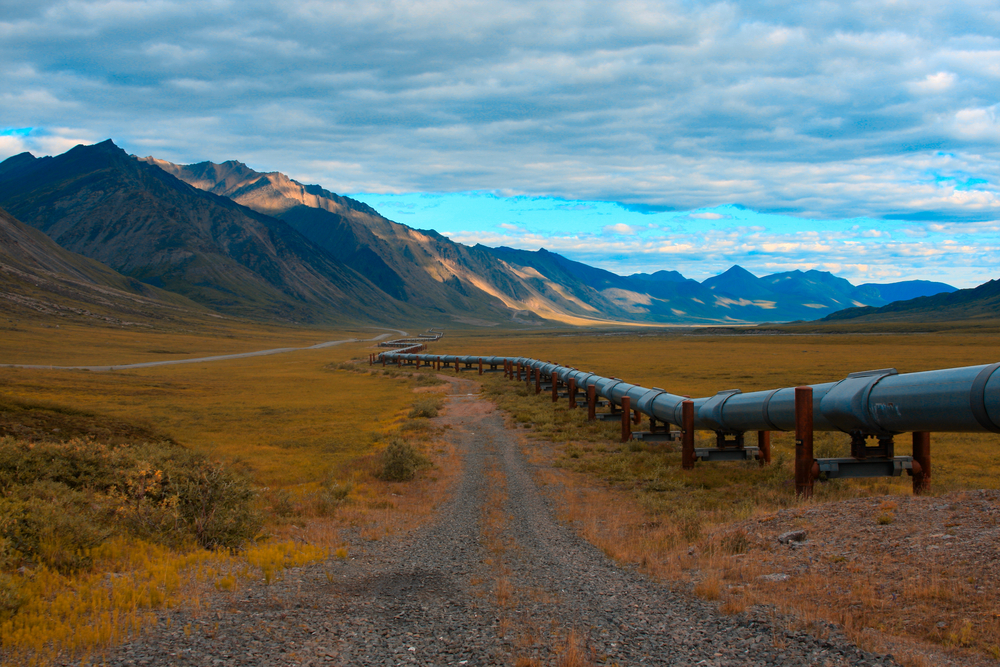
On November 27, 2025, Canada’s federal government and Alberta signed a formal agreement to develop a new oil pipeline. The project would export Alberta’s bitumen to Asian markets. It includes carbon capture projects, power-grid expansion, and faster regulatory approvals under the Building Canada Act.
If approved, this pipeline might be the first project to get a “national interest” designation under the new law. This would speed up the review process. It will run with the planned expansion of the Trans Mountain pipeline (TMX). This could boost West Coast export capacity to 2.5 million barrels per day (bpd) of diluted bitumen.
The agreement seeks to create jobs, attract private investment, and speed up major infrastructure projects that would reduce emissions. Yet, it raises concerns about environmental protections, Indigenous rights, and Canada’s climate commitments.
The Building Canada Act and Bill C-5
Bill C-5 became law in June 2025. It created the Building Canada Act, a framework designed to make it easier and faster to build major infrastructure. Projects labeled as “of national interest” — like pipelines, ports, railways, and power lines — can go through a quicker approval process.
The Act intends to reduce regulatory delays and encourage private investment. It also aims to respect environmental standards and Indigenous rights. Critics worry that protections might be weak. Supporters, however, believe the law is essential. It can help Canada build infrastructure, boost exports, and create jobs.
The Key Proposals in the Canada–Alberta Agreement
The Memorandum of Understanding (MOU) outlines several initiatives:
- Pipeline construction: A private pipeline could transport 300,000 to 1 million bpd of diluted bitumen from Alberta’s oilsands. It would use a new right-of-way to reach a deepwater port near Vancouver. Private developers, likely Pathways Alliance affiliates, would lead the project. It would run parallel to TMX, which has a capacity of 890,000 bpd after 2024.
- Carbon capture: The Pathways Alliance targets 22 million tonnes of CO₂ per year, equivalent to roughly 5% of Canada’s 2024 emissions. The $15 billion cost would be shared between federal and private investors.
- Electricity grid expansion: Investments may include nuclear and renewable energy projects.
- Regulatory review: Approvals are capped at two years after the application.
- Indigenous participation: 16 First Nations have signed MOU support letters. The agreement offers up to 20% equity ownership and a $1 billion benefits fund.
Economic and Job Projections
The pipeline project could bring significant economic benefits. Estimates include:
- Up to 10,000 construction jobs and 2,000 permanent operations positions.
- $20–50 billion in private investment over ten years.
- $10–15 billion annual boost to Alberta’s GDP from exports to Asia, including China and Japan.
- Reduced reliance on U.S. markets amid 2025 tariffs.
The project could boost energy growth in Alberta. It may also raise public revenue, attract private investment, and support related sectors.
Environmental and Climate Considerations: The Case of CCUS
The MOU focuses on practical steps: enhancing industrial carbon pricing and driving significant private investment in clean technologies. Canada already uses carbon pricing and emissions regulations. Industrial emitters face carbon taxes or output-based pricing.
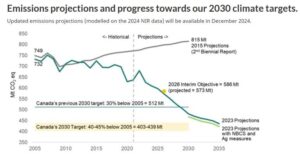
The new Alberta agreement puts a hold on earlier oil and gas intensity caps. These caps aimed for a 35–38% emissions reduction by 2030. These are replaced with output-based pricing at $170 per tonne of CO₂ by 2030.
Also, central to this effort is Pathways Plus, set to become the world’s largest carbon capture, utilization, and storage (CCUS) project. Carbon capture is intended to offset the higher emissions from increased production. Success depends on the CCUS project performing as promised.
Canada’s CCUS ambition has clear numbers: the country aims to have roughly 15 Mt CO₂‑per‑year of capture capacity installed by 2030. Under certain regulatory and investment assumptions, the energy sector could raise CO₂ capture to as much as 88 Mt per year by 2025 and 271 Mt per year by 2030.
Current capacity stands at ~2-3 Mt/year (e.g., from Alberta projects like Quest and Shell Polaris), with ambitions to triple or quintuple to 15-27 Mt by 2030 via ~34 new projects.
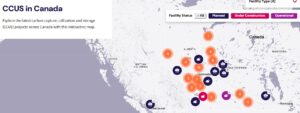
Meanwhile, Canada’s geological storage potential remains massive. About 389 gigatonnes of CO₂ are estimated to be safely storable in deep geological formations.
Stakeholder Reactions: Indigenous Rights and Community Involvement
Indigenous consultation and community involvement are also critical to minimizing social impacts. Historically, TMX faced delays and cost overruns, reaching $34 billion by 2024 despite approval in 2016. Northern Gateway was rejected in 2016 due to tanker risks.
Recent changes to the 2025 Oil Tanker Moratorium Act now permit up to 300 tanker trips each year in B.C. waters. This adds important regulatory context for the proposed route.
Thus, the agreement has received mixed responses: support, criticisms, and political concerns.
The Alberta Chamber of Commerce supports the deal. They highlight benefits like economic growth, job creation, and investment certainty. Doug Griffiths, President and CEO of the Edmonton Chamber, said:
“When we open new markets, build major projects and create the right conditions for investment, we make Alberta the greatest place in the country to live, work and build a future.”
However, environmental groups like the Sierra Club and Indigenous organizations such as the Assembly of First Nations highlight gaps in UNDRIP compliance. They raise concerns about free, prior, and informed consent.
The B.C. NDP opposes the project. They believe it lacks proper consent. They are also worried about tanker traffic harming coastal communities. Eby in B.C., noted in a Politico report that:
“We need to make sure that this project doesn’t become an energy vampire with all of the variables that have yet to be fulfilled — no proponent, no route, no money, no First Nation support.”
Industry groups and labor organizations see the project as a way to improve infrastructure and draw in investment. But critics say the agreement weakens federal climate policy. It lifts emissions caps and relaxes clean electricity rules.
Former Environment Minister Steven Guilbeault resigned in protest. He called the deal a step back from long-standing climate commitments.
Several factors will shape the deal’s outcome:
- Whether a private developer, likely a Pathways Alliance affiliate, finances and builds the pipeline.
- Progress in Indigenous consultation, co-ownership agreements, and community benefit delivery.
- Decisions by environmental regulators and B.C. authorities on tanker traffic.
- The success of the CCUS project in capturing 22 million tonnes of CO₂ per year.
- Alignment with Canada’s net-zero by 2050 target and other climate goals.
This agreement may serve as a test case for balancing resource development with environmental protection and Indigenous rights.
Implications for Canada’s Future
The Canada–Alberta deal reflects a complex balancing act. Supporters say it offers clear rules for private investment. It also speeds up approvals and helps modernize the energy sector while chasing climate goals. Critics fear it might weaken environmental rules and hurt UNDRIP commitments. It could also boost Canada’s reliance on fossil fuel exports.
Whether the project becomes a model for “clean growth” or a setback for climate action will depend on implementation. Key factors include the performance of carbon capture, emissions tracking, Indigenous participation, and private investment aligned with social and environmental standards. Economic benefits, environmental risks, and political challenges will continue to shape Canada’s energy and climate policy in the years ahead.