


Shell Eastern Trading (Pte) and Green Carbon, a Japan‑based carbon credit developer, have announced a partnership to reduce methane emissions from rice farming in the Philippines. The initiative uses a water management method and aims to generate verified carbon credits under Japan’s Joint Crediting Mechanism (JCM). The project seeks to cut greenhouse gases while offering new income opportunities for rice farmers and contributing to climate goals.
Rice paddies in the Philippines are a major source of methane, a potent greenhouse gas. Green Carbon and Shell will implement the project under the JCM framework, applying proven techniques across large farming areas. Validated carbon credits may be issued once emission cuts are verified.
Why Rice Fields Heat Up the Planet
Rice paddies release methane when fields stay flooded for long periods. This happens because wet soil creates conditions that allow methane‑producing bacteria to thrive.
- Methane traps heat in the atmosphere much more effectively than carbon dioxide; over 100 years, methane’s warming impact can be about 28–30 times greater than CO₂.
In the Philippines, the agricultural sector emits about 54 million metric tons of greenhouse gases per year. Rice paddies contribute roughly 13 million metric tons, which is about 25 % of total agricultural emissions.

The data show that agriculture has remained a consistent and significant source of GHG emissions in the Philippines over the past decade. This is driven largely by methane and nitrous oxide from farming activities.
The country is a major rice producer in Southeast Asia. And so changes in how farmers manage water in rice fields can reduce methane emissions significantly. Improved practices also align with national climate strategies and help reach goals in greenhouse gas reporting.
A Water-Smart Solution
Green Carbon and Shell are focusing their first large‑scale project on 50,000 hectares of rice paddies on Mindoro Island. They will introduce Alternate Wetting and Drying (AWD) irrigation. AWD means rice fields are not kept continuously flooded. Instead, fields are alternately flooded and dried at intervals determined by water level monitoring.
The approach has been studied and shown to reduce methane by about 30 % compared with traditional continuous flooding. This technique also uses less water and can help preserve local water resources.
The project follows the JCM methodology for “Methane Emission Reductions by Water Management in Rice Paddy Fields (PH_AM004),” which was officially approved by the JCM Joint Committee on 3 February 2025. This is the first JCM carbon credit methodology in the agricultural sector outside energy and industrial projects.
Under the JCM system, methane reductions achieved through AWD will be measured and verified by third parties. Verified reductions then become carbon credits that can be sold or used to meet climate commitments, including in markets such as Japan’s Green Transformation Emissions Trading Scheme (GX‑ETS).
Turning Methane Into Marketable Credits
The Joint Crediting Mechanism is a bilateral system between Japan and partner countries, including the Philippines, that supports climate action and carbon credit generation. When a project reduces greenhouse gases below a baseline level, it can earn credits. These credits represent quantifiable reductions and can be used by buyers to meet climate goals.
In this rice methane project, carbon credits will reflect actual methane reductions achieved through AWD water management. Verification and monitoring will follow international standards to ensure credits are credible and of high quality.
Once verified, these credits may help bridge demand from companies in Japan and other markets that recognize JCM credits. Some of these companies must reduce emissions or meet emissions trading obligations, such as under Japan’s GX‑ETS. This connection could increase demand for agricultural methane reduction credits.
Farmers Cash In While Cutting Emissions
For Filipino farmers, the project offers potential benefits beyond carbon credits. By adopting AWD, farmers can use water more efficiently and reduce irrigation costs. This practice can help farmers better manage water resources, especially in areas where water scarcity is a concern.
Generating carbon credits may also provide an additional source of income for participating farmers. If methane reductions are verified, farmers or project partners can sell these credits to buyers in carbon markets that value JCM‑registered credits.
Other benefits for farmers and the environment include:
-
Agronomic benefits: Well-managed water systems improve soil health, reduce other greenhouse gas emissions, and keep rice yields stable, offering farmers both economic and environmental gains.
-
Environmental impact: Reducing methane from rice paddies contributes to climate mitigation, providing near-term benefits due to methane’s high warming potential and short atmospheric lifetime.
-
Scaling potential: Expanding similar projects to provinces like Nueva Vizcaya, Pampanga, and Leyte could cover large areas and generate millions of metric tons of carbon credits over the next decade.
Scaling Green Rice Across the Philippines and Beyond
The ASEAN region, including the Philippines, is increasingly seen as important for methane reduction in agriculture due to its large share of rice production and potential for AWD adoption. Projects like this may pave the way for wider regional implementation of methane reduction techniques under systems such as the JCM.
In the U.S., the same improved rice farming method, AWD, cut methane emissions from flooded fields. It has also produced tens of thousands of verified carbon credits. For example, more than 33,000 credits from a U.S. rice methane project in 2025 that reduced methane by up to 70% and saved 21 billion gallons of water.
Globally, research shows that AWD can reduce methane emissions by roughly 30% to 65% compared with continuous flooding. One study found AWD fields emitted about 7–32 kg CH₄-C/ha, compared with 76–142 kg CH₄-C/ha under traditional flooding. That’s a ~64% reduction.
A Model for Climate-Friendly Agriculture
Carbon markets are growing, and demand for high‑quality credits is rising globally. Projects that generate verifiable carbon credits from agriculture contribute to market diversity and supply.
The voluntary agriculture carbon credit market is set to grow quickly in the next ten years. This includes methane reduction from rice farming and other agricultural practices.
The global market was valued at around US$36.1 million in 2024. Forecasts show strong growth through 2034, with an annual growth rate of about 32%, to about US$648 million in 2034. This growth shows increasing interest from corporate buyers looking for diverse, high-quality credits. Asia-Pacific is the largest market for this credit.
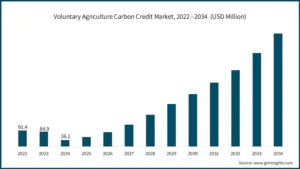 Methane reduction projects tied to rice farming are quickly growing. Some forecasts show these initiatives could grow by nearly 38% through the early 2030s. This highlights their rising importance in the agricultural carbon credit market.
Under the JCM, agricultural methane credits are among the first in this sector. This gives early project developers an opportunity to shape market practices and standards. Buyers such as corporations and investors looking to meet emission goals may consider these credits valuable if they meet strict verification criteria. As demand grows, more carbon credit generation from rice methane and other agricultural sources may follow.
If successful, the Green Carbon and Shell project could become a model for rice‑based methane reduction across Southeast Asia and beyond, connecting sustainable farming, local benefits, and global climate action.