


Anglo American and Chile’s state-owned miner Codelco have finalized a major deal. They will develop their neighboring Los Bronces and Andina copper mines. The agreement follows all necessary competition and regulatory approvals. This comes after a framework agreement from September 2025.
The partnership will boost copper production without needing a new mine. Instead, both companies will coordinate their mining efforts in nearby operations. This approach allows them to extract more copper from existing assets while keeping costs low.
- Once fully in action, the joint mine plan is expected to yield an extra 2.7 million tonnes of copper over 21 years.
- That means about 120,000 tonnes of additional copper each year, shared equally between Anglo American and Codelco.
- The project should also generate at least $5 billion in extra pre-tax value for both companies.
The project won’t start just yet. It needs environmental approvals and some customary conditions first. Implementation is expected around 2030.
A Low-Cost Strategy That Preserves Future Growth
Unlike a merger, this agreement lets both companies keep ownership and control of their mines. They will collaborate on mine planning. This will boost efficiency, optimize infrastructure, and extract more copper from their shared mineral resources.
Importantly, the agreement allows each company to continue its own future projects. Anglo American and Codelco will work on their underground projects. They will also coordinate with the joint mine plan.
The partners have set sustainability principles to guide the project. These include protecting community programs and upholding environmental obligations throughout the agreement’s duration.
This deal highlights a trend in the mining industry. Companies prefer to improve current operations rather than invest billions in new mines. This approach boosts production more effectively. Partnerships help cut costs, lower project risks, and speed up metal supply delivery.
Chile Faces Production Challenges Despite Long-Term Potential
The agreement comes at an important time for Chile’s copper industry.
Although Chile remains the world’s largest copper producer, recent production has weakened. According to the country’s National Institute of Statistics, copper output fell 13.8% year over year to 399,954 metric tons in April 2026, following another decline in March. Lower ore grades and difficult comparisons with last year’s higher production contributed to the slowdown.
- While analysts expect quarterly production to recover to around 485,000 tonnes, the recent decline has raised concerns about tightening global copper supplies.
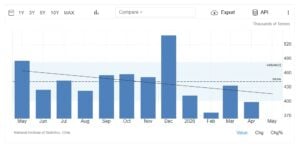
Cochilco Lowers Growth Outlook as Copper Supply Risks Increase
Meanwhile, Chile’s copper commission, Cochilco, has reduced its 2025 production growth forecast from 3% to 1.5%. The revision follows weaker output at major mines, including BHP’s Escondida and Collahuasi.
Despite the downgrade, Cochilco still expects Chile to produce 5.58 million metric tons of copper in 2025 while maintaining its average copper price forecast at $4.30 per pound for both 2025 and 2026.
The agency also warned that operational disruptions remain a major risk. A fatal accident at Codelco’s El Teniente mine could affect future production if recovery efforts take longer than expected.
- For 2026, Cochilco maintained its production growth estimate at 3%, although it lowered expected output to 5.75 million metric tons.
- Over the longer term, Trading Economics projects Chile’s monthly copper production to gradually recover to approximately 510,000 tonnes in 2027 and 530,000 tonnes in 2028.
Nonetheless, copper continues to play a major role in Chile’s economy. According to United Nations COMTRADE data, the country exported $20.43 billion worth of copper in 2025, highlighting its importance as the world’s leading copper supplier.
Collaboration Supports Chile’s Copper Growth Ambitions
The Anglo American-Codelco partnership could help strengthen Chile’s position in the global copper market.
Industry analysts note that integrating the Los Bronces and Andina operations allows both companies to maximize existing resources rather than spending years developing entirely new projects. Better mine sequencing, shared infrastructure, and coordinated planning could improve productivity while lowering operating costs.
The agreement follows several years of negotiations involving Anglo American, Codelco, Mitsubishi Corporation, and Mitsui & Co. Together, the neighboring deposits represent one of the world’s largest concentrations of copper resources.
- The project also supports Chile’s national goal of increasing annual copper production to 6 million tonnes by 2030.
Nevertheless, the benefits will take time to materialize. Chile’s environmental approval process for large mining projects is often lengthy, and any delays in permitting could postpone the project’s planned start date.
Duncan Wanblad, CEO of Anglo American, said:
“Our agreement with Codelco demonstrates what is possible when we work in partnership to unlock compelling industrial synergies -delivering significant value and more copper tonnes for both companies and for Chile. The next important milestone for Los Bronces – Andina is the timely receipt of the permits, which will allow us to begin delivering the additional volume and value that we are targeting, for the benefit of all our stakeholders, and for Chile.
“By integrating the Los Bronces and Andina mine plans, we are unlocking one of the most significant copper adjacency opportunities in the world. Adjacencies such as these are rare and they highlight the role that responsible, partnership-led development can play – in this case supporting Chile’s ambition to lift national copper production to 6 million tonnes per year by 2030.”
The Global Copper Outlook: Demand Vs Supply
While producers work to increase supply, demand for copper continues to accelerate.
Wood Mackenzie’s report projects global copper demand to increase 24% by 2035, reaching 42.7 million tonnes annually. That represents an additional 8.2 million tonnes per year, driven by economic growth, electrification, and digital technologies.
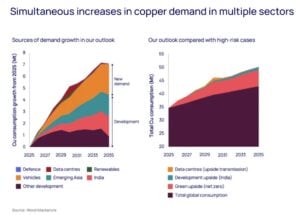
The consultancy believes several emerging trends could further tighten the market and increase price volatility beyond current expectations.
AI Data Centers Drive Copper Demand
Wood Mackenzie estimates AI-related data centers will consume an additional 2,200 TWh of electricity by 2035, increasing copper demand for power grids to 1.1 million tonnes a year by 2030. Copper accounts for less than 0.5% of total data center construction costs.
Clean Energy and EVs Boost Copper Use
Renewable energy projects are expected to require an additional 2 million tonnes of copper annually over the next decade. Copper demand from clean energy is projected to increase from 1.7 million tonnes today to 4.3 million tonnes by 2035. An electric vehicle uses up to four times more copper than a conventional vehicle.
Asia Leads Future Copper Demand
China is projected to consume 15.7 million tonnes of refined copper in 2025, while India’s demand is expected to grow 7.5%. By 2035, India and Southeast Asia are expected to add 3.3 million tonnes of annual copper demand
Supply May Struggle to Keep Pace
Meeting future copper demand will be tough.
Wood Mackenzie estimates the industry needs over 8 million tonnes of new mine capacity. It also expects a 3.5 million tonne increase in recycled copper by 2035.
The consultancy predicts more frequent mine disruptions. These will stem from climate issues, labor challenges, and operational risks. Annual supply losses could rise from 5% to 6%, removing about 250,000 to 300,000 tonnes of copper from the market each year.
As demand rises for AI, renewable energy, electric vehicles, and industrial growth, limited supply may keep copper prices high. This might cause more market volatility in the next decade.
For Anglo American and Codelco, their joint Chilean mine plan is a chance to add low-cost copper to the market. Every new tonne will be more valuable.